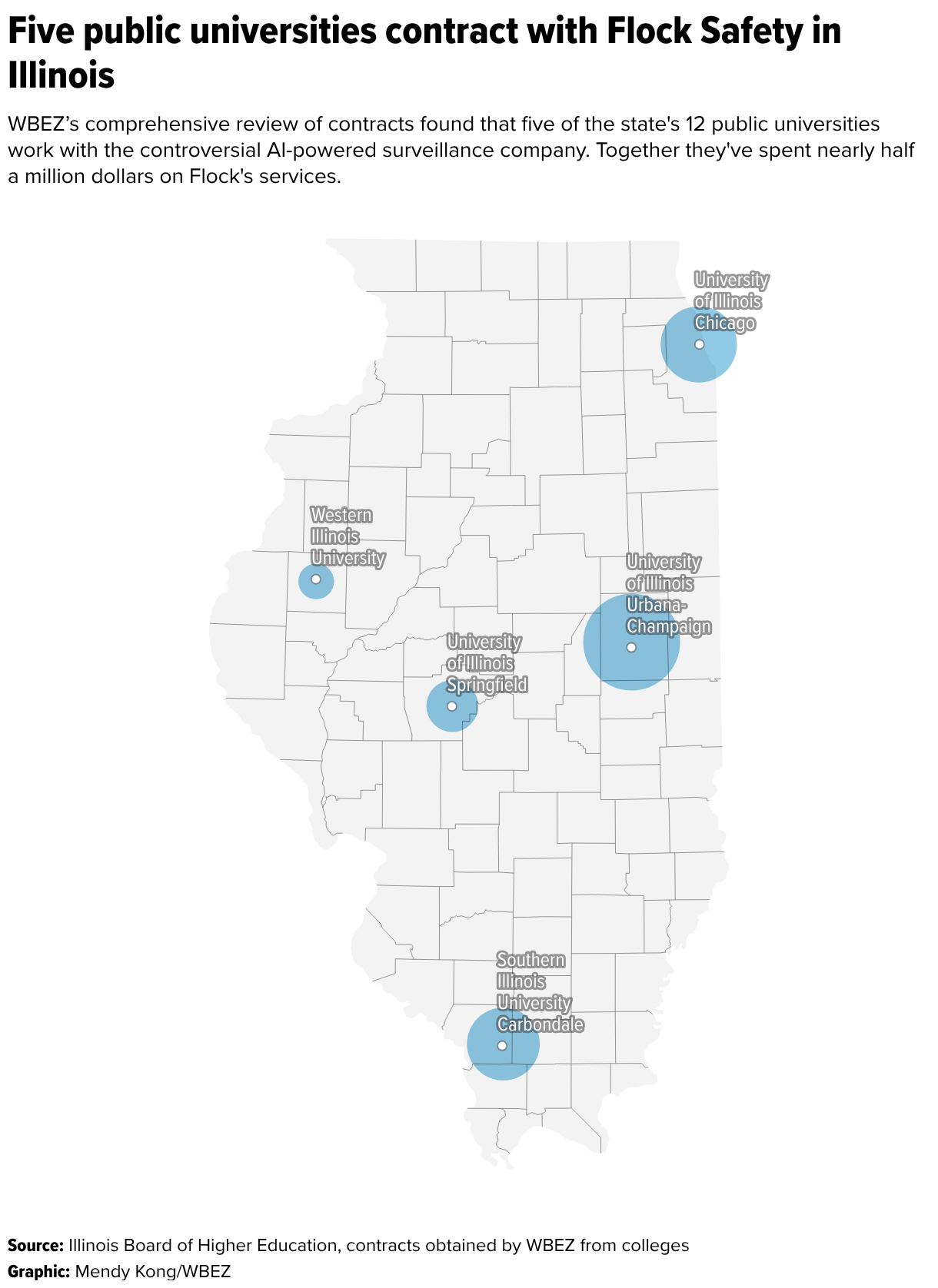
As towns, cities and colleges in Illinois and across the country cut ties with Flock Safety, a comprehensive review of contracts by WBEZ found that five of the state’s 12 public universities still work with the controversial surveillance technology company.
That includes the University of Illinois Urbana-Champaign, the largest campus in the state, and the University of Illinois Chicago, which is in the process of renewing its contract. Southern Illinois University Carbondale even employs a Flock surveillance drone that costs more than $40,000 a year.
These schools, in addition to Western Illinois University and the University of Illinois Springfield, have spent more than $450,000 on Flock’s services since 2021, records show.
Flock’s automatic license plate readers use cameras and artificial intelligence to capture data about every passing vehicle, including plate numbers, make and model and even dents and bumper stickers. That information is uploaded to a database that can be searched by campus police, as well as outside law enforcement agencies, to see where a vehicle and its driver have been and when.
College leaders say the surveillance helps solve crimes and keep campuses and students safe.
But Flock has come under intense public scrutiny following revelations that police officers have used the company’s surveillance cameras to stalk their exes. Data captured by Flock cameras have also led to wrongful arrests. At universities like UIC and Western Illinois University, students have started petitions calling on administrators to end their relationships with the company.

Some students and faculty say the use of Flock equipment to surveil American campuses is especially troubling because universities are meant to be places where people can discuss and study ideas freely. They worry Flock cameras could be used to identify and discipline students and faculty if they attend a protest or express opinions universities and the federal government find problematic.
People worry “they will be singled out, they could face repercussions, and all of that is really, in my mind, antithetical to the ideals of the university,” said Torin Monahan, a surveillance researcher at the University of North Carolina-Chapel Hill.
The presence of Flock cameras adds another layer of concern at schools like UIC that pride themselves on supporting underrepresented and marginalized students, because the data collected can endanger immigrant and international students and students of color.
Last year, an audit by the Illinois secretary of state found that U.S. Customs and Border Protection had searched Flock databases across Illinois in violation of the state’s Trust Act, which bans cooperation between Illinois law enforcement and federal immigration authorities. Earlier in 2025, the same state office found that Texas agents searched Flock databases in Illinois to pursue a woman who had an abortion.

Flock claims the company has made changes in the last year that allow police forces to limit who can access camera data. But as of this summer, outside agencies were still frequently searching the data collected at some Illinois public colleges.
In early August, WBEZ filed a public records request for a log of external agencies that had searched Flock data from the University of Illinois System since early 2025 and for what reasons.
System officials said the request was too burdensome because it turned up such a large volume of data — and revealed that outside law enforcement had searched Flock data from the three campuses more than 650,000 times over a 30-day period in July and August.
“The police I’ve been interviewing will say that they want to protect the campus community,” Monahan said.
But he questioned if university administrators want to be embracing this “fortress mentality” given the many trade-offs. “Do they want to be on the wrong side of these privacy concerns and these surveillance risks to their populations?”
‘Why are we gathering this giant pool of information?’
Among Illinois public universities, the University of Illinois System is Flock’s biggest client.
UIC has a two-year, $110,300 contract with Flock to operate 15 cameras on university property, according to documents obtained through public records requests.
UIC leaders denied a request for an interview. But spokesperson Sherri McGinnis Gonzalez said via email that Flock’s surveillance technology enables “investigators to identify vehicles associated with reported crimes, public safety threats and Amber Alerts.”
She said the university’s contract ends this month, but officials are in talks to renew it.
“The safety of our students, faculty, staff, patients and visitors is a top priority,” McGinnis Gonzalez wrote. “UIC is committed to transparency, accountability and privacy protections in its use of public safety technology.”
In addition to its contract with Flock, UIC officials agreed in December 2025 to pay a company called Volt Inc. $3.5 million over three years for AI-powered video detection of weapons, “crowd formation” and “unattended objects,” public records show.
A university spokesperson said via email that campus police hired Volt “to detect potential security issues in real time and quickly alert UIC Police, helping improve campus safety,” adding that the Flock and Volt systems operate separately.
Flock signed the University of Illinois Urbana-Champaign as its first public university client in the state in 2021, records show. A university spokesperson said the campus has since paid more than $180,000 to the company.
Leaders there denied an interview request. But in a written statement, a spokesperson said their Flock surveillance network of 20 cameras had “recently proved integral in investigations involving sexual assault, robbery, suicidal or missing persons, aggravated battery, and stolen vehicles, just to name a few.”
SIU Carbondale officials denied a request for an interview and refused to answer questions over email.
In all, more than 150,000 students at Illinois public universities are subject to surveillance on their campuses by Flock’s AI-powered tech, whether they are driving to class or getting dropped off in their family car on move-in day. That’s in addition to the many faculty, visitors and others who drive by campus daily.
Monahan said he worries not only about student privacy, but also about data security. Flock claims that local agencies own the data from their cameras, but that data is housed on Flock-owned servers, Monahan said, and used to train Flock’s AI models.
“What are you learning about the people on a campus through these systems that can then be fed into these artificial intelligence systems and monetized by a third party, such as Flock?” Monahan asked.
Some students have similar concerns.
“Why are we gathering this giant pool of information just in case it might help if somebody’s car might get stolen and drive on this road?” said Ellie Prafcke, a visiting student at UIC. “I feel like there are many other ways that we can solve crimes rather than just taking in random data.”
Prafcke and her friend Rachel Stein said they hope UIC leaders will take the time to get feedback from students before they sign off on a new contract with Flock. The two even have an idea for how to go about doing so.
“Set up a sign right here,” Stein said, pointing to a camera in front of UIC’s computer design building. Tell students: “This is a Flock camera. This is what it does. Here’s a QR code to tell us your opinion about whether you want this here or not.”
“Then before you sign the contract,” Stein said, “think about what the students want.”
Lisa Kurian Philip covers higher education for WBEZ in partnership with Open Campus.