Good morning, Chicago. ✶
🔎 Below: From failed building inspections to disciplinary cases — even bodies in a minivan parked on a suburban street — there were red flags around a funeral home and its owners before the grisly discovery of 56 decomposing bodies.
🗞️ Plus: County prosecutors informed ICE, more Canadian belugas set to arrive and more news you need to know.
📝 Keeping score: The Cubs bested the Brewers, 17-3; the White Sox fell to the Astros, 6-3
📧 Subscribe: Get our morning newsletter delivered to your inbox weekday mornings.
⏱️: An 8-minute read
TODAY’S WEATHER 🌤️
Mostly sunny with a chance of rain and a high near 92, with heat index values as high as 104. A heat advisory will be in effect from noon to 9 p.m.
TODAY’S TOP STORY 🔎

The troubled history behind South Chicago Chapel
Reporting by Mitchell Armentrout and Mariah Woelfel
Troubled history: The tax bills piled up for years on Clark and Johanna Morgan, the Evergreen Park couple who ran a network of crematory and funeral services across the South Side and suburbs. So did a series of professional disciplinary cases, along with a bizarre run-in with police who found two bodies in the back of a minivan outside their home. And that was before authorities discovered dozens of mishandled corpses at the Morgans’ now-shuttered Chicago Heights crematory.
Warning signs disregarded: No apparent red flags proved enough to prevent another gruesome discovery this summer: 56 unrefrigerated, decomposing bodies inside the couple’s South Chicago Chapel, a building that had its own troubled history with city inspectors long before the Morgans acquired it.
City sues: The city of Chicago is taking the Morgans to court for a litany of alleged building code violations, asking a judge to issue a fine of $11,500 per day for every day the violations are not corrected.
Who’s responsible?: Our review of public records underscores the tangled web of oversight responsibilities across multiple levels of government that officials are grappling with to prevent another nightmare scenario in the state’s mortuary industry.
IMMIGRATION ✶
Illinois prosecutors fed ICE information about immigrants, leading to arrests and deportations
Reporting by Aura Bogado
Prosecutors’ pattern: Dozens of emails reveal a pattern of consequential collaboration between county prosecutors and federal immigration agencies across Illinois during the first 15 months of President Donald Trump’s second term.
Data share: State’s attorneys offices in one out of every six Illinois counties acted as valuable assets of federal immigration enforcement, sharing sensitive personal data about the people they were prosecuting without criminal warrants, public disclosure or legislative oversight, and with no accounting of how often it happened or who was affected.
Helping hands: Sometimes, prosecutors volunteered information on their own. Other times, they simply answered when Department of Homeland Security agents came calling. The correspondence crossed party lines and included everyone from paralegals to elected state’s attorneys. The collaboration typically happened without the knowledge of defendants or their attorneys.
Can they do this?: The TRUST Act bars police and other agencies from helping federal agents deport people absent a federal criminal warrant. But the law doesn’t squarely answer whether prosecutors and their staff are bound by those same restrictions.
PUBLIC SAFETY 🚨
Shooting victim had 3 daughters, ‘loved everybody’
Reporting by David Struett, Sophie Sherry and Keenan Chen
Celebration turns deadly: On Saturday night, a reunion in Washington Park among former Robert Taylor Homes residents ended in tragedy when masked gunmen opened fire, killing Rontonio Guterz and wounding 14 other people in the largest mass shooting in Chicago this year.
Family in mourning: Guterz, 35, was the youngest of 12 siblings and was known among family as “Tray,” according to his sister. Guterz had a girlfriend and three young daughters, and he’d just bought a truck after earning his commercial driver’s license, his sister told the Sun-Times. “He was such an outgoing person,” she said. “He loved everybody.”
Search for answers: Local Ald. Jeanette Taylor (20th) said the attack had nothing to do with the reunion, which was wrapping up when the gunfire erupted. She called on those who know anything about the gunmen to step forward.
MORE NEWS YOU NEED 🗞️
- Trucking school closures: Two downstate federal prosecutors’ offices joined the U.S. Justice Department Monday in announcing a crackdown on trucking schools that the Trump administration claims have helped immigrants without documentation obtain commercial driver’s licenses.
- Ex-hospital exec wants a deal: Facing charges that could put him away for the rest of his life, indicted former Loretto Hospital executive Anosh Ahmed will try to strike a deal with the feds now that he’s back in the U.S. — but he’ll again raise claims of prosecutorial misconduct if they can’t agree.
- Kiss-cam scandal brewing: Security cameras caught Bridgeview Mayor Steve Landek kissing Lyons Township Clerk Elyse Hoffenberg after hours at a government office. The footage and ensuing disputes have become an issue for Hoffenberg, a candidate for the Cook County Board of Commissioners.
- Car insurer pays up: First Chicago Insurance — a car insurer that’s drawn attention for its high number of consumer complaints — and a related company have agreed to pay Illinois $201,750 and improve their claims handling practices.
- Indiana governor checks in: Indiana Gov. Mike Braun on Monday toured storm-ravaged Gary, where he visited with residents and reiterated calls for an investigation of the area’s utility company.
- Food access grants: Small businesses and farmers markets can receive one-time grants of up to up to $10,000 through a new city program set up to expand food access.
- Treasure Island Foods’ replacement: A Whole Foods Market is set to open in the former grocery store’s Old Town building that has sat vacant since the store’s closure in 2018, according to local Ald. Brian Hopkins (2nd).
- More belugas en route: The last of Marineland Canada’s beluga whales were expected to leave the shuttered aquatic park Monday, with two heading for Shedd Aquarium, according to Canadian media reports.
EDUCATION 🍎
CPS seeks to make it easier for students experiencing homelessness to enroll, get support
Reporting by Emmanuel Camarillo
Policy change: For the first time in a decade, Chicago Public Schools is changing how it serves students experiencing homelessness and youth without legal guardians, aiming to make it easier for them to enroll in school and access support.
What’s new: Under the new policy, approved unanimously by the Chicago School Board, students in temporary living situations must be enrolled the same day they present themselves at the school zoned for where they are staying. The changes also require schools to dedicate private spaces where students can seek help.
Key context: At least 22,000 CPS students — about 6.8% — experienced homelessness during the 2024-2025 school year, according to the Chicago Coalition to End Homelessness. That’s more than double the national rate.
ON WBEZ 91.5 FM 📻
In the Loop with Sasha-Ann Simons, 9 a.m.
- ‘Midway Blitz’ anniversary: A discussion on what has changed in the year since the start of the Trump administration’s “Operation Midway Blitz” campaign against immigration.
- Chicago River sounds: The Beats on the River program asked DJs to incorporate sounds of wind, rain and waves from the Chicago-Calumet River into a song as part of an initiative to spread environmental awareness. Those involved with the program stop by the show to discuss.
Say More with Mary Dixon and Patrick Smith, 10 a.m.
- What do you want your reps to focus on?: Congress is back in session after a five-week recess. What’s the one thing you want your Congressional representative working on this session? Callers weigh in.
CHICAGO MINI CROSSWORD 🌭
Today’s clue: 4D: ___ Wacker (spooky subterranean highway)
BRIGHT ONE 🔆














Black & Bronze festival brings South Side generations together
Reporting by Somer Van Benton
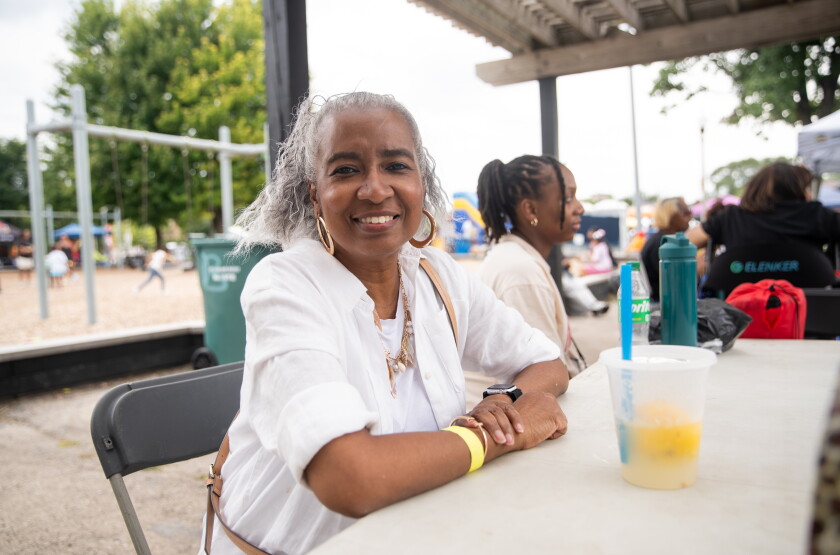
For organizers of Chicago’s Black & Bronze Festival, Saturday’s event in Bronzeville was intended to gather and connect neighbors from different generations in Armstrong Park.
They wanted the Bronzeville fest, now in its second year, to recreate the feeling of the traditional front porch — a place where generations naturally crossed paths, where children learned from elders, neighbors looked out for one another and stories moved from one generation to the next.
“Where Grandma and the grandbabies and aunts and uncles and cousins were all together,” founder Jessica La Rel told WBEZ.
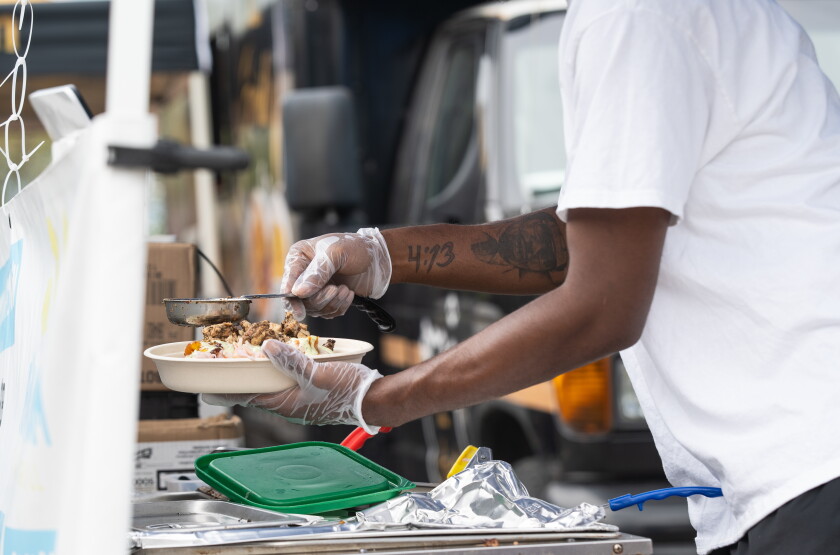
One way that connection was forged among the hundreds who attended Saturday was live jazz music, food, panel discussions, dance performances and more.
“I think Bronzeville — the broader South Side — can be disparaged in a way where people think that only crime, poverty, a lack of investment or care in the community exist,” La Rel said. “But I see a community that cares very deeply. I see people who are resilient and tenacious. I see people whose creative ideas are extremely generative, and I see people looking for opportunities to reach up and reach out to each other.”
FROM THE PRESS BOX 🏈⚾
- Bears checklist: With preseason and roster cuts behind them, here’s what’s next for the Bears before the season opener against the Panthers on Sept. 13.
- Cubs rom-com: The team’s in-house creative arm on Friday will release “Nine Innings to Love,” a romantic comedy broken into 17 parts and available only on TikTok.
- Big division lead: The Cubs got off to a hot start in the opener of a four-game series at Wrigley Field, but the Brewers’ eight-game division lead was hardly under any real threat. It feels all too familiar, writes Steve Greenberg.
- Sox reacquire Pham: A 13-year veteran with postseason experience, the White Sox hope Tommy Pham will provide a proven bat against left-handed pitching.
- High school football: Geneva’s Bennett Konkey and Mount Carmel’s receivers dazzled, Loyola’s time to earn No. 1 — and more Week 2 takeaways.
YOUR DAILY QUESTION ☕️
This month marks 25 years since the attack on the Twin Towers of the World Trade Center in New York City on Sept. 11, 2001.
For today’s daily question, we want to hear your reflections: How did 9/11 change you?
Reply to this question via email (please include your first and last name). We may run your answer in a future newsletter or story.
Thanks for reading the Sun-Times Morning Edition!
Got a story you think we missed? Email us here.
Written and curated by: Matt Moore
Edited by: Michael Lansu and Esther Bergdahl