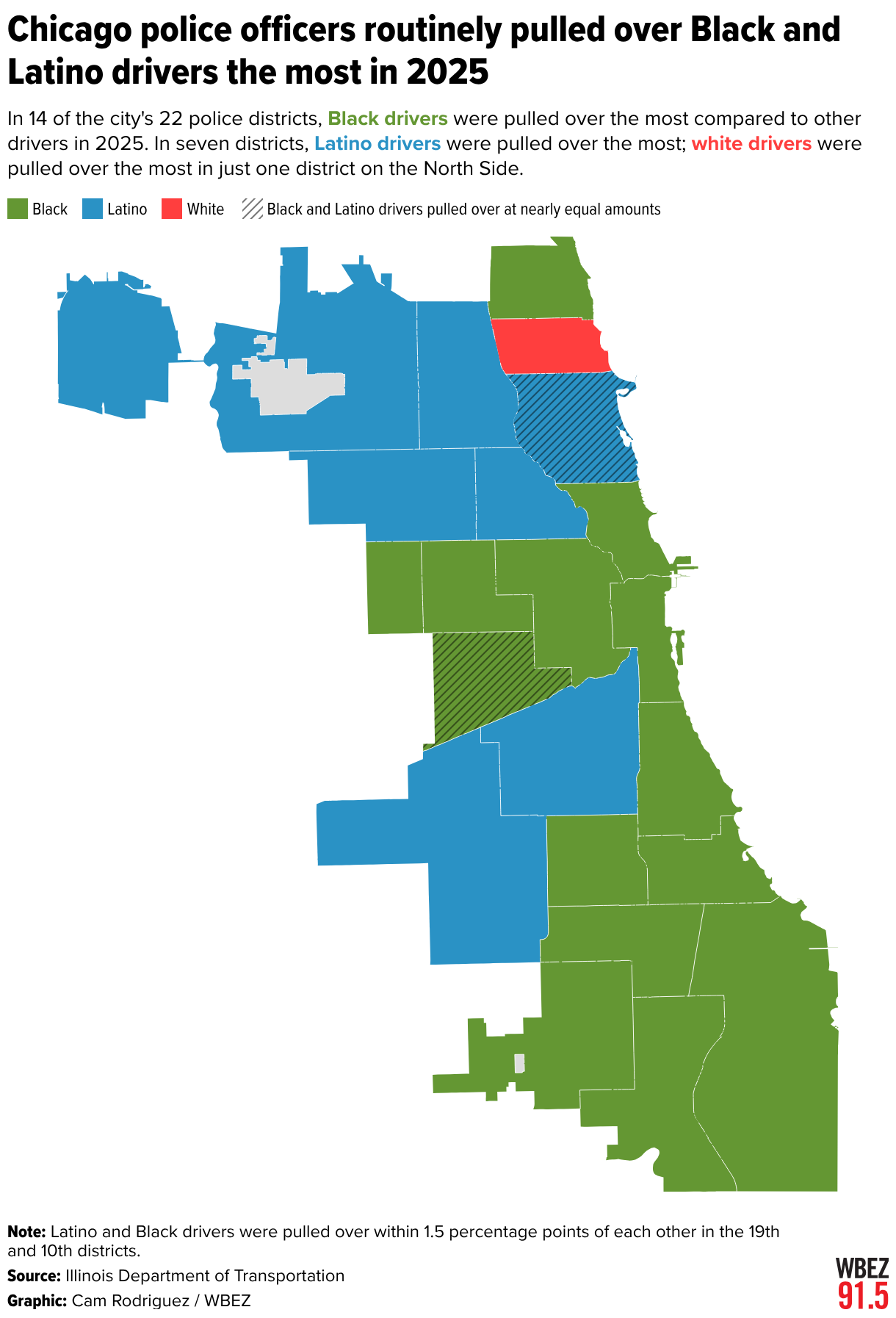
The Chicago Police Department made fewer traffic stops in 2025 than in the previous year and less than half the stops it made in 2023, according to a new report by the Illinois Department of Transportation, but Chicago police officers continued to pull over Black and Latino drivers at much higher rates than white drivers.
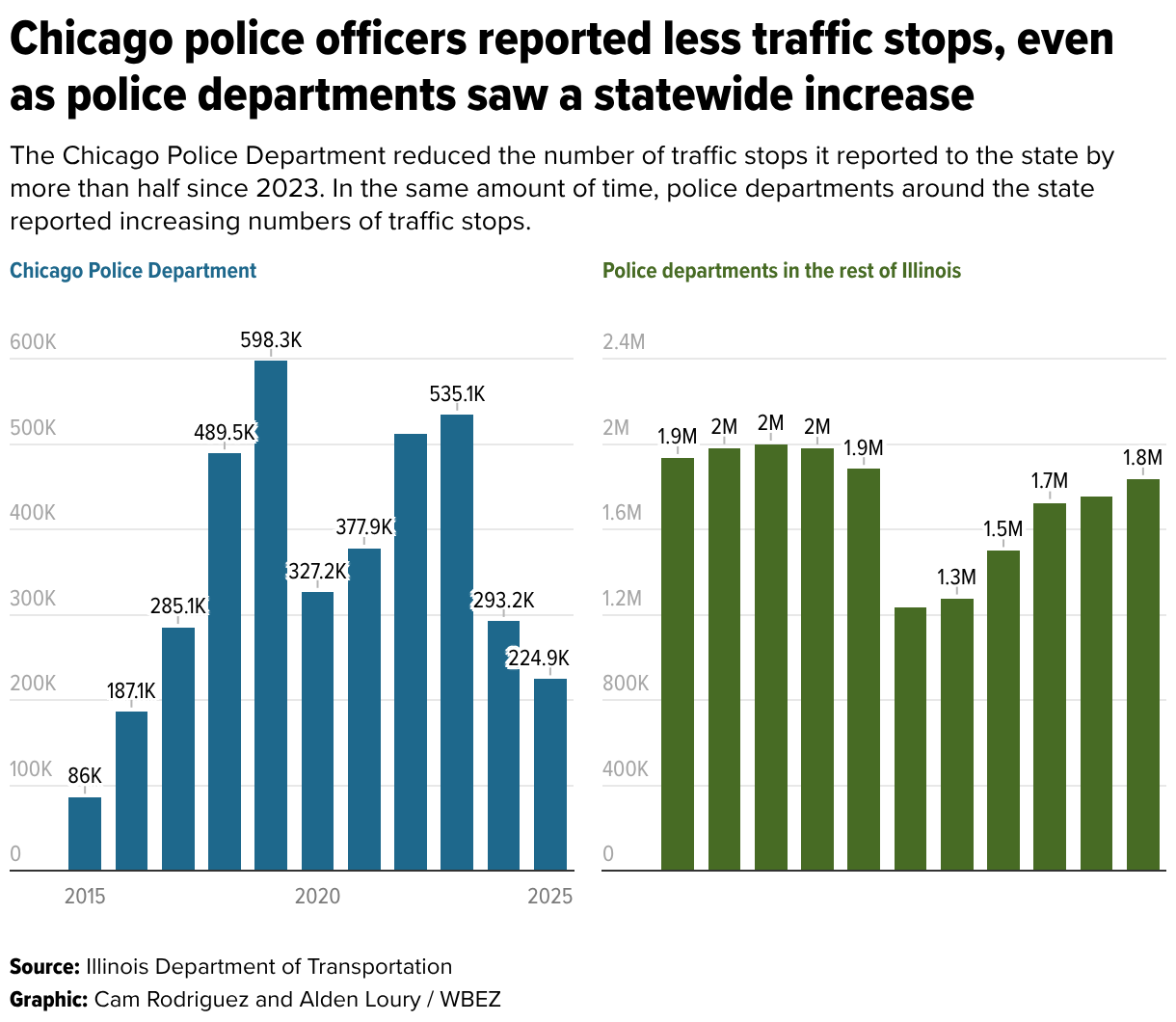
The Chicago Police Department reported 224,851 traffic stops in 2025, about 23.3% fewer than in 2024 and 58.0% less than in 2023.
IDOT uses two methods, or benchmarks, to measure the rates at which drivers are stopped. Those attempt to estimate the driving population or the total mileage driven within the jurisdiction of each law enforcement agency. By one measure, Black drivers were 3.6 times more likely than white drivers and Latino drivers were 2.85 times more likely than white drivers to be stopped by the Chicago police last year. By another measure, Black drivers were 5.6 times more likely and Latino drivers 6.9 times more likely to get stopped.
Most traffic stops made by the Chicago police last year, about 67.6%, were for non-moving violations, according to IDOT.
Those stops in particular have drawn flak, with some critics contending that police officers routinely use minor traffic violations as a pretext to stop drivers — and sometimes to search their vehicles — in hopes of uncovering more serious crimes.
A lot of traffic stops in Chicago are for things like expired plates, tinted windows and broken taillights, said Maya Simkin, an Appleseed Network Collaboration for Justice Fellow with Chicago Appleseed and a member of the Free2Move Coalition. “It’s not about posing a genuine safety risk.”
Craig Futterman, a University of Chicago Law School professor who’s a member of the state’s Racial Profiling Prevention and Data Oversight Board, said the police often view traffic stops as a way to fight crime.
“I don’t think that it is necessarily the case that departments are being evil,” Futterman said. “It’s that they actually think this is a good crime-fighting tool and don’t want anyone to take that tool away from them.”
He said “there’s also nefarious aspects of … this tool. It has created dramatic harm in communities as well as losses in public safety and losses of trust and confidence, or the absence of trust and confidence in police, if people feel that they are being harassed and targeted not because of what they’ve done but because of their race or ethnicity.”
Chicago police officials didn’t respond to a request for comment.

In 2023, the American Civil Liberties Union of Illinois sued the department over mass traffic stops of Black and Latino drivers. The lawsuit recently was certified as a class action, meaning the organization now represents all Black and Latino drivers who have been or will be pulled over by the Chicago police.
According to Alexandra Block, director of the ACLU’s Criminal Legal Systems and Policing Project, the Chicago police have known about IDOT’s traffic stop reports but taken no significant action to address the issues raised. The ACLU has taken depositions of about 35 Chicago police officials, including seven former superintendents. Block said former Superintendents David Brown and Eddie Johnson testified they were aware of the reports.
“They receive copies every year, but they didn’t make any changes in response to IDOT’s analysis,” Block said.
In his first months on the job, former Supt. Larry Snelling said he would reduce the department’s use of traffic stops. “There’s already been a reduction in traffic stops since I’ve taken over because the focus is different. My focus is [on] violent crimes and traffic safety,” Snelling said at a meeting of the Community Commission for Public Safety and Accountability in December 2023.
The reductions in CPD traffic stops during 2024 and 2025 occurred under Snelling’s watch, but the racial disparities remained. A federal judge has ordered Snelling to testify in court as part of the ACLU’s lawsuit against CPD.
Block and others have said the police department hasn’t reported all of its traffic stops to the state over the past few years, pre-dating the Snelling era. Block said data from the city of Chicago Office of Emergency Management and Communications showing the number of times that officers radioed into dispatch for a traffic stop indicates that the department made far more stops last year than it reported.
“What we know is that the number of stops reported has declined but that the Chicago Police Department failed to report more stops in 2025 than they did report,” Block said. “There were over 250,000 stops that they did not report.”
Traffic stops up elsewhere in Illinois
The Chicago police and law enforcement agencies statewide are required to report data about their traffic stops each year under a 2003 state law, originally proposed by then-state Sen. Barack Obama to assess potential racial bias in traffic stops. IDOT collects data from law enforcement agencies and contracts with outside groups to analyze the data.
Last year, among 963 law enforcement agencies in the state that made traffic stops, nearly one in every five did not report any data, according to the IDOT report. The percentage of agencies making stops but not reporting their data has increased the past two years, from 16.5% in 2023 to 18.4% in 2024 and to 19.5% in 2025.
In total, law enforcement agencies across Illinois conducted more than 2 million traffic stops last year, slightly more than the previous year. While traffic stops reported by CPD have decreased the past two years, stops made by all other police agencies in the state, collectively, have increased in each of the past five years. In 2025, excluding Chicago, law enforcement agencies in Illinois reported nearly 1.84 million traffic stops, a 48.9% increase from about 1.23 million reported in 2020, according to IDOT.

Like Chicago, most police agencies in Illinois pulled over Black and Latino drivers at higher rates last year. Nearly 95% of all agencies that reported at least 50 stops had higher stop rates for Black drivers compared to white drivers. About 80% of all agencies had higher stop rates for Latino drivers compared to white drivers, according to IDOT.
But law enforcement agencies have routinely criticized the state’s methodology for determining traffic stop rates. More than 30 police agencies offered such comments in the IDOT report.
IDOT notes that researchers use a combination of data sources — including surveys from the U.S. Census Bureau, Illinois crash reports, driver’s license counts, employment data, traffic counts and other sources — to estimate the driving population and total mileage driven by motorists.
IDOT acknowledges the limitations of its benchmarks. “However elaborate these datasets may be, they can only approximate local traffic dynamics and necessarily rely on particular assumptions, which may not always be accurate,” the report says.
Futterman and other civil rights advocates are calling for an end to pretextual stops as a way to remedy the long-standing racial disparities.
“There’s a real addiction and a wrongful belief, in my view, that using pretext stops is an effective crime-fighting tool,” Futterman said. “It actually hurts the ability of police to effectively fight crime and gain the cooperation of community members to solve violent crime.”
Futterman points to research that followed traffic stops of the San Francisco Police Department from 2022 to 2025. San Francisco police banned pretextual traffic stops in 2024.
“Put plainly, the pretext ban policies did not result in fewer guns and drugs discovered, nor did they result in the apprehension of fewer criminals,” the Berkeley Public Policy Journal wrote in a February report about the research. “They did, however, result in fewer searches of Black and Hispanic drivers.”
Futterman said a similar reform could work in Illinois.
“Illinois, as a state, could prohibit police from pulling over people for low-level traffic violations when drivers don’t pose any immediate risk to public safety,” Futterman said.