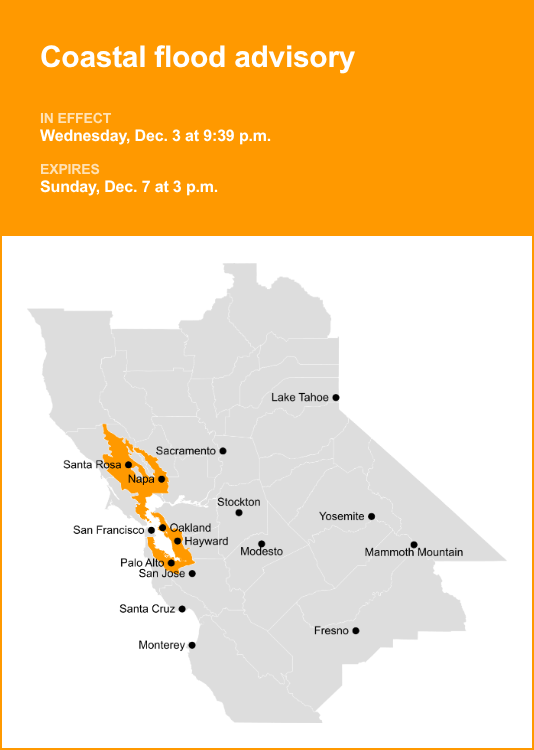
North Bay Interior Valleys and San Francisco Bay Shoreline were placed under a coastal flood advisory by the National Weather Service on Wednesday at 9:39 p.m. The advisory is in effect until Sunday Dec. 7, at 3 p.m.
“Up to 1.4 ft of inundation above ground level is possible in low-lying areas near shorelines and tidal waterways,” can be anticipated according to the NWS San Francisco CA. “At the San Francisco tidal gauge high tide is expected to be 1.2 ft above normal (7.00 ft MLLW) at 9:04 a.m. Wednesday, 1.4 ft above normal (7.20 ft MLLW) at 9:48 a.m. Thursday, 1.4 ft above normal (7.23 ft MLLW) at 10:35 a.m. Friday, 1.2 ft above normal (7.08 ft MLLW) at 11:25 a.m. Saturday, and 0.9 ft above normal (6.75 ft MLLW) at 12:17 p.m. Sunday. High tide timing varies up to 90 minutes earlier or later along the Pacific Coast and throughout the San Francisco Bay respectively.”
“Flooding of lots, parks, and roads with only isolated road closures expected,” the NWS said. “If travel is required, allow extra time as some roads may be closed. Do not drive around barricades or through water of unknown depth. Take the necessary actions to protect flood-prone property.”

How to use a sandbag and where to get sandbags in your area:
Follow these instructions on how to use sandbags and other flood preparation tips to protect your home, and click on the links below to get sandbags in your county:
Where to get sandbags in San Mateo County
Where to get sandbags in Alameda County
Where to get sandbags in Santa Clara County
Your guide to weather alerts: advisories, watches, and warnings
- Flash flood warning: Take action!
A flash flood warning is issued when a flash flood is imminent or occurring. If you are in a flood-prone area, move immediately to high ground. A flash flood is a sudden violent flood that can take from minutes to hours to develop. It is even possible to experience a flash flood in areas not immediately receiving rain.
- Flood warning: Take action!
A flood warning is issued when flooding is imminent or occurring.
- Flood advisory: Be aware:
A flood advisory is issued when flooding is not expected to be bad enough to issue a warning. However, it may cause significant inconvenience, and if caution is not exercised, it could lead to situations that may threaten life and/or property.
- Flood watch: Be prepared:
A flood watch is issued when conditions are favorable for flooding. It does not mean flooding will occur, but it is possible.
Weathering the storm: Flood safety guidelines from the NWS
In flood-prone regions or while camping in low-lying areas, understanding and following the NWS flood safety guidelines can be a lifesaver:
Move to higher ground:
If you reside in a flood-prone region or are camping in low-lying terrain, the first step to safety is relocating to higher ground.
Follow evacuation orders:
When local authorities issue an evacuation order, promptly comply. Before leaving, secure your home by locking it.
Disconnect utilities and appliances:
If time allows, disconnect your utilities and appliances. This reduces the risk of electrical hazards during flooding.
Avoid basements and submerged areas:
Steer clear of basements or rooms where water has submerged electrical outlets or cords. This helps prevent electrical accidents.
Evacuate promptly for safety:
If you notice sparks or hear buzzing, crackling, snapping, or popping noises, evacuate immediately. Avoid any water that may be charged with electricity.
Refrain from walking in floodwaters:
Never attempt to walk through floodwaters, even if they appear shallow. Just 6 inches of fast-moving water can forcefully sweep you off your feet.
Seek high ground if trapped:
In the event you become trapped by moving water, make your way to the highest point available and contact emergency services by calling 911.
During heavy rain, flooding is possible, especially in low-lying and flood-prone areas. Never drive through water on the road, even if it does not appear to be deep. It takes just 12 inches of rushing water to carry away most cars, according to the NWS. Stay safe by being prepared and informed.
For more weather alerts in the Bay Area, visit Weather Advisories