Consumer advocacy groups and the state’s top law enforcement official are opposing a Chicago company’s plan to obtain a national bank charter — arguing the move would allow it to lock customers into loans at more than 100% interest rate.
Their ire is directed at online lender and servicer Opportunity Financial, which is seeking regulatory approvals for a $130 million deal to acquire BNCCORP and its subsidiary BNC National Bank, a nationally chartered commercial bank in Arizona.
If approved, OppFi would be able to evade state laws that cap interest rates for borrowers.
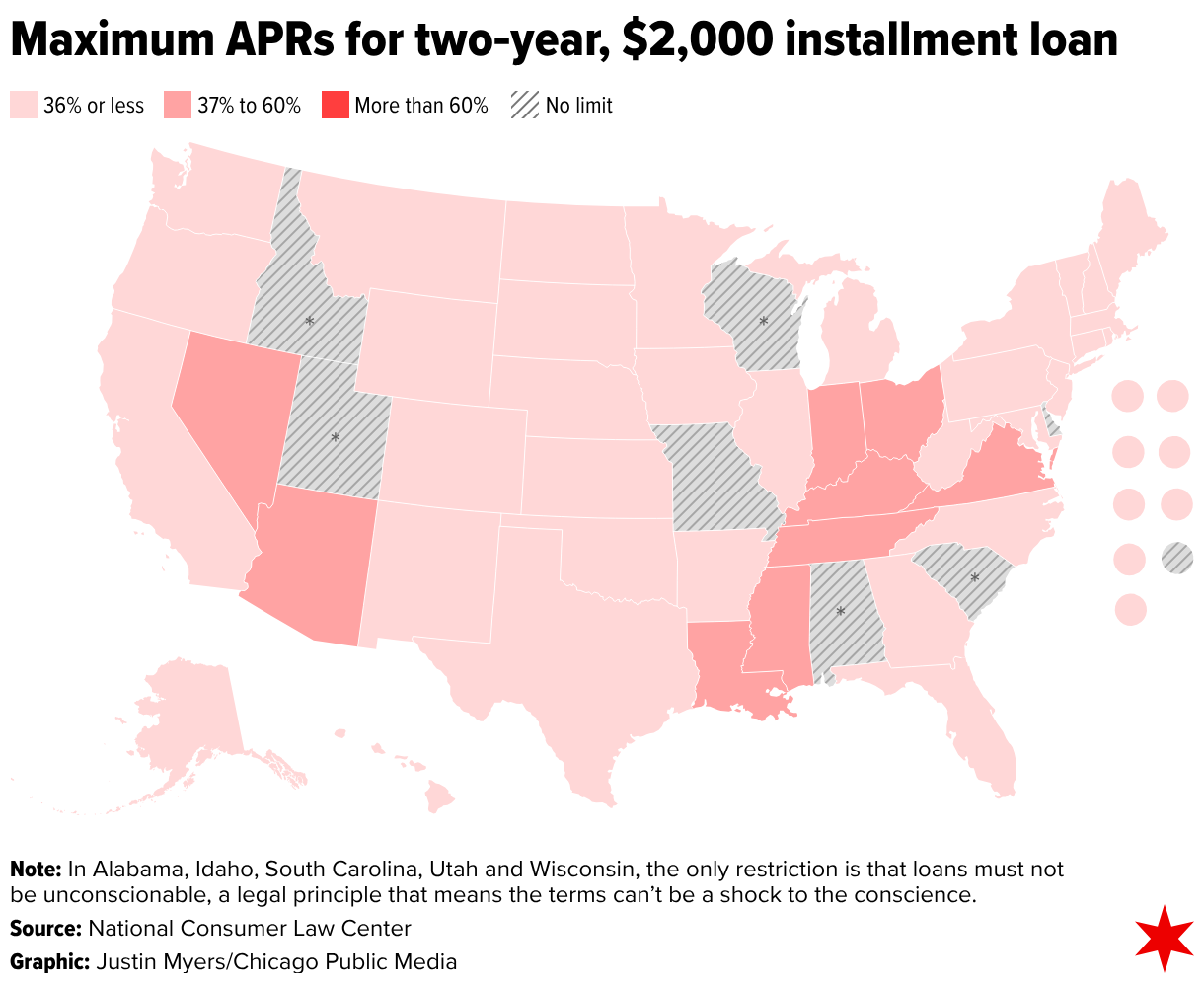
Illinois has a 36% interest rate cap on consumer loans and is among 45 states that impose a rate limit, according to the National Consumer Law Center.
“Largely, banks and credit unions are not the problem in the predatory lending space,” said Jane Doyle, director of policy and advocacy for the Woodstock Institute, a Chicago nonprofit that advocates for consumer protections. “The problem comes in when companies like OppFi try to get their own banking charter to get around that exemption.”

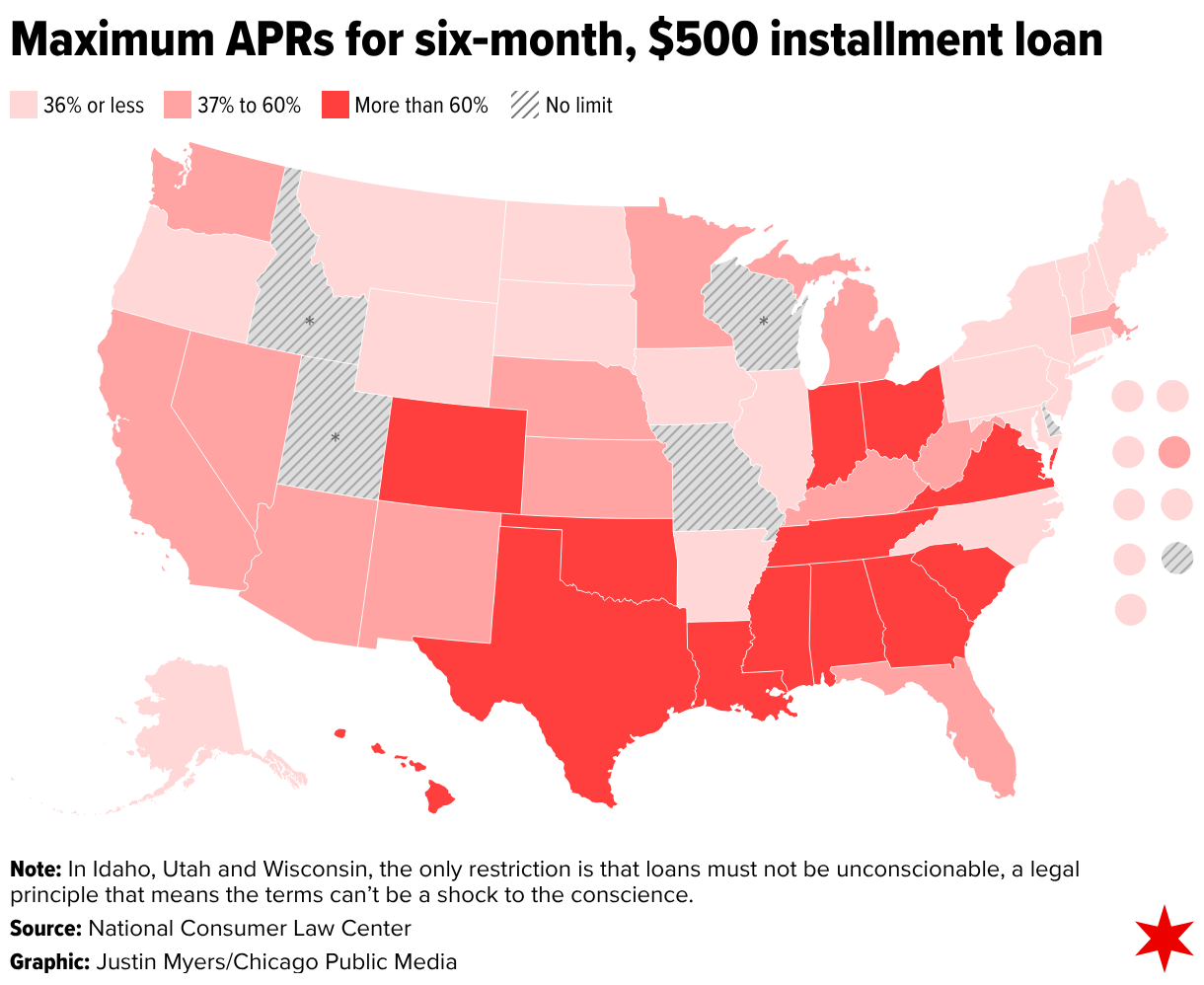
Federal banking rules allow banks with national charters to levy the maximum interest rates established in their home state to borrowers in states with stricter laws or lower caps. So online companies like OppFi are able to skirt state caps by partnering with charter banks in states like Utah that lack interest rate caps — partnerships described as a “rent-a-bank” scheme by industry critics.
Meanwhile, borrowers of the high interest loans often end up paying double or triple the principal, pushing them further into debt. Studies show these loans disproportionately affect Black and Latino communities. And lax federal regulations and the dismantling of consumer protections by the Trump administration is making these loans more pervasive, evident by a surge of fintech companies and other digital platforms applying for national bank charters, like Loop-based Enova International.
Enova is expected to close its $369 million purchase of New York-based Grasshopper Bancorp and its online bank subsidiary during the second half of the year — a deal that has also drawn opposition from consumer advocacy groups and attorneys general.
OppFi confirmed plans to relocate its headquarters from 130 E. Randolph St. to Utah, following its acquisition of BNCCORP. The cash and stock transaction, expected to close in the fourth quarter, requires regulatory approval from the Office of the Comptroller of the Currency, Federal Reserve Board and Federal Deposit Insurance Corp.
Opposition mounts
Illinois Attorney General Kwame Raoul and 17 other state attorneys general sent a letter on Aug. 6 to the OCC, Federal Reserve and FDIC urging the agencies to deny OppFi’s pending acquisition.
“OppFi should not be granted a national bank charter because it targets vulnerable consumers with risky, unsafe and unsound loans that cause more financial harm,” Raoul said.
They argued OppFi’s acquisition would increase “unaffordable high-cost loans” that pose significant safety concerns for consumers, small businesses and the banking system while allowing the company to circumvent state laws protecting borrowers. A similar letter about Enova, signed by 15 state attorneys general, including Raoul, was written in July.
“It’s unfortunate that a group of politically motivated AGs chose to issue a poorly researched letter that is unsupported by the facts, attacking companies focused on providing credit access,” OppFi said in a statement. “OppFi’s mission is to expand access to credit for hardworking consumers who are overlooked by traditional financial institutions.”
The company markets personal and small business loans to help consumers cover emergencies, medical bills, debt consolidation and large purchases, among other expenses. OppFi’s available market includes 48 million Americans and 12 million small businesses lacking traditional credit options, according to its website.
“They’re not writing $500,000 mortgages,” Dave Storms, director of equity research at Dallas-based Stonegate Capital Partners, said.

Storms said their business is predicated on volume, with most loans around $1,000.
OppFi said every applicant is evaluated on income and cash flow to verify their ability to repay.
But its customers are struggling to pay them back, according to financial filings and customer accounts.
OppFi reported 52.3% of its outstanding loan balances on an annualized basis were charged off in the second quarter due to delinquencies, personal bankruptcies or other reasons deemed uncollectible. An annualized charge-off rate is a proportion of total loans deemed uncollectible, with the creditor typically writing it off as bad debt after 90 days of missed payments.
OppFi said evaluating short-term credit using its annualized charge-off metrics is misleading.
“The true measure of repayment health is lifetime charge-off rate, which holds steady within our historical baseline of 20% to 25%,” the company said.
Still, the recently reported charge-off rate was higher than analysts expected, according to Storms, who covers the company.
“One data point doesn’t make a trend but certainly something to monitor,” he said.
‘Repairing my life’
Facing mounting bills and a new mortgage payment on a house she inherited after her parents died, Courtney Thompson turned to OppFi to fill the gap. She went through the quick approval process in 2024, borrowing $3,000.
In September 2025, she stopped making the monthly $124.17 repayments. A month later, the loan was written off.
“I did the best that I could to stay afloat,” the 40-year-old South Holland single mother of three said. “After a while, I got behind.”
Providing for her family and juggling monthly bills, as well as her parents funeral costs took precedence.
“I communicated with OppFi and let them know what was going on,” she said. “They didn’t care. They wanted their money.”
If Thompson paid back the $3,000 loan with its 127.6% APR over two years, as the contract stipulated, the total balance would have skyrocketed to $6,829.35.
The first time she used OppFi, following a coworker’s recommendation, was in 2021, when she borrowed $1,600 to cover bills and gifts for the holidays. She paid it back in about 18 months, with the final balance exceeding $3,500.
“You’re not realizing how much you pay back,” she said. “I wish there were better loan options out there.”
When Thompson’s sister, Kesha Thompson-Warren, 44, took out a loan with OppFi in 2023 her interest rate was 159.5%.
Thompson-Warren, a mother of two who lives in South Holland, said the loan, which required garnishing her income, helped cover a variety of bills, including expenses for her landscaping business, mortgage payments and funeral costs for her parents, who both lacked life insurance policies.
“I took out maybe $1,000 and ended up paying double or triple that,” she said. “I’m still repairing my life after all the interest I had to deal with. I just feel taken advantage of.”
OppFi said it rejects claims that its business model creates a cycle of debt.
“OppFi facilitates fully amortizing, fixed-term installment loans with clear repayment schedules and zero prepayment penalties,” the company said. “In fact, one-third of customers use loans originated through our platform to pay off higher-cost alternatives like payday loans.”
Legal limits
Illinois lawmakers in 2021 passed the Predatory Loan Prevention Act, which capped interest rates on most consumer loans at 36%. The bill was meant to combat payday lenders that, unlike fintech companies such as OppFi, require customers to repay on their next payday.
Even though payday lenders have left the state, Woodstock said there are still lenders who are evading state law by partnering with banks in states with no rate caps.
Given the proprietary nature of OppFi’s business and its bank partnership agreements, it’s difficult pinpointing the number of loans it facilitates annually or the interest rates attached to them, but a national research study and some lawsuits offer insights.
From 2020 to April 2022, OppFi provided more than 38,000 California consumers with loans carrying principal amounts between $500 and $4,000. The average APR was 153%, according to court documents. In Washington, D.C., it was providing loans to most residents at a 160% APR, according to a 2021 lawsuit.
A January report from the Center for Responsible Lending found that OppFi facilitated personal installment loans with up to 195% APR on loans ranging from $500 to $5,000.
Meanwhile, borrowers in the last three years have filed nearly 1,700 complaints against OppFi, according to the Consumer Financial Protection Bureau.
“Somebody needs to advocate for us,” said Thompson-Warren, whose story of financial hardship helped push Illinois lawmakers to enact a rate cap.
She’s still struggling, deferring payments on student loans that exceed $100,000 while trying to build her landscaping business and launch a logistics company. She also works in an administrative role at a South Loop hotel.
“If I didn’t have my business, I would probably drown,” Thompson-Warren said. “So there’s not really a lesson I can tell anybody because this is what we’re up against.”
It’s unlikely the federal regulatory landscape will sharply curb the industry’s growth.
Since 2025, the OCC has received 40 new bank charter applications and approved 21, denying only two — many applications are from the fintech and crypto sector. Recently, the regulator granted preliminary approval to World Liberty Financial Trust Co., a cryptocurrency venture affiliated with President Donald Trump and his family.
From 2021 to 2024, the OCC received only 18 new bank applications and approved half of them. Over the previous decade, there were some years when the agency received no charter applications.
“This administration definitely in the second term is much more M&A friendly with banks,” said Rob Farling, national risk and regulatory banking lead at West Monroe, a Chicago-based consulting firm that helps banks with mergers and acquisitions.
That’s helped spur M&A activity for non-banks seeking national charters via acquisition, similar to OppFi and Enova.
“We’ve definitely seen an uptick,” Farling said. “A lot of people are expecting to see even more in 2027.”
Meanwhile, Thompson is working overtime to make her mortgage payments but she has already ruled out a high interest loan.
“It’s so stressful,” she said. “But I would take a different route.”