In the new play “Adirondack Chair Circle,” a small group of well-off women meet regularly in one of their suburban backyards, always over a gorgeously crafted charcuterie platter, to plot strategy. Their goal: to get books they consider dangerous, morally repugnant or just age-inappropriate removed from local school libraries.

They have a list and, just as importantly, have managed to put their cause onto the agenda of the upcoming school board meeting. They also have opponents. And it just so happens that one of them, the school district’s superintendent, lives next door.
“This is the fight of our lives,” implores the leader of the group of concerned moms, Banna (Katrina Lenk), to her two compatriots in the battle, Libby (Sadieh Rifai) and Winona (Wendy Mateo).
This is a relatively promising setup for a comedy from the playwright Stephanie Alison Walker, who herself lives in the Chicago suburbs and readily admits the work was inspired by a real effort.
But these oh-so-misguided characters never get their fair say.
Walker finds plenty of satirical humor — the word “grooming” gets a good workout — and arguably a wee touch of pathos in exploring the characters’ motivations. Director Pam MacKinnon and a reliable cast capture the dynamics among the friends who aren’t always friendly.
Tony-winning Lenk quietly gives voice to poised Banna’s loneliness. Rifai digs deliciously into Libby’s boiling anger with furious texting. Mateo finds both the comedy and complexity of Winona’s aversion to conflict, given that she’s a child of parents from communist societies.
These are all educated, energetic and resourceful women. They’re ready for battle, so why not give them one?
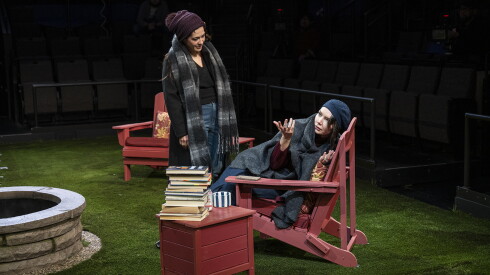
There’s a moment in Act II that seems primed to go there when Winona brings her vocally liberal pickleball partner Evelyn (Carolyn Neff) to sit on one of Banna’s titular red chairs.
But the argument doesn’t get far. Evelyn asks Banna to define “woke.” The usually articulate group leader immediately starts hesitating. “It’s rooted in, uh, Marxism.” That’s the coherent part. Evelyn sits quietly, with Neff investing the silence with the appropriate air of triumph.
Wait! No knockdown drag-out brawl? No cogent debate? No effort from Walker to put Evelyn on her back foot? Not a single example of the extremities of the left?
Theater has always been used as a medium to get inside the minds and lives of people very different from the target audience. The oldest surviving ancient Greek play — Aeschylus’ “The Persians” — tells the story of a war from the perspective of Greece’s enemy.
But such work needs to offer more than just a degree of generalized human sympathy — we all have problems, life is hard — which Walker does provide here. Without dimension, insight or nuance, it comes across as condescending and smug, little more than target practice.
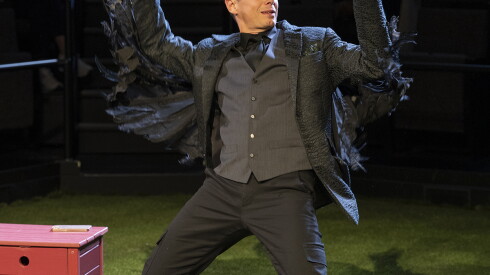
It isn’t a fair fight. Before Libby gives a reading of a very sexual scene from a targeted book, we’ve had a monologue about the book’s positive effects. Even the supposedly objective observer here — in the form of a very amusing crow (David Darrow) who comments on the action — gets to torture Banna. It’s fun, making book-banners suffer, but it’s too easy.
Relatively recently, we’ve seen far funnier and more penetrating work in a similar social-satirical vein about schooling. “The Thanksgiving Play” (also produced by Steppenwolf in the same in-the-round Ensemble Theater space as “Adirondack Chair Circle”) dealt sharply with the absurdities of trying to tell a more truthful American history in a children’s play. “Eureka Day,” produced by TimeLine Theatre in partnership with Broadway in Chicago, followed the implosion of a school board over a mandatory vaccination policy.
These plays found a way to put different viewpoints at odds with each other to mine for caustic commentary about our inability to get along. We knew where the playwrights stood in those cases, too, but we had a real sense they were willing to challenge both themselves and the audience.
And in terms of craft, those plays were also far more dramatic in their storytelling. Throughout “Adirondack Chair Circle,” there’s the sense that the most interesting characters are barely heard from, such as Banna’s nonbinary child and the school board members under pressure from multiple angles. The aforementioned stories led towards decisions the central characters themselves needed to make, but that’s not the case here.
In other words, one problem with “Adirondack Chair Circle” is that even the winning, and the losing, feels anti-climactic.