Andrew Lloyd Webber’s mega-musical “The Phantom of the Opera” exemplifies how two things can be true at the same time. On one hand, the show — adapted from Gaston Leroux’s 1909 novel — has aged absolutely horribly since its London debut in 1986. The leading lady here is mostly a glassy-eyed sleepwalker with all the agency of the wind-up monkey music box.
On the other hand, the production running through Feb. 1 at the Loop’s Cadillac Palace is wildly entertaining. Lloyd Webber’s thunderous, over-the-top score is overwhelmingly seductive as it soars from money note to money note in a cascade of bombastic crescendos that roar and tumble like crashing waves. The set and the costumes embody eye-popping opulence.
Not for nothing does the seven-time Tony winner (book by Webber and Richard Stilgoe, lyrics by Charles Hart and Stilgoe) hold the record for the longest-running show on Broadway, clocking almost 14,000 performances since its debut there in 1988.
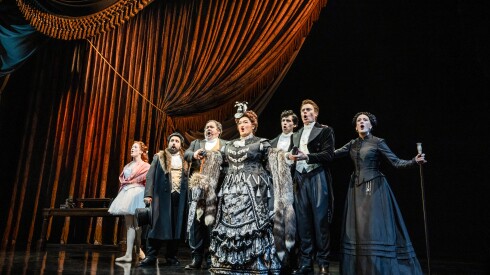
In this revival, birthed on London’s West End in 2021, the bombast is turned up to a heart-thumping 12. Directed by Seth Sklar-Heyn (based on the original direction by Hal Prince), the production is a feast of excess with enough bells and whistles to almost mask its failure to make Christine Daaé (Jordan Lee Gilbert) more than the Phantom’s (Isaiah Bailey) somnambulant muse.
The plot is propelled by the Phantom and his hapless protegee. He’s the fabled “Opera Ghost” controlling the Paris Opera House from the catacombs below it. He’s seen by most as a lurid rumor — until gossipy stagehands and pompous actors start turning up dead.
After the Phantom takes chorine Christine to his underground lair for singing lessons, she emerges as the Opera company’s star, displacing the mysteriously ailing diva soprano Carlotta (Midori Marsh).
Like the Phantom, Vicomte Raoul de Chagny (Daniel Lopez) is obsessed with Christine. He does not like her strange comings and goings (she vanishes through a mirror one night, as Raoul pounds on her dressing room door), and vows to marry and protect her.
As the Opera’s managers (great comic work by William Thomas Evans, as Monsieur Firmin and Carrington Vilmont as Monsieur Andre) bluster about divas and ticket sales, the Phantom grows increasingly demanding and violent. A showdown becomes inevitable, the bumper-jawed Raoul and the half-faced Phantom eventually sparring with swashbuckling panache worthy of a silent movie. Throughout, the choreography (recreated and adapted from the original by Chrissie Cartwright) heightens the visual richness with kinetic dazzle.

You couldn’t ask for a better Phantom than Bailey. His falsetto on the iconic “Music of the Night” could pierce clouds, his anguish and loneliness could melt stone. A musical genius raised in a freak show and condemned as a monster, Bailey’s outcast Phantom teeters between yearning, rage and destruction. Gilbert is passive by comparison as she’s buffeted between Raoul and the Phantom, but her voice is a crystalline delight, especially during the cascading arias the Phantom demands. When the two duet on the title tune, it’s with mesmeric power.
Along with its glorious vocals and lush orchestrations (by Lloyd Webber and David Cullen), the production is largely defined by the complex, glittery set adapted by Matt Kinley from Maria Bjornson’s original design.
Elaborate pillars sculpted into flowy-haired women frame the Paris Opera House, depicting a scene of them being either rescued or ravished by horned, masked creatures — set pieces, incidentally, that fit in nicely with the CIBC Theatre’s Versailles-on-Acid aesthetic. The action moves from candlelit underground lagoon to windswept rooftop to glittering ballroom with an ease that feels like magic. An elephant in a silver headpiece trundles by as the doomed company rehearses “Hannibal.” A towering, rotating Pegasus rises from a misty graveyard, ultimately serving a killer reveal. The corpse bride the Phantom keeps in his lair beneath the Paris Opera provides a terrific jumpscare.
Jill Parker’s take on the Bjornson-originated costumes offer a buffet of eye-candy, from dandified formal wear, to diaphanous tutus to the gleaming array of masquerade looks — the last giving the flashy bacchanal an “Eyes Wide Shut” meets “The Masque of the Red Death” vibes.
As for that infamous chandelier, it looks about twice as large and falls about twice as fast as it did that last time the show last came through roughly a decade ago. It is still a highlight.
The story is infuriating. The spectacle is breathtaking. The music is fabulous. And that light fixture is impressive. In its fifth decade of subterranean hijinks, “Phantom” itself remains a fantastical example of excess at its most entertaining.
Corrected: This story was updated to reflect that “Phantom” is running at the Cadillac Palace Theatre.