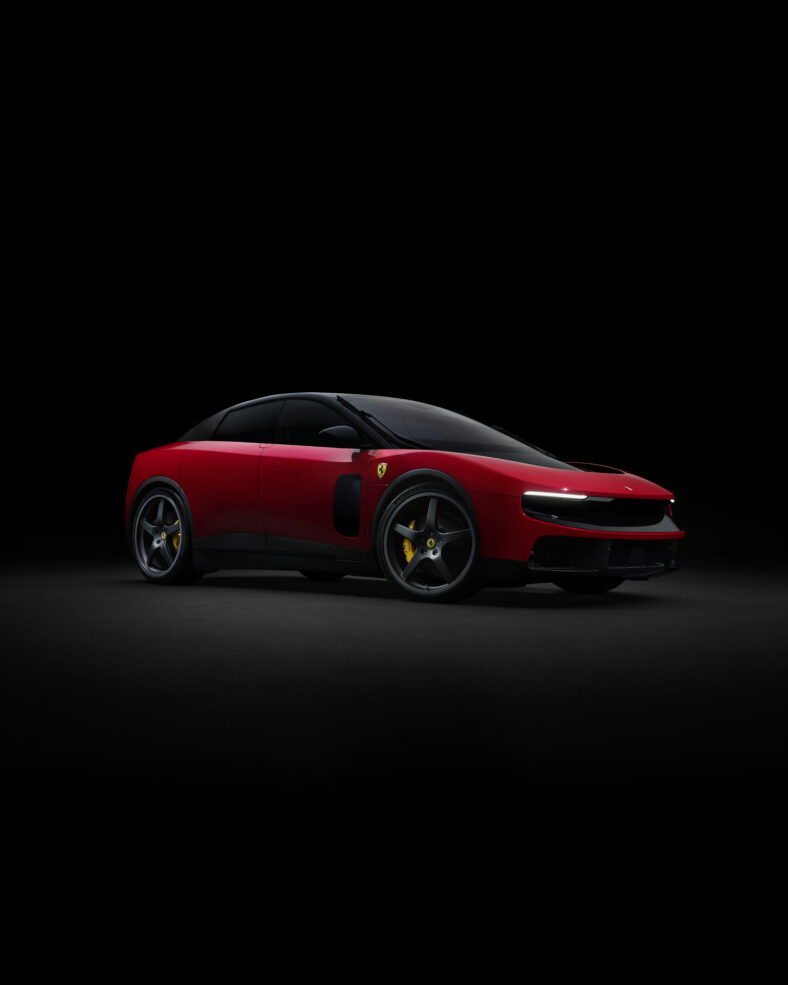
Back when you couldn’t drive a public road without seeing a pure EV, now-former Ferrari chairman said that the preeminent Italian supercar maker would “never make an electric car.” Nearly 15 years later, the Ferrari Luce has finally arrived as arguably the most impressive ICE-less automobile that’s ever been.
Ferrari elected to engineer, develop, and manufacture the main components in Maranello—from the electric motors to the battery pack—necessitating the filing of more than 60 new patents. Many of them pertain to the powertrain, which drives each wheel with a radial-flow permanent synchronous magnet e-motor connected to a 122-kWh battery by an 800-volt electrical architecture and overseen by high-performance silicon carbide inverters, Motor Trend reports. While most four-motor configurations are born to chase power, Ferrari’s primary motivation was to enable torque vectoring, i.e. independently managing torque between the left and right wheels for sharper, more precise cornering.
As with several Prancing Horses since the F50, Ferrari tapped into the racing expertise that’s made it Formula 1’s winningest team, borrowing from its hybrid race cars a “Halbach” configuration that uses a clever magnet arrangement to allow each motor’s hollow carbon rotor to reach a peak angular acceleration of 40,000 rpm in a second while remaining lightweight and compact. Each front motor develops 140 hp and 103 pound-feet of torque, each rear motor 415 hp and 262 pound-feet. The combined total system output is monumental at 1,035 hp and 730 pound-feet.
The Luce’s battery, chassis, and body are all built as one monocoque-like unified structure—the battery sits under the floor and doubles as a structural element, making the car stiffer and lighter, while freeing up interior space by eliminating the central tunnel. Advanced suspension, rear-wheel steering, and optimized brakes round out a setup tuned for both thrill and comfort, with emphasis on the thrills. It’ll hit 62 mph in 2.5 seconds, 124 mph in 6.8 seconds, and a top speed of 193 mph. On a single charge, Ferrari says the Luce will prance onward for 330 miles.
The Ferrari Styling Centre, led by Flavio Manzoni, collaborated intimately with LoveFrom on both the interior and exterior, which explains why the Luce looks like no Ferrari that came before it. The San Francisco-based creative collective is headed by Sir Jony Ive—who almost single-handedly shaped the personal technology trends of the past 20 years with his work on the Apple iPod, iMac, and iPhone—and his longtime collaborator, Marc Newson.
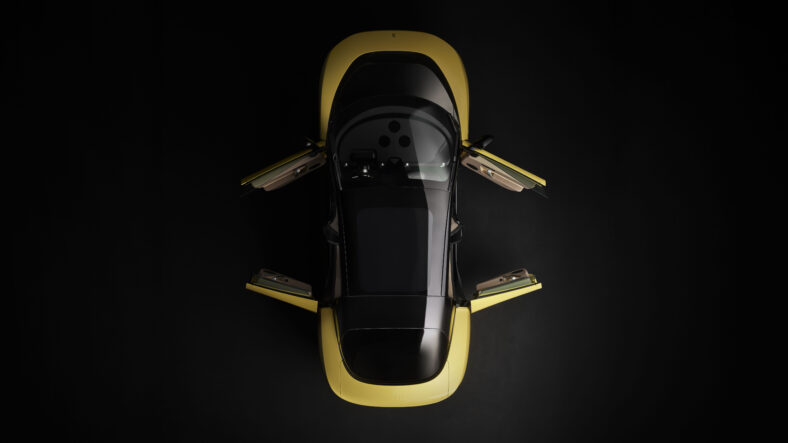
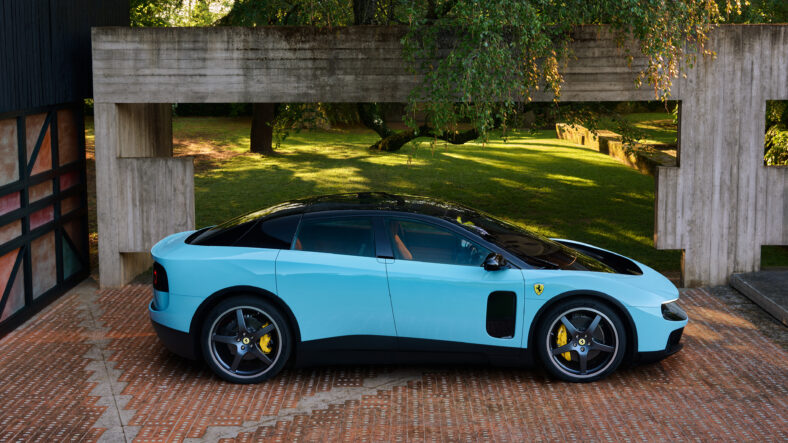
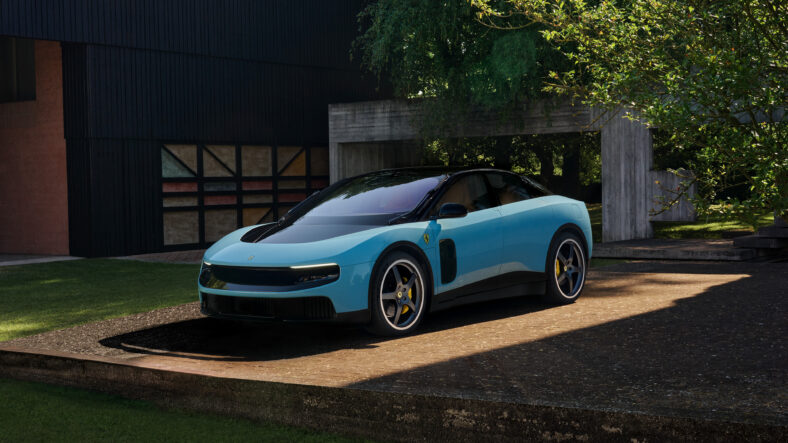
The result of the ambitious collab is the second-ever four-door Ferrari after the Purosangue and the first with five seats. The design’s focal point is what Ferrari dubs a “glass house,” an uninterrupted form which extends below the belt line to the extremes of the car. The bird’s-eye view seen above offers the best look at the breadth of the breathatking element and the dual-axis visual symmetry that defines the Luce’s form, with front and rear aerodynamic wings floating above and around the glass. Even when opened up, the symmetry is maintained, thanks to rear-hinged rear doors that are typically seen on luxury coach cars.
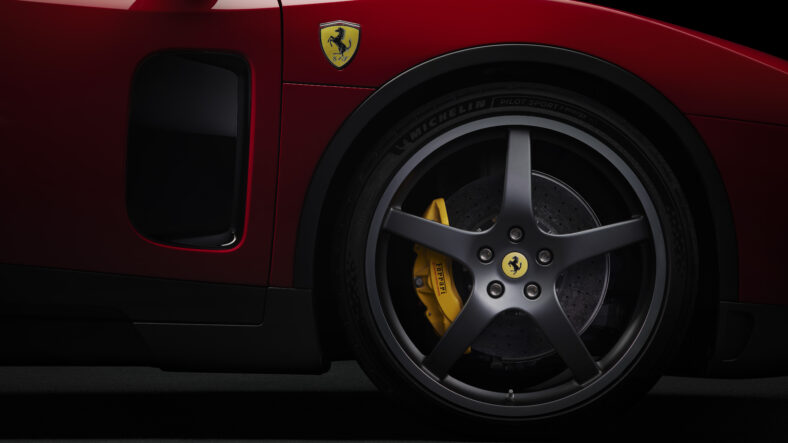
The silhouette is the result of five years of aerodynamic development, including 330 hours of wind-tunnel testing. Even the windscreen wiper required careful study in order to achieve the ambitious performance targets.The entirely smooth shape gives the car a teardrop aeronautical profile, the jet turbine-shaped wheels—the largest on any series production Ferrari—cut drag by around 5%, and the flat battery floor helps clean up airflow underneath.
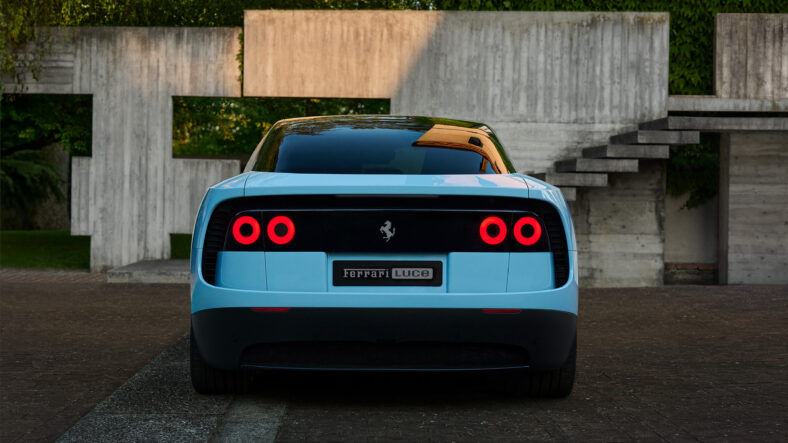
There are a few Ferrari design signatures, including the halo taillights, which hark to those of the 360 Modena and 458 Italia. The launch colors—comprising Azzurro la Plata, Giallo Luce, Rosso Dino, Bianco Artico, and Rosso Fiammante—are also quintessentially Ferrari, particularly the yellow shade inspired by the historic hue seen on the Ferrari logo.
Like all Ferraris, the Luce’s interior centers on a driver-first philosophy, blending physical controls with digital displays. Ferrari previously described a cabin that was “conceived as a single, clean volume, with forms simplified and rationalized in the service of driving, creating an environment that feels calm, focused, and spacious. Hardware and software were developed together, so the physical architecture and the interface behavior feel harmonious. Essential elements such as the binnacle, control panel, and central console are self-contained and clearly organized around inputs (controls) and outputs (displays).”
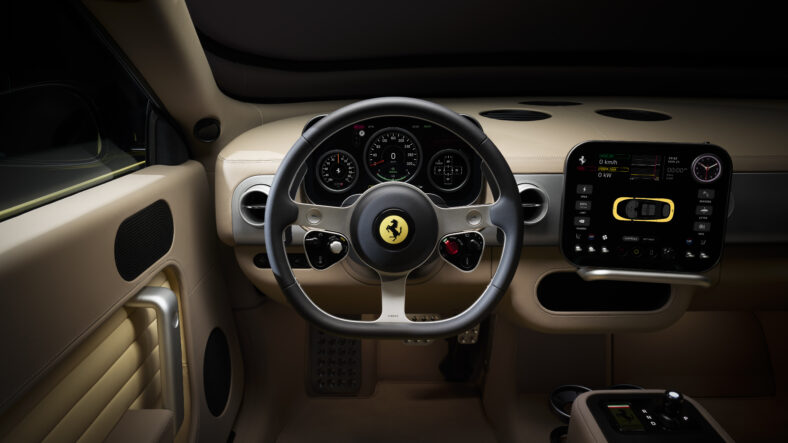
Samsung developed the OLED screens exclusively for the Ferrari Luce, in accordance with the specifications agreed during the co-design phase for three display areas in the cabin: the binnacle, the central panel, and the rear panel. “In particular, the binnacle display adopts a multi-layered design based on the superimposition of two panels and openings cut into the upper layer, creating a sense of visual depth and a more natural way of reading the information, consistent with the desire to combine digital output with an analogue sense of interaction,” Ferrari describes. “Compared to traditional LCD designs, the use of backlight-less OLED technology allows for a simpler and slimmer structure, offering greater freedom of integration and contributing to a cleaner, more compact internal layout.
Most of the metal is entirely recycled and anodized aluminum–chosen for durability and integrity—that’s machined from solid billets using 3- or 5-axis Computer Numerical Control (CNC) technology to create an “ultra-thin, hexagonal cell microstructure on the surface.
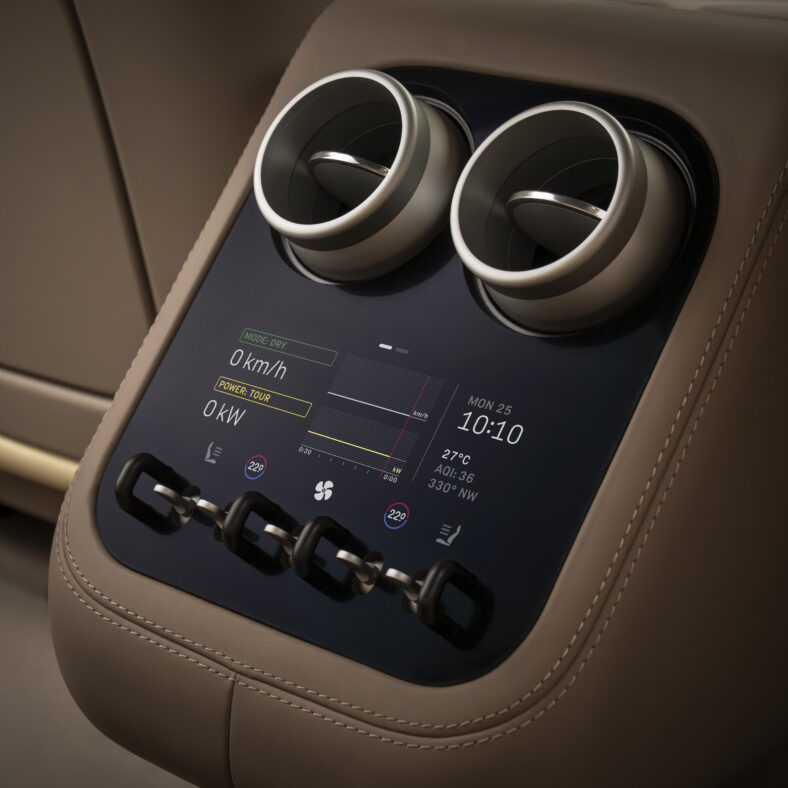
Given Newson and Ive’s involvement, one might expect to see a radical deployment of button-less touchscreens. But instead of trying to one-up Mercedes and Cadillac and their 50-inch-plus pillar-to-pillar glass displays, Ferrari and LoveFrom kept things simple by paring down the interface to its essential functions, which are actuated through a combination of Gorilla Glass screen and mechanical controls. Speaking to the feel, Motor Trend wrote, “Almost everything you touch, from the simple vents to the toggle switches at the base of the center screen, from the drive selector to the paddles behind the steering wheel, has a delicious mechanical tactility not found in any other Ferrari.”
The Luce’s steering wheel features an exposed aluminum three-spoke design, a modern interpretation of the wooden Nardi wheels used in Ferraris during the 1950s and 1960s. Constructed from 100 percent recycled aluminum, the wheel is 400 grams lighter than current production versions. Ferrari officials said the wheel’s controls are modeled after Formula One cockpits, utilizing two analog modules. Each button underwent more than 20 evaluation tests with professional drivers to hone specific acoustic and mechanical feedback.
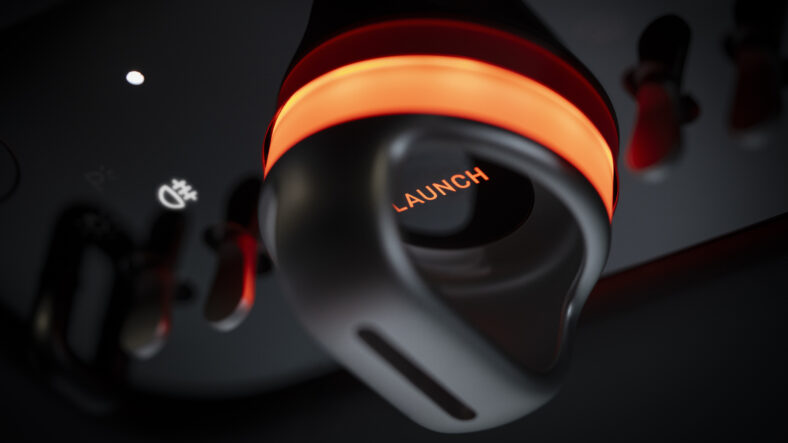
The car’s key is crafted from precision-milled Corning Gorilla Glass—an evolution of lightweight, scratch-resistant smartphone glass that’s specifically engineered for automotive application—and features an integrated E Ink display, marking the first time the low-power electronic paper technology, most famously featured in the Amazon Kindle, has been used in an automotive key. When the key is docked in the center console, it triggers a “choreographed” startup: the key shifts color from yellow to black as the dashboard and instrument binnacle illuminate. Developed with Samsung, the binnacle uses two overlapping OLED panels. Three precision cutouts in the top layer allow information from the second screen to show through, creating a 3D visual effect.
For the first time in a Ferrari range car, the instrument cluster is mounted directly to the steering column and moves in sync with the wheel. A central control panel features a ball-and-socket joint that allows the screen to tilt toward the driver or passenger. It houses a “multigraph”—a micro-engineered dial with three independent motors that can switch between a clock, chronograph, compass, and launch control. Like the key, the car’s shifter is laser-etched from Gorilla Glass. To achieve uniform graphics, Ferrari used lasers to create holes half the width of a human hair in which ink is deposited.
An arrangment of 21 loudspeakers engineered and integrated for maximum acoustic performance (ribbon tweeters, sealed-box midrange units, woofers, a subwoofer in an ultra-rigid enclosure, an ultra-flat speaker headliner for a 3D experience and sealed-box surround speakers). Processing is handled by the new proprietary Ferrari Audio Director software platform, which oversees all the vehicle’s audio streams, managing content, presets, functions, and equalisation to ensure the best experience in all driving conditions. The Luce marks the arrival of Ferrari Audio Signature—a unique EQ architecture featuring five presets (“Studio”, “Concerto”, “Immersive”, “Opera”, and “Electronic”) and a “Solo” mode to optimise the listening experience from every seat. Each car is measured individually using a proprietary, patented system that certifies its audio quality.
“With Ferrari Luce, we are once again redefining the limits of what is possible,” said John Elkann, President of Ferrari. “We are not simply unveiling a new car, we are inaugurating a chapter that turns our vision into reality, strengthening Ferrari’s tradition of anticipating and shaping the future. Such a leap forward in product innovation could only have been achieved through process innovation; this is why we chose to embark on new collaborations, such as the one with LoveFrom for the design. And, as always, our research and engineering excellence have been placed at the service of driving emotions, without compromise. Rome, the symbolic location of our first victory, becomes the starting point for a Ferrari that lights up the future and opens new horizons.”
Lest you believe that the Luce’s arrival marks the beginning of the end of Maranello’s cornerstone V12s or award-winning V8s, Ferrari promises that “electrification is just one of the means available to Ferrari to expand its design potential in product architecture, performance, design, and driving experience, without replacing existing engines.”
The Ferrari Luce will start at $640,000 when it arrives at U.S. dealers in 2027.