The U.S. Supreme Court agreed Tuesday to consider a challenge to Cook County’s ban on assault weapons, setting the stage for what could be a crucial ruling on whether there is a constitutional right to own the types of firearms that have been used in mass shootings.
It did so even though the federal appeals court in Chicago is still considering a challenge to the Illinois assault weapons ban signed into law in 2023 by Gov. JB Pritzker. A three-judge panel heard arguments about the state law nine months ago, but no ruling has surfaced.
The high court has instead picked up a challenge to Cook County’s weapons ban that dates back to 2021, before the justices started reshaping gun law through a series of landmark decisions that began in 2022 with New York State Rifle & Pistol Association v. Bruen.
The justices combined the challenge to Cook County’s law with another challenging a similar law in Connecticut. But they said they would consider the question raised in the Cook County case.
That is, “whether the Second and Fourteenth Amendments guarantee the right to possess AR-15 platform and similar semiautomic rifles?”
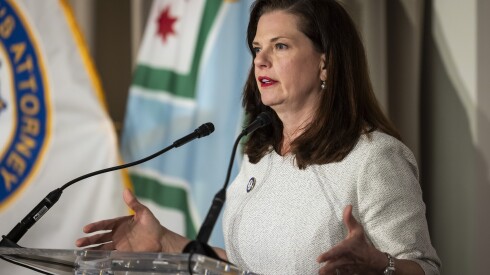
The Supreme Court will likely rule on that question in the first half of 2027. In the meantime, the job of defending Cook County’s assault weapons ban now falls to Cook County State’s Attorney Eileen O’Neill Burke.
In a statement, O’Neill Burke said, “we will not back down from defending Cook County’s long-standing ban on assault weapons.
“These weapons of war are designed to inflict the maximum amount of carnage and destruction and have no place in our communities,” O’Neill Burke said in a statement. “Countless victims have already endured the devastating impact of gun violence. We will defend this lawful ordinance before this nation’s highest court to continue protecting the people of Cook County.”
The Firearms Policy Coalition, one of the groups challenging the Cook County law, said Tuesday’s news “marks the end of the beginning” of the fight to eliminate such weapons bans.
“As we approach Independence Day — as our nation celebrates 250 years — we embrace our movement’s next challenge: securing a historic Supreme Court victory that protects the right to keep and bear arms for generations to come,” it said in a statement.
The Supreme Court has long been expected to take up a challenge to assault weapons bans, with the state law signed by Pritzker seen as a top candidate. Assistant Attorney General Harmeet Dhillon even traveled to Chicago last fall to argue against the state law.
It was inspired by the 2022 Highland Park parade shooting, which left seven dead. The gunman used an AR-15-style semiautomatic rifle.
Justice Clarence Thomas wrote in 2024 that, if the federal appeals court here “ultimately allows Illinois to ban America’s most common civilian rifle, we can — and should — review that decision once the cases reach a final judgment.”
Thomas is the author of the 2022 Bruen decision. It found that, if an individual’s conduct is covered by the Second Amendment, the government must then demonstrate that the law is “consistent with this nation’s historical tradition of firearm regulation.”
The 7th U.S. Circuit Court of Appeals oversees federal district courts in Illinois, Indiana and Wisconsin. It first heard arguments over Illinois’ weapons ban in 2023. At the time, it was considering whether to block a lower court’s preliminary injunction against the law.
A three-judge panel ruled that year that the weapons covered by Illinois’ law don’t have Second Amendment protection because they “are much more like machine guns and military-grade weaponry” than they are like other firearms used for self-defense.
The challenge to Cook County’s assault weapons ban arrived in the 7th Circuit four months later. Judges Diane Sykes, Michael Brennan and Amy St. Eve concluded their 2023 decision about the state law applied, in part because not enough evidence had been presented to overrule it.
The challengers then took their case to the Supreme Court last August.