From 1990 to 1993, Bears fans knew Jim Harbaugh was their starting quarterback. There was even greater certainty from 2009 to 2016, the Jay Cutler years. For 15 seasons in between, though, the Bears’ quarterback picture changed so often it was like staring into a carnival house of mirrors.
Over that decade and a half, the Bears had, if you can believe it, 11 different players lead them in passing yards for a season. Erik Kramer did it three times (1995, ’97, ’98); Jim Miller (2001, ’02) and Kyle Orton (2005, ’08) twice each. Also mixed in were Steve Walsh, Dave Krieg, Shane Matthews, Cade McNown, Kordell Stewart, Chad Hutchinson, Rex Grossman and Brian Griese.
As this year’s Bears — led by one of the most promising QBs in the NFL, Caleb Williams — were hard at it in training camp, five of Williams’ predecessors talked with the Sun-Times about the team’s history at the position. Kramer, 61, was in Southern California getting his latest round of youth football camps off the ground. Miller, 55, was sorting out what comes next in his broadcasting career. Orton, 43, was in the insurance business in his native Iowa. Walsh, 59, was fundraising for his high school in Minnesota, where he recently hung up the coaching whistle. And Matthews, 56, was podcasting and prepping for another season as a radio color analyst at his alma mater, Florida. Their words have been lightly edited to include key facts such as years, opponents, etc.
Who’s the best Bears QB of them all?
Miller: You’re always going to say Jim McMahon because he got a championship, right? Whether or not it was because of the defense and the running game, he was obviously a good leader and the team followed him. Probably the most talented was Jay Cutler, but he just didn’t get it done. I probably would put Caleb at three.
Orton: I guess I would preface it by saying I’m not, like, a football historian and might miss one of the really early guys, but Jim McMahon in my mind would be the best of all. The Super Bowl. I don’t know him, but he seems like he brought great leadership and a persona to the offense. He had a different kind of energy.
Walsh: You can’t argue with a ring and a championship, and that points to Jimmy Mac. Even though he was injured a lot because of the way he played, rings are hard to dispute.
Matthews: You’ve obviously got to put McMahon first. He won the Super Bowl. Rex got the Bears there as well, and Erik Kramer put up huge numbers, so you have to mention them. But probably the most talented one of all of them is Caleb Williams. He is a great thrower of the football and has great mobility.
Where will Williams end up in the pecking order?
Kramer: He’s probably the most physically talented quarterback the Bears have ever had, so he’s got that going for him. He probably has the best offensive-minded coach we’ve seen in a long time, too; I think Ben Johnson is right up there with Sean McVay for sure. There won’t even be a close second to Caleb when it’s all said and done. I think last year will be the worst year he’s had for at least the next seven or eight years.
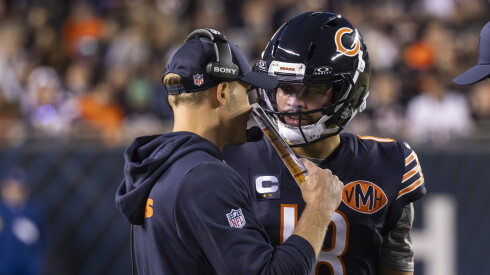
Matthews: If he stays healthy — and with Ben Johnson calling the plays — he’s got a chance to be No. 1 on the list. Ben is one of the best schemers and play-callers in the league. If Caleb is healthy and stays a Bear for a long time, he could be that franchise quarterback they’ve been looking for for a long time.
But whoever the trigger man is needs good players around him, a good football team. Different franchises have had Hall of Famers, great QBs — just look at the Packers — but I think the Bears have had a lot of QBs who weren’t stars. I was an undrafted free agent. Great quarterbacks don’t just fall off trees.
Walsh: This is a pivotal season for a lot of these young quarterbacks, not just Caleb but Jayden Daniels, C.J. Stroud, a lot of guys. They’ve all had good moments and they’re talented, athletic, but the key to long-term elite quarterback play is going to be consistency.
Can Caleb go out this year with maybe even more on his shoulders — because he’s proven he can handle it at times — and make the right decisions, make the critical play, stay healthy, handle all that? You can’t just say, ‘Oh, he’s going to be the best.’ He’s got to prove it on the field. That’s not done in one year. He had an average rookie year and spectacular comebacks in his second year. Can he back it up in his third year?
Orton: He’s got a super-high ceiling. I’d say for early on he has everything he needs — playmakers, talent, great coach, great system — to be a special player. With good things around him, who knows how good he could be?
Miller: I think he’ll be the Bears’ all-time leader in passing, I really do. He’s got a ton of skills and the ability to improvise, and he’s with a good play-caller. I think Caleb is smart enough to understand that Ben Johnson is good for him. If he pays attention, he probably will emerge as the Bears’ best QB of all time.
Why haven’t the Bears had better play and more long-term success at the position?
Orton: I’m no front-office expert, but certainly in the time I was associated there — and for a long time before and after — I would say a majority of the salary cap was used on the defensive side of the ball. If you’re not going to go get a $150 million QB, then you probably won’t have a wide receiver and a left tackle to go with it. In the NFL, kind of just follow the money.
Miller: When you go back and look at the quarterbacks drafted in the first round — McNown (1999), Grossman (2003), whoever — you’ve got to surround young QBs with weapons. You can’t expect them to just take over the team. The Bears have always been defense, the “Monsters.” Now, Caleb has kind of flipped the script. Colston Loveland, Luther Burden, Rome Odunze, Joe Thuney — these are not your grandfather’s Chicago Bears. This is an offensive team now. This is an offensive league now.
Walsh: With the Bears, it’s going back to how George Halas established the identity of the franchise. Gritty, tough defense led the way for a long time. There just was a style of play that permeated throughout the franchise that doesn’t lead to big stats from the quarterback position.
You were Bears teammates with a lot of pretty good QBs — fairly notable names — but none of them became stars or locked down the job. What was that like?
Orton: Man, very choppy. Coming out my rookie year, I started (15 games in 2005). Then, I think, the next season I was back to No. 3 on the depth chart. It was so hard to establish leadership, hard to establish consistency within that job. You never felt like you could get comfortable, for sure.
Matthews: All those guys, none of them were the superstar-type QBs you have to have at any level to win big, right? People talk about the NFL Draft, but the majority are going to be busts because they don’t turn into that superstar QB everybody’s striving to find. It was just one guy after another. It wasn’t great.
What was your best game, moment or memory as a Bear?
Walsh: The playoff game in Minnesota to beat the Vikings (35-18 on Jan. 1, 1995) after they had beaten us twice during the season — obviously a lot of things went well that day, and I played well — is high in my register of memories.
But another game earlier that year, playing Detroit in Soldier Field, our whole game plan was to keep the ball away from [Lions running back] Barry Sanders. I remember going on monster drives in that game. (The Bears had three scoring drives of at least 15 plays and possessed the ball for 44:12 in a 20-10 win.) We controlled the clock and just kept them off the field. We set out with a plan and executed it perfectly. I didn’t throw for a lot of yards, but I completed a high amount of my passes and everything just felt right. That was a good day.
Matthews: It had to be the miraculous comeback against the Browns in 2001, with the Hail Mary and winning the game in OT (27-21, after Matthews threw two touchdown passes — with an onside kick recovery sandwiched between them — in the final half-minute of regulation). And the week before that, we had the comeback against the 49ers. (Matthews came off the bench to lead the Bears from a 28-9 deficit to a 37-31 overtime win. Incredibly, safety Mike Brown ended both games with interception returns for touchdowns.)
I had my moments, but I wasn’t the prototypical QB. I was 6-3, 190, didn’t have a strong arm. I probably should have been a coach and not a player.
Orton: I played a pretty long time (10 years, with five teams), but my best memories of my career are with the Bears. I never wanted to leave that place. I loved my teammates, loved the fans, some of our comeback wins, improbable stuff because of our special teams and defense. It was the greatest locker-room environment I’ve ever been a part of, with the greatest superstar leader I’ve even been around in (Hall of Fame linebacker) Brian Urlacher.
Miller: When Tampa had their great defenses, we beat them twice in one year (27-24 and 27-3 in 2001, with Miller starting both games). For me, it was just about managing the game, managing the clock. Winning a tight affair is a big challenge because you cannot have the costly mistake that costs your team the game.
We were a good team that year, 13-3 and won the division. I still, to this day, feel like if I hadn’t gotten hurt in the playoffs against Philadelphia, we’d have made it to the Super Bowl.
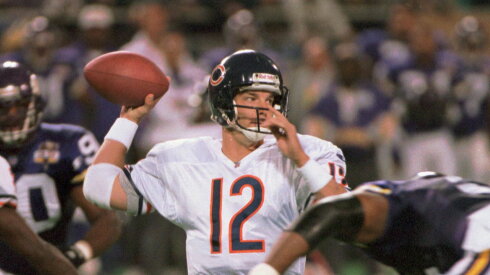
Kramer: I’ll say the most memorable, and this had nothing to do with me. We played Green Bay (in 1995) on a Monday night at Soldier Field. I think we lost (27-24). But Kevin Butler kicks an extra point, it goes through the uprights, the guy jumps out of the stands and catches it and falls on one of the security guards. He ends up on David Letterman. He should have been dead.
Here’s another. I don’t eat pizza a lot, but when I do, I like Gino’s East. I would go down to the one just off Michigan Avenue. Well, the first eight or nine years of my life, we lived in an apartment in North Hollywood (near) Riverside Drive. A few years ago, I’m driving on Riverside one day and what do I see? A Gino’s East. I go in and — you know how Gino’s East is — it’s all things Chicago. I walk out, and a guy comes running out: “Are you Erik Kramer? Come back in here!”
He has a picture of a game in 1995 when we played Philadelphia. “Would you sign this?”
Yeah, sure. How in the world?