Surrounded by a sea of sewing supplies, fabric and boxes, Michael Hall gently rolls out a slight mannequin, draped with an elegant black cape. Hall, whose job is to ready the mannequins for display, points to the garment’s bottom edge and says, “There are some splatters here.”
Those splatters, which will soon be on display inside the Chicago History Museum, represent the real and human cost of the infamous night when President Abraham Lincoln was assassinated at Ford’s Theatre and blood stained this dark velvet overcoat, reportedly worn that night by his wife, Mary Todd Lincoln.

The cape is a permanent but rarely displayed part of the museum’s vast textile collection of more than 50,000 items — essentially, the 19th-century equivalent of Jackie Kennedy’s blood-soaked pink suit. This month, it joins other Lincoln artifacts and clothing associated with the likes of George and Martha Washington and John Adams on display in a banner new exhibit at the Lincoln Park museum called “Threads of a Nation.”
The exhibition, powered by a Save America’s Treasures grant of more than $450,000, focuses on presidential clothing and the extreme measures required to preserve these delicate pieces for generations of researchers and history lovers.
Visitors can see china from the Lincoln White House, dress fragments kept by Mrs. Lincoln’s personal seamstress and a spyglass used by Washington. On view, too, are documents associated with both Washington and Lincoln.
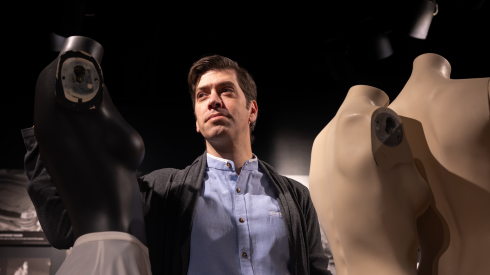
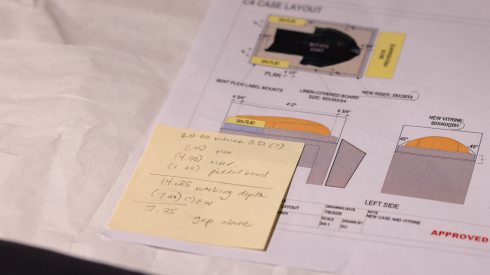
Displaying the works is a chance to commemorate the country’s 250th birthday, but the exhibit is also meant to highlight the behind-the-scenes work required to care for the fragile pieces. The museum team has ongoing investigations into the provenance of the historical items — many of which have been in the collection for decades — photographing them all thoroughly and taking precise measurements of the garments.
As Hall puts it, this is the team’s chance to extract as much information as possible before the items again enter a long stretch of dormancy.
Many of the pieces on view were acquired by the museum in 1920 from the prominent Chicago businessman Charles F. Gunther, a candy mogul, one-time alderman and enthusiastic collector, who ran a museum of his own before his death. “He had impeccable taste, and he had a lot of money,” said Jessica Pushor, collections manager at the history museum.
In the late 1800s, Gunther bought 26 Lincoln relics from Elizabeth Keckly, a formerly enslaved woman who bought her freedom through her sewing skills and eventually worked as Mrs. Lincoln’s personal seamstress. In 1920, what was then known as the Chicago Historical Society purchased those items from Gunther’s estate, marking the beginning of the museum arm of the organization.
On a rainy morning in mid-September, Hall and Pushor are in the throes of preparation, with about a month to go until the exhibit opens. As Hall puts it, this is the “hurry, hurry, hurry! Get it all done!” stretch.
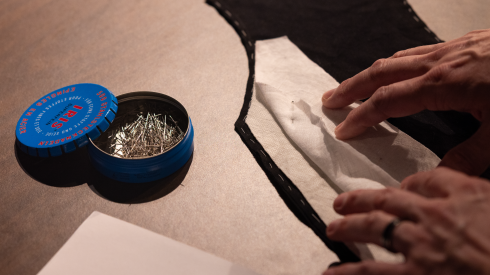
Inside a shuttered exhibition space just off the museum’s main lobby, Hall is hard at work constructing a replica of a velvet suit Washington is believed to have worn to his second inauguration.
A similar Washington reproduction, from 1958, is already mounted on a nearby mannequin. That one will be on display for the first half of the exhibit, along with Washington’s original suit coat, which, Hall says, “is maybe not in the best condition, and that’s putting it lightly.”
Then, halfway through the show, the garments will be swapped. That original coat will be traded out for the original Washington vest, and the 1950s replica will be replaced by Hall’s new version. A brown velvet John Adams suit will also be swapped out for another that belonged to the second president, in a butter-yellow color.
The many wardrobe changes in the show underscore the push-and-pull felt by the museum team: They want to show the items off, but they also know that any amount of light exposure will degrade centuries-old fibers. “That’s why you have to take them off exhibit and let them rest for a while,” Pushor said.
“Museums are trying to keep things for hundreds of years for an object that was not supposed to last that long,” Pushor added. “You’re asking an object to last for years and years longer than it was supposed to.”
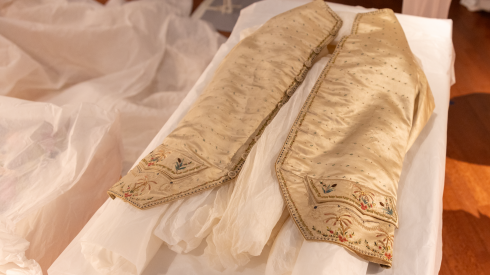
The many wardrobe changes in the show underscore the push-and-pull felt by the museum team: They want to show the items off, but they also know that any amount of light exposure will degrade centuries-old fibers. Here, is part of a suit reportedly worn by President John Adams.
Candace Dane Chambers/Sun-Times
About 10 miles south, another curatorial team is grappling with how to preserve far more recent presidential garments. The newly opened Obama Presidential Center includes a display of clothing worn by former First Lady Michelle Obama on occasions like Election Night 2008 and the 2009 inauguration. But as museum director Louise Bernard told InStyle Magazine, “We can only display these garments for 12 months before they have to rest for 10 years.”
While the Obama team has the benefit of living memory and color photographs to firmly trace the provenance of their collection (even still, well-known pieces like President Obama’s infamous tan suit have gone missing), the history museum team is often trying to solve mysteries with few clues.
That velvet Washington suit? It’s purported that the first president wore it to his second inauguration, but historians also know that Washington had a few such suits in his wardrobe and can’t say for certain this is the one he donned while being sworn in.
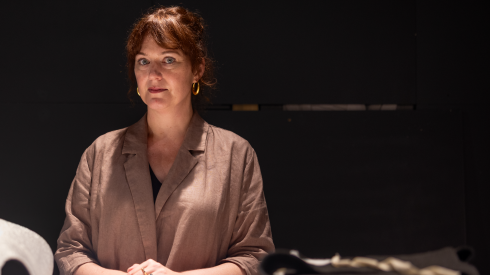
As the team, led by guest curator Olivia Mahoney (who had a long tenure at the museum before switching to a freelance career) continues its provenance research, it must also provide caveats, clearly stating what it knows for certain — and what it’s still figuring out.
Pushor — who half jokingly quips her role at the museum can be summed up as: “If you can wear it, I take care of it” — is deep in research mode. Among the museum’s vast storage, she set out to find all 26 items that Elizabeth Keckly sold to Gunther from her time in the Lincolns’ realm. (Through research, Pushor has discovered that while Keckly’s name was often spelled “Keckley,” including on the cover of her memoir, she signed her own name as “Keckly,” which the history museum has opted to use.)
Pushor’s favorite discovery came one day when she was sorting through items with Mahoney and museum conservator Julie Benner. They unrolled a dress fragment and suddenly Pushor was overcome with what she was looking at: a piece of a dress Mary Todd Lincoln had worn to a wedding in 1861.
On that evening, the First Lady had her photo taken, a rare occasion for the time. While the black-and-white image remains, the dress itself is long lost, leaving historians to wonder about the garment’s color and fabric. Research for this exhibit led to the discovery of the dress fragment, saved by Keckly, which revealed a white silk fabric with purple dots and a multicolor floral brocade.
“It’s just this full circle moment, and as a fashion historian, to know the color of the dots and everything and then, all of the information and provenance behind it, is just, to me, mind-blowing,” Pushor said.
Of course, the history museum is not the only Illinois institution interested in Lincoln artifacts. The Springfield-based Lincoln Presidential Library and Museum recently made headlines after a pair of blood-stained gloves, which were once envisioned to be part of the library’s permanent collection, resurfaced in Southern California after being sold at auction last year for $1.5 million.
The sale to a mystery buyer underscores that rare historical artifacts often have a hefty price tag and nonprofit institutions — many of which have faced financial hardships in recent years — aren’t always able to hold onto the items for the long haul. Plus, provenance research is time-consuming and expensive.
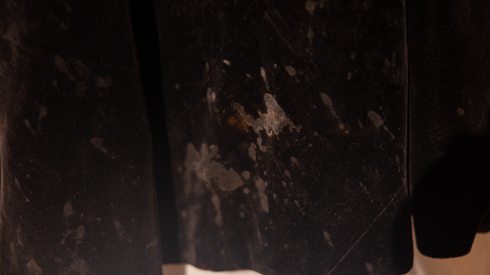
Even at the history museum, where Mrs. Lincoln’s black opera cape will soon be on view, curators can’t say definitively that those stains are President Lincoln’s blood. Being certain would require a DNA test, which would destroy a section of the garment. And right now, the museum isn’t interested in that.
Instead, the team will make careful notes of what they know for sure and what they don’t. They’ll share that with the public and invite them to make their own decisions, hoping that the chance to see these garments up close brings history to life for the viewers.
“When it comes to clothes or garments or textiles, these are things that are the closest you’ll ever get to a person. So the sweat stains, oh yeah, that was their sweat that they put on it,” Hall said. “I think that’s the importance of saving textiles; it allows us to glom onto what this person used to be like. It makes them more real.”
Courtney Kueppers is an arts and culture reporter at WBEZ.