Curious City recently answered a question about two separate small planes that made emergency landings on Chicago’s scenic lakefront expressway.
As it turns out, DuSable Lake Shore Drive has served as an intentional runway too.
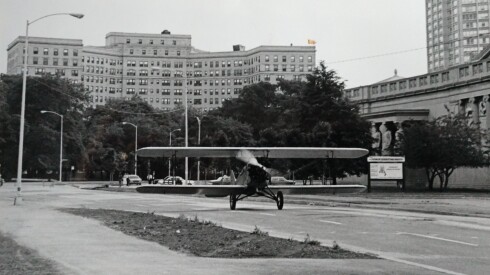
On July 14, 1983, four vintage airplanes landed on Lake Shore Drive on a (slightly curvy) straightaway near Jackson Park between 59th and 63rd streets. The pilots received a police escort as they taxied to their destination. And that wasn’t even the only time this happened.
For a professional pilot, landing on a strip of concrete is no big deal. But for a city to turn a popular thoroughfare into a runway? That would require a big ask from a local institution and an assist from the mayor, making this story about as Chicago as they come.
The event was spearheaded by E. E. “Buck” Hilbert, a captain for United Airlines and an antique aircraft expert, at the request of the Museum of Science and Industry for its 50th anniversary in 1983.
The museum is known for telling the history of transportation and for bringing in large transportation artifacts, according to head curator Voula Saridakis.
“As part of this birthday bash, the museum wanted to bring in these vintage airplanes that in many ways complemented the ones that we already had here,” Saridakis said.

In 1976, Buck Hilbert restored a single-engine Swallow airmail plane and toured it around the world for United’s 50th anniversary. He also owned other vintage aircraft, including a 1933 Aeronca C-3 and a 1943 Stinson L-5 Sentinel reportedly used by Gen. George Patton in World War II.
Hilbert was the perfect person to field the MSI’s request, but one big question remained: How would he get these planes to the museum?
“The initial thought was to fly into the Meigs airport, which was open at the time,” said Earl “Chip” Wilson of Rockford, Illinois, who was one of the pilots who would help Buck in his effort.
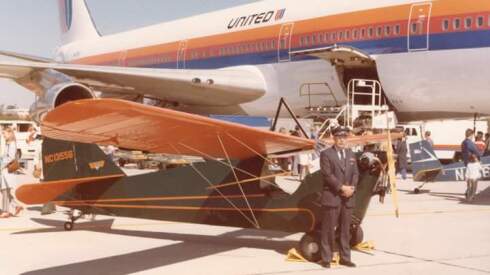
Wilson, Buck Hilbert and two other pilots planned to load the planes onto flatbed trucks and drive them from Meigs Field to the museum, but a bevy of obstacles along the route changed their minds.
“My father was not willing — or did not want — to disassemble the airplanes, bring them down and reassemble them,” said Lee Hilbert, son of Buck Hilbert. “That’s a difficult process, especially with a biplane.”
That’s when the idea of landing on the drive took serious shape, according to Lee Hilbert and Wilson. Buck Hilbert pitched the idea of landing on Lake Shore Drive to the MSI and the MSI asked for permission from the Chicago Police Department.

“The police department says, ‘No freaking way are we going to do that,’” Wilson recalled. “Close down Lake Shore Drive so airplanes can land? No way.”
Buck Hilbert was not the kind of guy who would take no for an answer, Lee Hilbert said. His father “pulled some strings,” got ahold of the right phone number at City Hall and placed a call with then-Chicago Mayor Harold Washington.
Washington apparently loved the idea.
“According to my father, he said, ‘This sounds like fun. This sounds like a great idea. Let’s do it,’” Lee Hilbert said.
Harold Washington died in 1987 and Buck Hilbert died in 2016. Curious City could not independently confirm if this was exactly how the deal to land on Lake Shore Drive was struck. The Griffin MSI did not have a record of these pre-landing machinations.

“It does sound like something he might do,” said David Orr, one of Washington’s key allies. He did not remember this particular event but added of Washington: “He was willing to swim upstream, no doubt about that.”
On July 14, 1983, four vintage airplanes took off from Meigs Field at dawn. The pilots were Hilbert in the Swallow, Wilson in the Aeronca C-3, Don Toeppen in the Stinson L-5 and local businessman Steve Detch in his 1942 Stearman PT-17, according to a United Airlines internal newsline.
One by one, they landed on Lake Shore Drive on a straightaway next to Jackson Park. Chicago police escorted the planes as they taxied north to 57th Street and onto the lawn at the Museum of Science and Industry, where they remained all weekend for the museum’s birthday party. Four days later, local officials briefly closed the drive again so the planes could take off.
“I mean, I feel kind of special,” Wilson said of the opportunity to land a plane on Lake Shore Drive. “Truly one of the highlights of my life. And the fact that Buck trusted me enough to do it was truly awesome.”

MSI officials must have loved this stunt, because they pulled it off again four years later.
On Oct. 9, 1987 — a few months into Mayor Washington’s second term — four more vintage airplanes with four new pilots landed in the same spot on Lake Shore Drive and again took off a few days later. This time, the planes were brought in to promote a film called “Flyers” at the museum’s new Omnimax Theater.
The pilots were siblings Dave, Phil and Susan Dacy of Harvard, Illinois, and Tim Nealey of suburban Downers Grove. The biplanes were a Super Stearman, a Bücker Jungmeister, a stock version of a German biplane and a Pitts Special, according to Phil Dacy.
That means the Griffin MSI is responsible for closing Lake Shore Drive and turning it into a runway at least twice.
“While there are no current plans to land airplanes on Lake Shore Drive, that doesn’t rule out the possibility of doing it in the future,” Saridakis said.

The section of the Drive where these planes landed looks different today. In the 1980s, only a single column of streetlamps lined the east side of the road. Today, streetlamps hug both shoulders, while a concrete median runs between them.
Every pilot we spoke with said the days of Lake Shore Drive serving as a planned runway are likely over.
“If you can drive a car on it, I can probably land an airplane on it,” Wilson said. “[But] telephone poles and those hanging-over pole lights, that would be a problem.”
Justin Bull is a producer for Curious City.