Chicago Sun-Times photojournalist Anthony Vazquez covered many confrontations during the federal government’s Operation Midway Blitz after the immigration deportation campaign began in early September. In October, he spoke in an interview with WBEZ’s Melba Lara about his work. The following is an excerpt, which is edited for length and clarity.
WBEZ: You actually have a military background. Can you tell us about that and how you became a photojournalist?
Vazquez: I was in the Marine Corps for four years from 2010 to 2014. I joined because I wasn’t sure what I was gonna major in or anything.
During my time in the Marine Corps is when I sought out journalism, because I had an experience that people need to know about — this situation that’s going on in Afghanistan.
I thought maybe I can pursue journalism after I’m done with my four years here, because it’s important to have journalists talk about things that are going on in our world.
You were in the East Side where protesters and Chicago police officers were tear-gassed by federal agents after a car chase and a collision. Will you walk us through what you saw through the eyes of a photographer?
Yeah, I should start prior to even getting there. So like, right now, I’m wearing a long-sleeve button-up shirt, and I’m wearing it because what if I need to take it off, put on a vest quick and then cover it? And then I’m wearing glasses, because I can’t wear contacts because of tear gas. So it’s like I’m kind of changing my day-to-day just based on what might happen.
On that day in particular, I had everything I needed just in case, and then I got the call that there was something going on in the East Side. When I got there, I was taking photos, walking around, checking out the scene for about 10 minutes.
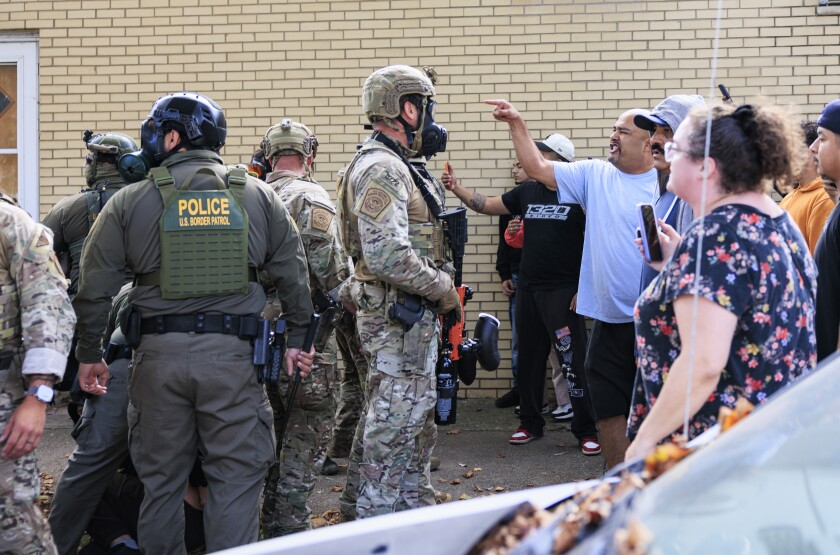
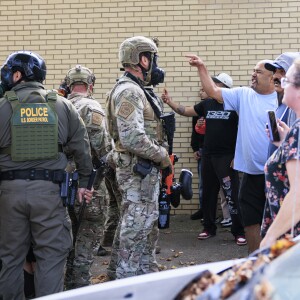
And there’s just protesters on the block surrounding federal agents as they were investigating the scene of the crash. And then something just set it off, I don’t know exactly.
It’s either someone threw something or something else, but something set it off. And then you had a federal agent chasing into the crowd of protesters to catch this individual. And so I took chase after the federal agent to see what was going on and what was gonna happen.
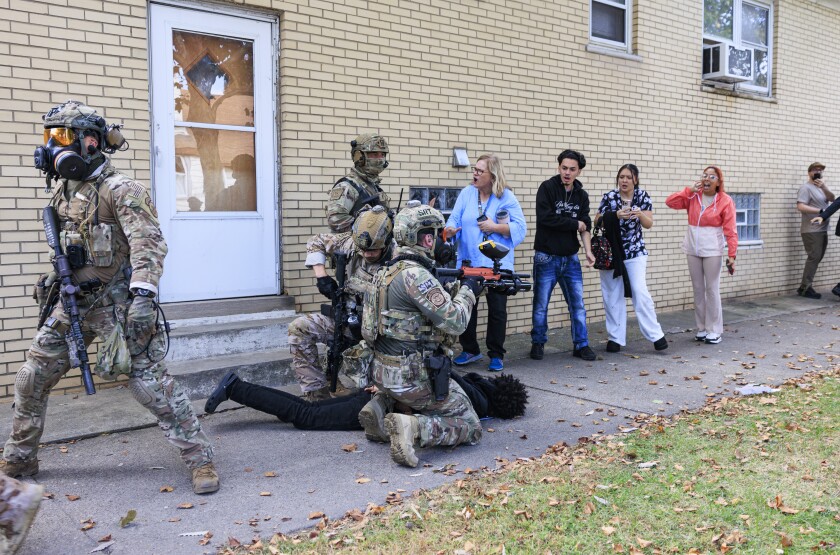
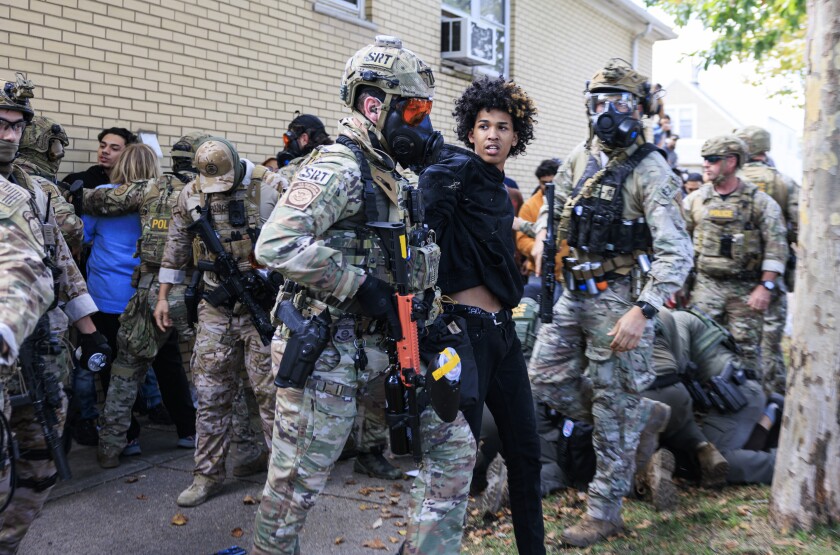
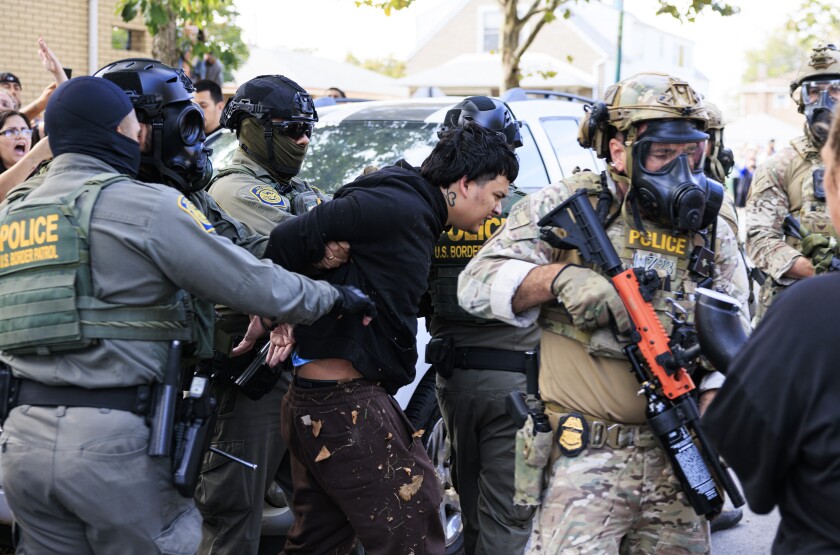
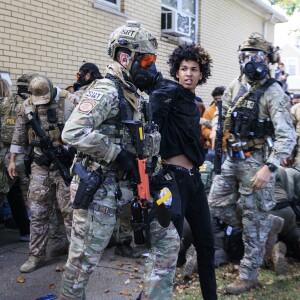
Then it became apparent that they were chasing this one individual down the sidewalk. And then the agent caught up to him, and then other agents came up as well. And they just tackled and held this protester, which we now know is a 15-year-old child, to the ground.
While they were holding him down, other protesters also were trying to pull them off, off the young child, trying to free him. There was some back-and-forth between other federal agents and the protesters.

|
Anthony Vazquez/Sun-Times

|
Anthony Vazquez/Sun-Times
|
Anthony Vazquez/Sun-Times
|
Anthony Vazquez/Sun-Times
|
Anthony Vazquez/Sun-Times

|
Anthony Vazquez/Sun-Times
|
Anthony Vazquez/Sun-Times
|
Anthony Vazquez/Sun-Times

|
Anthony Vazquez/Sun-Times

|
Anthony Vazquez/Sun-Times

|
Anthony Vazquez/Sun-Times

|
Anthony Vazquez/Sun-Times






Let’s talk about one of the pictures that you took that day, which shows a man surrounded by federal immigration agents. He’s got his hands up, but there’s a crowd-control weapon pointed directly at him by those agents. How did you capture that moment?
It goes back to when they were holding down that 15-year-old kid, and others were trying to come and push federal agents off the kid. One of the protesters who came back, came over, almost made it there, but then federal agents held him back and he was trying to fight his way back to get to this 15-year-old.
That’s when the other federal agent raised up his weapon and pointed it at him. And then that’s when he put up his hands to have him not shoot him. During that whole moment, I was photographing both what was going on to my left, which is the detainment of the 15-year-old, but also watching, keeping an eye on what was going on to my right, which is what was going on between that federal agent and that other protester.
I was just going back and forth, taking photos of the situation because I didn’t know which one was gonna escalate, right? I didn’t know if that agent was gonna shoot that other protester, right? Because when you see that weapon up, it’s a split-second decision whether or not he decides to pull the trigger. So [I’m] just keeping my eye on it and just photographing the whole time prior, during and after and just following them until they took him back to the containment area.
Your recent photos have just been going viral everywhere. They’ve been cited by Gov. JB Pritzker and a federal judge who’s been questioning ICE’s aggressive tactics. But this is not the first time that we’ve seen your work documenting what’s happening right now in the Chicago area. You also took pictures in Brighton Park and Broadview outside the Immigration and Customs Enforcement facility. What feels different this moment in your time as a photographer?
Just being able to capture the moment. There’s been a lot of talk about the aggressive tactics that ICE agents were using against protesters. In the past, as photographers and journalists, we’ve been standing in the periphery because we’ve been a little bit afraid of getting too close to what’s actually happening. And now, just being in a neighborhood, being so up close and up-front with the interactions between the agents and protesters, and then capturing this moment of protesters being defenseless, I think hits more for people when they see that — where they see a 15-year-old boy kind of pinned down to the ground and then others with their hands up.
Seeing it up close is different. Like seeing kind of the fear in the protesters’ eyes is different.
How do you stay safe in the midst of kind of chaotic events while you’re still trying to do your job?
Situational awareness goes a long way. You just have to be hypervigilant and keep your eyes on both sides. Things can go pretty bad pretty quickly. You have to be ready to either decide to stay or run for your own safety.
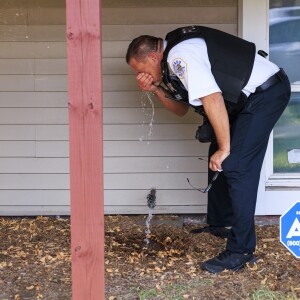
And then also having the proper PPE. Wearing a gas mask and helmet helps a lot. The tear gas that they throw really disables an individual. You can’t see, your eyes burn, you can’t breathe. You might get hit by a rubber bullet pellet or pepper ball — just understanding that risk and doing what you can to mitigate it.
Click the Listen button above to hear WBEZ’s Melba Lara interview Chicago Sun-Times photojournalist Anthony Vazquez about his work capturing “Operation Midway Blitz” around Chicago this fall.