With a new year on the horizon, Dry January has matured beyond its origin as a monthlong wellness challenge and seeped across the rest of the calendar for many former drinkers or the sober-curious turned serious. Gone are the days when non-alcoholic drinks at a bar or restaurant amounted to a defiantly uncool O’Douls, tonic with lime or Diet Coke. Now, the options for nondrinkers are positively booming.
“We’re in the golden age of beverage production,” said Ed Marszewski, the food entrepreneur behind Maria’s Packaged Goods, Kimski and Marz Community Brewing Company, a microbrewery in McKinley Park. “Everything’s exploded. You can get every single sort of drink you could ever imagine in a bottle or can. We’re just part of that movement. We love beer, but we also decided that we could make all kinds of beverages with our system.”
U.S. alcohol consumption is at its lowest point in 90 years, according to a mid-2024 Gallup survey, fueling a growing market for more interesting and tastier alcohol-free options. Non-alcoholic drinks now fall into six categories: alcohol-free beer and wine, spirit alternatives, ready-to-drink mocktails, adaptogenic beverages (mushroom coffee is one of these), and hemp-derived THC and CBD drinks.

To keep pace with demand, Marz now offers kombucha, seltzers, a Korean barley tea drink, cold brew coffee, and yerba mate. Marszewski credits this change in his business model for keeping his staff of 35 people employed full-time. “A significant amount of what we produce at Marz Community Brewing is the NA stuff,” he said. “For a brewery of our size, that shift has allowed us to continue having a business.”
The Gallup survey also revealed that adults under 30 are opting for cannabis instead of alcohol. When the 2018 Farm Bill removed hemp from the list of federally controlled substances and legalized its production as an agricultural commodity, Marszewski saw an opportunity to manufacture CBD beverages. Though he declined to share specifics, he says his hemp-derived products “amounts to 50% of Marz Brewing’s total business and sales are in the millions.”
(In November, Trump’s federal spending bill closed the 2018 hemp loophole. Said Marszewski about the impact: “I’m pro-regulation but the hemp industry killer bill will end a lot of businesses and put hundreds of thousands of people out of work.”)
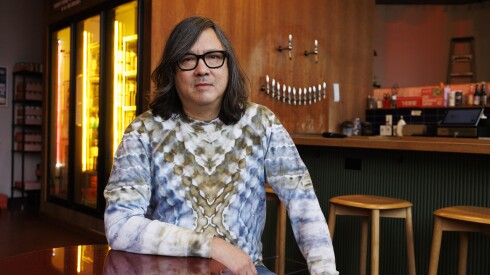
For Marszewski, the motivation goes beyond trends and revenue.
“We want to make sure all of our drinks taste good, and that’s what the majority of the whole NA thing is about,” he said. “If you make a killer cocktail why does it matter if it has alcohol or not in it? It should just taste good. Restaurants are just expanding on what they do best, which is to create great flavor profiles.”
Combating sticker shock
And that’s where thoughtful sommeliers and mixologists like Nathan Ducker, the sommelier and general manager at Feld, have found a lane.
More diners are opting for alcohol-free drinks when eating out, he says. But at $12-$18 per cocktail, sticker shock is common. “The average bottle cost for the NA pairing is perhaps surprisingly close to that of the wine pairing,” Ducker said. “NA is actually not that different from a wine. It’s certainly not an afterthought, or any less of a creative statement.”
Feld, in Ukrainian Village, recently earned its first Michelin star only 13 months after opening. The fine-dining hotspot offers one of the city’s most ambitious — and most expensive — non-alcoholic pairings. The $110 spirit-free pairing signals how far the category has come, but it still faces skepticism from guests.
“Almost everyone who shows interest is hesitant because they’ve been burned before,” Ducker said. “We have to verbally hold their hand and say ‘trust me, I understand there’s a lot of disappointing examples out there. Don’t worry. We’re not going to do that tonight.’”
Ducker operates under two strict rules: He will never add a beverage to his menu that has had alcohol removed, and there are no drinks meant to mimic the flavor of wine or other spirits.
“De-alcoholized wine will never reach the potential of an intentionally made NA beverage,” he said. “If you remove alcohol, you lose a core structural element and you’re left with a ghost instead of something designed to stand on its own.”
Instead, Ducker buys and serves bottled NA beverages just as he would wine. One maker is Muri, based in Denmark and started by an alum of Noma, the Scandinavian fine dining mecca. Another, Villbrygg from Norway, specializes in the use of botanical ingredients like meadowsweet, fireweed, birch and yarrow.
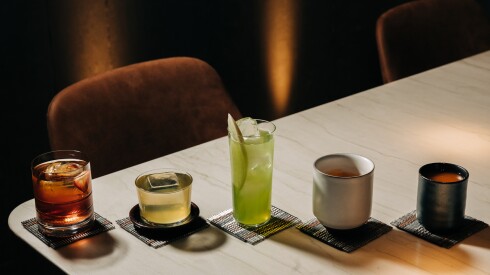
This desire to take spirit-free drinking seriously is shared by Kevin Beary. Beary leads beverage programs across major Lettuce Entertain You restaurants, including the just-opened Crying Tiger; Gus’ Sip & Dip and Three Dots and a Dash. Widely considered a national cocktail authority, Beary says his most difficult project to date was the spirit-free beverage pairing at The Omakase Room, which took three months to develop.
For an additional $65, guests are served a progression of five, tea-based cocktails. A melon oolong with notes of pandan is served chilled, while a gingerbread rooibos with five spice arrives hot. Beary sees the program as an extension of his broader approach to crafting any kind of beverage regardless of alcohol content. Still, there’s reality to contend with.
“No matter how you frame it, they just don’t sell as much,” Beary said. “That’s why a lot of bars can’t justify the labor put into putting six spirit-free drinks on the menu. They won’t move enough volume. Most places default to ready-to-drink stuff, or buy de-alcoholized spirits, or alcohol-free replacements.”
Same attention to detail

Christina Chae, the co-owner of Moonflower in Portage Park and Golden Years in West Town, is among the cadre of bartenders working to meet the upward tick of spirit-free imbibing with the same attention to detail that regular alcohol drinkers receive.
“The chaotic, fun, high energy pace of a bar is why people come,” Chae said. “Bartenders are putting a lot more effort into making an NA cocktail now more so than before. And people understand why this is $12 bucks or more, even though there’s no alcohol in it. Because you’re still part of the fun and the experience.”
Her No Means No cocktail is made with grapefruit, a Giffard Aperitif syrup and coconut cream for a silky finish. The same aperitif is used in a sweet and bubbly NA Spritz that offsets bitter notes with strawberries and a jigger of St. Agrestis’ Phony Negroni, a pre-mixed, bottled mocktail. Each comes in at an affordable $10.
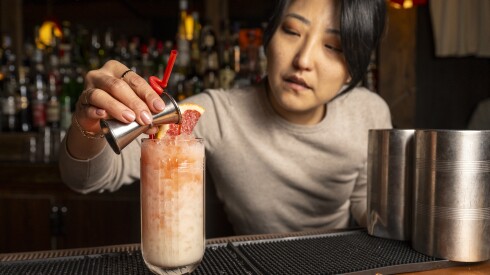
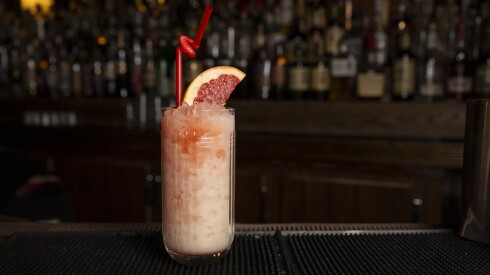
The No Means No non-alcoholic cocktail served at Golden Years is made with grapefruit, a Giffard Aperitif syrup and coconut cream.
Tyler Pasciak LaRiviere/Sun-Times
Sandra Rivera chose to eliminate alcohol six months ago. “People find out and ask ‘What’s wrong? Are you okay? What happened?’ The answer is ‘nothing.’ I’m just trying something new,” said the 38-year-old Norwood Park resident. “I love the feeling of going out and knowing the next day I’m going to be fully functional and have a great day because I’m not going to be hungover.” She says she has no plans to reintroduce alcohol back into her life and is enjoying exploring all the NA options available.
Rudy Valenta, also 38, says in the past he would order multiple booze-infused drinks while out with friends. Today, although he still drinks alcohol, Valenta says he often goes for an alcohol-free Heineken or a mocktail. “It took me a really long time to understand the approach to spirit-free drinks is different from alcohol,” he said. “You’re not ordering to keep up with the person who’s drinking alcohol. It’s the cost of being out, supporting the business you’re at, having fun and socializing with friends.”