Evergreen Real Estate Group CEO Steve Rappin was one of many executives who had their eye on President Donald Trump’s trade war when it ramped up at the start of 2025.
The import tariffs had Chicago’s real estate industry bracing for impact, with concerns largely around higher supply costs. Taxes on some materials — like steel, a mainstay in construction projects — rose from 25% in March 2025 to 50% in June, though certain countries received a reprieve from the higher rate.
Rappin said the trade war hasn’t been as big of an issue as the West Loop-based commercial real estate firm anticipated. In fact, most of the biggest risks it anticipated last year, like tariffs, ended up being navigable, despite market volatility.
“We’ve been really vigilant,” Rappin said. “Everybody — all the subcontractors, all of the [general contractors] — are on hyper alert, but we really did not see a significant impact. … We’re a little bit more conservative when we underwrite our projects. So, for us, it really hasn’t been a big deal.”
Rappin viewed 2025 as the year of “Evergreen 3.0” — the next iteration of the company’s 10-year plan to strengthen its business.
Evergreen was founded in 2001 with a focus on property management. But over the past 10 years, it has widened its scope to include development and construction. And its residential projects — typically reaching about 20 or more annually — are often turned over to its property management division.
Rappin said a focus on diversification is partly how the firm remains nimble, despite economic hurdles.
“When one thing is going down or is facing an issue, if you have a couple of other fingers in other pots, you’re going to be able to have a better balanced economic strategy for the long run,” he said. “Diversification is definitely a lesson that I knew before but has really been more synthesized coming out the past year.”
Evergreen employs nearly 580 people across at least 13 states and Washington, D.C., though most are based in Illinois.
Part of the firm’s diversification efforts last year included expanding into new markets — like Colorado. Evergreen’s satellite office in Denver is where most of its deals are, Rappin said. The firm is now eyeing some projects in rural locations, too.
“It’s a very competitive state,” Rappin said of Colorado. “Our lead developer out there is looking at expanding to other states out West. It could be Oregon; it could be Utah; it could be Arizona.”
The firm is set to complete 20 deals this year, and development projects in new markets are largely to thank.
At the start of last year, Rappin said it’s become more difficult for Evergreen to do projects in Chicago because of limited resources and funding opportunities. Much of Evergreen’s work is in affordable housing, which often requires a combination of tax credits, tax increment financing, grants and other funding sources to get projects off the ground.
But Evergreen saw the completion of several Chicago projects last year, including the 89-unit Encuentro Square affordable housing building in Logan Square and the two-building Auburn Gresham Apartments.
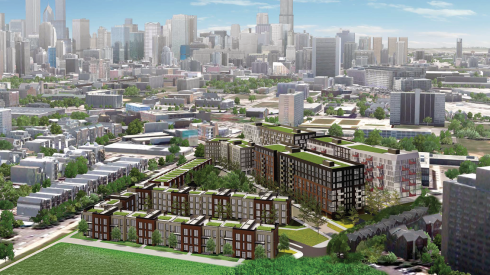
It was also selected, alongside partner KLEO Enterprises, to build housing on 7 acres near the old Cabrini-Green public housing complex, several months after financial pressures forced the original developers to back out.
“We’ve found through partnerships with the [Chicago Housing Authority], the city of Chicago, with [Illinois Housing Development Authority], the ability to use creative financing to really produce new housing,” Rappin said. “Cabrini is a big project for us but those are long projects. There’s a lot of work to do with the CHA, with the city, to get aligned to what the plan would be, what the financing would be. But anytime you have the chance to do something with the scale of 530 [units], it’s amazing.”
While labor and tariff concerns never materialized for Evergreen, Rappin said the firm has kept a close eye on interest rates.
He believes Evergreen’s expansion in naturally occurring affordable housing, or unsubsidized housing that’s affordable because of market conditions, along with conservative financial projections helped it power through 2025.
“Affordable housing, for better or for worse, is very reliant on public policy and that public policy can shift,” Rappin said. “There were some positive things that happened [last] year and some negative things. For us to diversify outside of policy-based housing, … I think that’s really important to us.”