An ex-employee of the DuSable Black History Museum and Education Center has filed a lawsuit against the institution and its president and CEO, Perri Irmer, alleging misuse of public funds, harassment and retaliation.
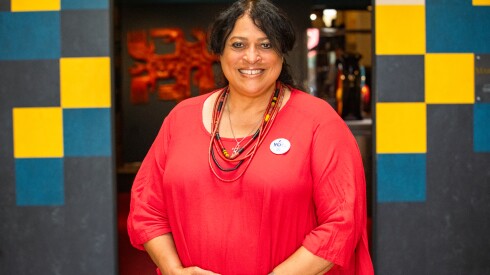
The lawsuit is the latest in an ongoing whistleblower campaign by Kim Dulaney, a retired Chicago State University professor who joined the South Side museum in 2021 as director of education and programs. She later became the vice president of the same department.
Dulaney alleges in her suit, filed Monday in Cook County Circuit Court, that she was retaliated against after “questioning DuSable’s irregular fiscal practices.” Dulaney claims in the suit that she was excluded from meetings, harassed and ultimately terminated in October. The lawsuit brings the claims forward under the Illinois Whistleblower Act.
Dulaney also filed formal complaints after her termination with the Chicago Park District, Chicago Mayor Brandon Johnson’s office, Gov. JB Pritzker’s office, the Illinois attorney general’s office, the Chicago Office of the Inspector General and the office of 20th Ward Ald. Jeanette Taylor.
DuSable is a not-for-profit museum that receives funding from the city of Chicago and a park district tax levy. Other funders include the MacArthur Foundation, the Institute of Museum and Library Services and private donors.

In her lawsuit, the bulk of Dulaney’s complaints stem from what she calls a “misuse of funds” and concerns about “budget transparency.”
She alleges in the suit and in an interview with the Chicago Sun-Times that funds meant for the education department — which created virtual programs, steered the museum’s Juneteenth celebration and created the institution’s first children’s exhibit — were diverted to other areas without her approval or knowledge.
The lawsuit also states that she was asked to “falsify reporting” on grants by Irmer and board member Wendy Williams and that she refused.
Irmer, who holds a law degree from the University of Chicago, has been the president and CEO of DuSable since 2015.
Reached directly, Irmer directed questions to a spokesperson for the DuSable Museum, who asked a reporter to submit questions in writing. As of publication time, no response had been received. Williams could not be reached.
A spokeswoman for the park district, which is the museum’s landlord, said in a statement that it forwarded Dulaney’s complaint to its Office of Inspector General and declined to provide further comment until a review is completed.
“We expect that our cultural partners will abide by all applicable laws and best practices,” the park district’s statement read.
Terminated due to ‘restructuring’
According to the lawsuit and an interview, Dulaney was terminated from her position by DuSable’s legal counsel, Cecil Lucy, and the human resources representative, Detrice Ward, during a meeting on Oct. 3.
Lucy told Dulaney then that her position was being eliminated, and it was justified due to the company’s restructuring. Dulaney said in an interview that she was offered a $17,500 severance package, which she refused to accept.
Dulaney is seeking reinstatement to her role at the museum, along with back pay, attorney’s fees and a $10,000 civil penalty under the Illinois Whistleblower Act.
“I have tried for the past couple of years to handle my complaints internally, first,” Dulaney told the Sun-Times. She said she first voiced her concerns with Irmer in a one-on-one conversation, but soon found herself being isolated after filing grievances with the museum’s Board of Trustees in 2022.
In one exchange detailed in the lawsuit, Williams allegedly asked Dulaney to falsify information in a report back to the University of Chicago about funds donated for this past year’s Juneteenth celebration. The funds were intended to be used for children’s programming that day, the suit states.
DuSable’s department received $5,000 from the University of Chicago, but Dulaney only used $600 to $700 of the funds for the Juneteenth children’s programming, the lawsuit states. Dulaney pressed Irmer and Williams to return the unused money to the University of Chicago, according to emails attached in the lawsuit. Dulaney said in an interview she does not know where the remaining funds went, and the suit does not specify.

Williams told Dulaney to “be creative” in her report, and Irmer refused to return any funds, telling Dulaney, according to a copy of an email in the suit, “[I]f you are unable or unwilling to provide the information requested, then others will. You can consider the request to you closed.”
In the lawsuit, Dulaney described Irmer entering her office and “shouting and cursing” and “repeatedly slamming both hands” on Dulaney’s desk over a series of issues. The alleged verbal assault took place within earshot of staff and visitors to the museum, the lawsuit states.
“I really need to state clearly that I do not feel safety [sic] under the leadership of Ms. Irmer,” Dulaney wrote in a March 2024 email to Ward and the vice chair of the museum’s board, Patricia Knazze, according to the suit and a copy of the email provided to the Sun-Times by Dulaney’s lawyer, Justin DeLuca.
Sharing spaces with Irmer caused Dulaney “extreme anxiety,” along with “headaches, stomach discomfort and shortness of breath,” according to another email addressed to Ward and Knazze.
Dulaney said in an interview that she lodged complaints with other members of DuSable’s board of trustees, including the late board chair Patrick McGhee. His role was ultimately filled by Carol Moseley Braun, the first Black woman elected to the U.S. Senate.
Dulaney reached out directly to Braun to get an update on her grievance, to which the board chair replied that Dulaney was “entirely out of order,” according to an email included in the lawsuit.
Other legal issues
As first reported by local Black-owned publications The Triibe and The Crusader, the DuSable Museum has experienced other legal and financial problems.
A Chicago company, Atlas BPS Inc., sued the museum in June, alleging breach of contract. Atlas had provided management, security and janitorial services to the museum starting in 2018. But beginning in March 2024, DuSable failed to pay for Atlas’ services, according to the suit.

Paul Dejoie, owner and operator of Atlas, told a reporter that he’s waited more than a year to receive a payment of $52,841.45 from DuSable for services rendered — and still has not seen the money.
Dejoie said he struggled to make payroll as a result of the breach and had to borrow money from his ex-wife to keep his company afloat.
A former museum staffer also filed a suit in 2018, alleging that she was terminated the year prior after raising concerns with how the museum used grant money, according to the court filing. That suit was settled out of court.
Taylor, whose ward encompasses the DuSable Museum, told the Sun-Times that the issues at the institution predate Dulaney’s complaint — and she wishes Dulaney had spoken up publicly long before she was fired.
She acknowledged that there is no formal path for holding private institutions accountable, such as the DuSable Museum, even if it receives public funding, because it is not publicly governed.
“The city of Chicago has no bearing over the museums,” Taylor said. “There is nobody to report them to. … The museum has been struggling. It needs some support, but it also needs to have some accountability measures.”
Taylor added that the DuSable Museum has been underfunded for decades, especially in comparison to other museums across the city.
The “Blackness of that museum” hasn’t been respected for a long time, she said. “Let’s call it what it is. It’s racist as hell.
“This is the only space that we’re able to protect that documents our history and what it was, and how we did start from slavery. That’s just a part of the conversation. This is a place I used to go to as a kid on field trips, so it’s very disheartening.”
The museum was finally accredited by the American Alliance of Museums in 2021 after 60 years of cementing itself as an important part of Black Chicago and U.S. history. DuSable Museum is also a Smithsonian affiliate.
In November, the museum at 740 E. 56th Place opened its “Paris in Black: Internationalism and the Black Renaissance” exhibition. The collection is set to run through early 2027, featuring work from Black American artists who lived abroad from 1890 onward, and includes iconic pieces and artifacts from Langston Hughes, Josephine Baker and James Baldwin.
Correction: A previous version of the story incorrectly stated that the DuSable Museum is accredited with the American Alliance of Museums. It is not.