Tyrek Gates had hit his lowest point.
As an 18-year-old student at Alabama A&M University he was too focused on making money, he says. He didn’t want to burden his mom back home in Chicago, who had his younger siblings to raise, by asking for help paying for food and other daily expenses.
Instead he worked security at every campus athletic event and step show. But eventually that got in the way of class and studying and Gates’ GPA dropped below 2.0. After working so hard to get to college, he flunked out his sophomore year.
“Having to basically start over — that was definitely one of the most depressing times of my life,” Gates said.
Gates packed up his belongings and boarded a Greyhound bus for the 10-hour-plus ride back to the Austin neighborhood on Chicago’s West Side. He moved in with his family and worked fast food and security gigs. But he never stopped thinking about re-enrolling in school.
“My mom and my dad don’t have a college degree and I wanted to be a great example for my siblings and my future children,” the now 25-year-old said. “[I can’t] push down their throat, ‘Go to school, go to school, go to school, get your degree,’ and I don’t have mine.”
But Gates worried he couldn’t afford to take out more student loans; he was already in debt from his first attempt at college.
That’s when his mentor and pastor Charles Brown stepped in. Gates’ family joined Brown’s storefront church in Austin about 15 years ago, when Gates was a kid. Since then, he says, Brown has become a father figure to him.
“He always saw greatness in me, even when I didn’t always see it in myself,” Gates said.
Brown reminded Gates that his value was not defined by a single decision or change in plans. Sometimes, Brown told him, the bravest move is “picking up where you left with clearer eyes, greater focus and a stronger sense of self.”
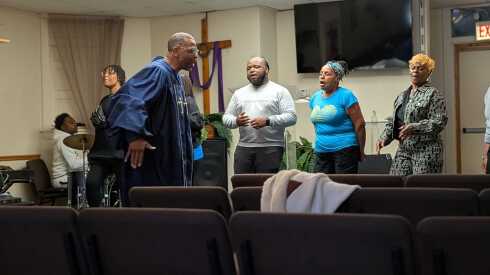
Then, Brown gave a sermon that lit a fire.
“He was talking to everybody, but he was talking to me,” Gates recalled. “He said, ‘Don’t waste your youth.’ And that stuck with me.”
Austin leaders see higher education as a way for young Black men there to lift up themselves and their neighborhood. But students like Gates and Brown confront some of the most formidable challenges of any student group on their path to college graduation.
In Austin, where the two men grew up and live, just 1 out of 4 Black men who go to college graduate within six years, according to data from the University of Chicago To&Through Project. That rate has not budged for a decade and is slightly below the citywide rate for Black men. The racial disparity is stark: Nearly 3 in 4 white men in Chicago finish their degrees in that time.
Across the country, Black men are the least likely student group to finish college.
A lot stands in their way. Black students are three times more likely than their white peers to go to school in a chronically underfunded K-12 district, and Black boys in particular face lower academic expectations from white teachers, who make up a majority of the education workforce. This can damage their self-esteem and undermine their preparation for college.
Their families also have a harder time paying for college because they hold a fraction of the household wealth of white families. The median Black family has under $28,000 in assets, while white families have more than $250,000, according to national figures from the Pew Research Center.
Those who don’t graduate miss out on the higher wages and better jobs that come with a college degree, and are less likely to be engaged in their community through activities like voting and volunteering. Yet they still owe student debt for the classes they did take and often struggle to cover their monthly loan payments.
Austin residents who have made it to college graduation, like Brown, say mentorship can help disrupt the cycle. He has seen firsthand how guidance from someone who understands their experience can help Black men overcome the perception that they do not belong in college — and connect them with the resources they need to make it to graduation.
“Young black males … want better but they don’t know how to achieve that, or don’t know what better looks like because you don’t know if you haven’t been exposed,” Brown says. “With a little guidance, a little patience, they can do some great things and they need that voice to let them know: ‘You can make it.’”
Gaining ‘mentor status’
Brown, now 56, barely made it himself.
He grew up in Austin, one of the most populous and racially segregated neighborhoods in the city. It’s been subject to disinvestment for decades, and families there earn almost half as much as they do across the city.
Brown was the first in his family to attend college. He juggled his studies at Wright College on Chicago’s Northwest Side with full-time work and raising his young son. It’s a common struggle: Nationally, Black students are twice as likely as their classmates to balance school with caregiving or work.
“I wasn’t focusing on class, so I was failing. I know because it took me 10 years to get a two-year degree. It really did,” Brown said. “Toward the end, one of the advisors told me, ‘You’ll never graduate from college.’ He said, ‘You’re not college material,’ literally. And I was broken.’”
The advisor suggested he would be better off getting a factory job to support his family.
“Something changed from that moment on,” Brown said. “I didn’t want him to be right, so I made sure that I buckled down.”
Brown said he made the dean’s list and finished his associate degree before continuing on to his bachelor’s degree. But he kept hearing that voice in the back of his head saying: “I’m not good enough, I can’t make it” — until he encountered his first professor who was a Black man.
Farid Muhammad, a dean at East-West University in the South Loop, grew up in an earlier generation but alongside the same persistent belief that Black men are not “college material.”
As a college sophomore in the 1960s, Muhammad said, a professor called him into his office after he received an “A” on a research paper.

“He had books piled up that I had referenced,” said Muhammad, now 82. “And he just challenged me because he thought I wasn’t smart enough from what he knew of me, or whatever racial or cultural thing he had going on within his brain. He thought that somehow I had somebody else do this paper.”
Muhammad did not let that experience, or countless others like it, stop him. He worked his way up to his Ph.D. and into a position where he could help younger generations of Black men, like Brown, still struggling in a system that was not built for them.
Brown said he nearly dropped out his senior year because he did not have enough money for tuition. But Muhammad told him to stop making excuses and walked him through a scholarship application.
Brown said that compassion not only helped him to keep going — it showed him the true meaning of “mentorship.”
“It’s not just giving you a word or giving you advice,” Brown said. “Mentoring is connecting you to the resources that you need in order to be successful in whatever you do.”
Brown finished his Ph.D. and is now a professor of psychology at Malcolm X College. When his students need help, he thinks of Muhammad’s example and walks his students right to what they need — whether that’s the tutoring center, the financial aid office or food.
Black students are 1.5 more times likely to experience food insecurity in college than their white and Asian peers.
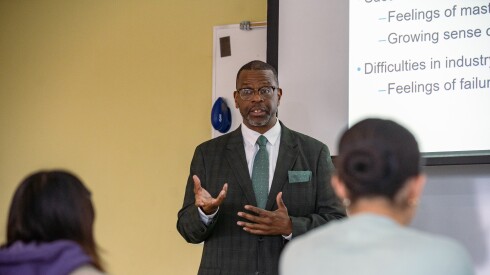
“It’s hard to educate … a student that’s hungry,” Brown said. “You could get them the food and then even let them eat in class … . I notice that after they eat, they are engaged.”
Research has shown this kind of intensive mentoring helps Black men persist through college to graduation, especially when it comes from someone who shares a similar background and experiences.
Gates, the 25-year-old, said that’s why Brown has impacted him so much.
“I haven’t been there through Pastor Brown’s whole life, but at least I know that he’s been through some things,” Gates said of Brown. “You have to go through … some type of trial in life to be able to show me that you’re worth that ‘mentor’ status.”
Mentors in Austin do the work of many
But the challenges that make mentorship so necessary mean that mentors like Brown are hard to come by, especially in Austin, where residents are up against systemic barriers like poverty, racism, and under-resourced K-12 schools.
There, just 2 in 10 residents have at least an associate degree, so many students don’t know someone who can help them navigate complicated higher education systems.
In whiter, wealthier neighborhoods like Lincoln Park nearly 9 in 10 people have at least an associate degree, so students have a much easier time finding someone who can help.
That means residents in Austin like Brown do the work of many.
Brown informally mentors young members of his congregation at New Heaven Christian Church in Austin, including Gates, and he coordinates a formal mentoring program for Black men at Malcolm X College that serves 30 to 50 students at a time. Another Austin pastor has paired dozens of middle and high schoolers in the neighborhood with mentors to help students get through college and beyond.
As Brown and other community leaders try to grow these programs, though, the idea that Black men, or Black students in general, need specific supports is under attack.
Through executive orders and lawsuits, President Donald Trump’s administration has tried to eliminate scholarships, student centers and other interventions that benefit students of color, arguing that they are racially discriminatory to other students. Trump officials pulled grant funding from Chicago Public Schools after the district refused to abolish a major initiative aimed at supporting Black students, which includes improving their preparation for college.
This shift in federal policy only further motivates Brown, his mentor Muhammad and his mentee Gates. The three recently got together at New Sound Cafe in Austin, which used to be a record shop Brown remembers browsing as a kid.
Although they grew up more than 50 years apart, Gates nods along with recognition as Muhammad recounts his struggle as the first person in his family to go to college.

“[There are] those who have had the intergenerational opportunity, and I don’t hate them or fault them for it, but it is a reality,” Muhammad said. You can’t start a race with a “40-mile handicap and expect to somehow create equality.”
Muhammad is impressed to hear that, after his setbacks, Gates is a year away from finishing his bachelor’s degree online and that the 25-year-old has found fulfilling work at a nonprofit that serves people who are unhoused.
Muhammad says he’s not surprised Brown helped make that happen. He sees in Brown the kind of patience and care that Muhammad tried to show his mentee so many years ago.
Mentorship requires a long-term commitment through college and beyond, Muhammad tells the two younger men. But he says it’s worth the effort.
“At graduation when you see them walking, you can almost see them blossom,” Muhammad said. “You can just see the metamorphosis. It’s powerful.”
This story was produced with support from the Education Writers Association Reporting Fellowship program.
Lisa Kurian Philip covers higher education for WBEZ, in partnership with Open Campus. Follow her on Bluesky @lkpwrites.bsky.social.