When “Manual Cinema’s Christmas Carol” debuted in 2020, we were throttled in the maw of a pandemic that turned the world into a hellscape. But as the year entered its final weeks, Manual Cinema’s intimate, intricate, livestreamed, puppet-centric take on Charles Dickens’ classic offered a reflection of devastating loss and a reminder that creativity and joy can co-exist alongside chaos and grief.
Running through Dec. 28 at the Loop’s Studebaker Theatre, Manual Cinema’s 75-minute production (devised by Drew Dir, Sarah Fornace, Ben Kauffman, Julia Miller and Kyle Vegter) has lost none of its cinematic richness. A merger of light and shadow, puppets and humans, original music and an evocative set, “A Christmas Carol” reflects the harsh, hopeful duality of a world defined by devastation and wonder.
As in its previous incarnations (it debuted a live version at Writers Theatre in Glencoe in 2022 and moved to the Studebaker in 2023), the 2020-set plot focuses on Aunt Trudy (LaKecia Harris, reprising her role), a widow of seemingly intractable bitterness. Trudy is reluctantly carrying on a Christmas tradition she has always loathed: Her late husband Joe’s annual puppet show recreation of “A Christmas Carol.” A morass of grief and rage, Trudy is in no mood for Christmas, much less anchoring a puppet show on Zoom. The only worthwhile line in all of Dickens’ story, Trudy rails, is “Bah humbug!” The ghosts soon come for her, just as they did for Scrooge, and their stories become entwined with alchemic impact.
Manual Cinema merges 19th-century literature with 21st-century flair. The ghost of Christmas Present has “hella” siblings. There are stab-sharp references to a health care system that lets children like Tiny Tim die and a monetary system where the incredibly rich get richer while the poor, like the family of Scrooge’s clerk Bob Cratchit, live on the threshold of starvation.
Harris anchors the production, manipulating puppets and spanning the entire emotional spectrum as Trudy’s world parallels Scrooge’s, her isolation and curdled emotions incrementally blooming into heartfelt connections with others around her.
Harris is working with a phalanx of virtually invisible puppeteers (Felix Mayes, Jeffrey Paschal and Lizi Breit through Dec. 21, Kevin Michael Wesson from Dec. 24-28) who bring a wealth of characters to life, ranging from Scrooge’s estranged family to a towering, terrifying Ghost of Christmas Future. (Keep your eye on the latter; they’ve got a jaw-dropping exit straight out of your worst nightmare.)
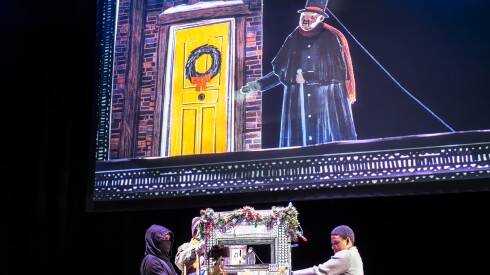
The set (designed by Manual Cinema’s collective of artists) features a toy theater framed by Christmas lights, perched like an altar above dozens of packing boxes. As the remarkably human wood-and-paper puppets take the tiny stage, they’re replicated with 70-mm clarity on a large screen hovering above them.
Every meticulously etched detail — the jumping, jovial enthusiasm of the Ghost of Christmas Present, the starry rooftops of London, the tears of a jilted lover, the dripping umbrellas of top-hatted gentlemen — becomes magnified to an effect that feels both intimate and epic.
Some of the most moving scenes occur when dialogue stops and scrolls depicting decades in Trudy’s life with Joe unfurl. Flirtatious courtship morphs into loving domesticity, which morphs into bickering, discord, disease, death and the regret of things left unsaid. Another scroll depicts a breathtaking barrage of years in Trudy’s life, images from the 1990s going into the aughts and up to 2020.

Throughout, live musicians (cellist/keyboardist/bassist Nora Barton; violinist/vocalist Lucy Little and lead vocalist/pianist Alicia Walter,) turn Kauffman and Vegter’s original music into an ethereal, eerie soundscape, the soaring vocals adding expansive sonic drama. Kauffman and Vegter’s sound design is equally effective. Small details (the aggressive scratch of a quill on parchment, Scrooge’s footsteps echoing on empty streets) and large (the buoyant chatter of a rollicking holiday party, the screeching dissonance of fearsome ghosts) enrich all of it. Trey Brazeal’s lighting design is also powerful, whether drenching the show in diaphanous twilight or lighting that hair-raising Ghost of Christmas Present.
The one place where the production flags is toward the end, when Trudy bonds with a food deliverer (Paschal) bearing Chinese takeout. The magic wilts slightly as Trudy cajoles him into helping her finish off the puppet show. Harris’ earlier puppet-free monologues are effective, the truth in Dickens’ text hitting her like a ruthlessly effective therapist. The puppet-free dialogue feels slightly intrusive.
That’s a quibble. As Christmas traditions go, “Manual Cinema’s Christmas Carol” is a treasure. It’s also powerful enough to resonate through the rest of the year, whatever it may bring.