With “The Long Christmas Dinner,” a one-act written several years before his far better-known full-length “Our Town,” Thornton Wilder provided a little gem that serves as an even briefer theatricalized summation about life and family in the American heartland.
Set at the same dinner table over a span of 90 years, the play whizzes through a series of Christmases with multiple generations of the Bayard family. Children are born, parents (and not just parents) die, some family members move in, some move out. The same catchphrase might be repeated by a character several times, then repeated by others in memory of that character after they’ve passed. Family tales are shared, repeated, changed, questioned.
It’s life and time and family abstracted, distilled and theatricalized with a spare yet rich minimalism. There are no scene changes. Newborns get carried in via one “portal” — Wilder’s word in the stage directions. When someone walks out another “portal,” we know they’ve died. Actors must age from juvenile to elderly and play multiple characters with little time for costume alterations.
In this TUTA production, restaged from last year, set and lighting designer Keith Parham places us in an environment with the perfect mix of realistic familiarity and expressionistic elegance. The familiarity comes from the nondescript table, the typical and timeless rug and chairs. The elegance comes from three chandeliers — a giant one over the table and two small pendants placed in white-curtained boxes on either side of the stage to represent the portals. The central, gorgeous chandelier has a natural branch-like structure and, with Parham’s lighting design, winter-ish qualities that capture the play’s references to the icy beauty of a frozen Midwest (Wilder was born in Wisconsin and likely wrote this play while living in Chicago).
Director Jacqueline Stone also makes some strong decisions. She includes anachronistic songs, not just as a prelude — delivered with jazzy bluesiness by Aziza Macklin, accompanied playfully on the bass by Bide Akande — but also during some scenes as well.
More intriguingly, the playing style blends period behavior with a contemporary naturalism that lets the actors be both in character and somehow themselves at once. It’s an effort to relate deeply to the piece while acknowledging the work’s own take on what’s timeless. It nicely supports an effective present-ness to the performances from an able ensemble of seven, each of whom has compelling moments.
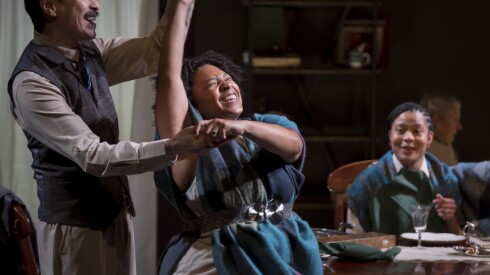
A bit more problematic, though, is the pacing. There seems to be quite a conscious effort to elongate the piece. The musical insertions help extend it a bit, but this is a 75-minute version of a piece that can, and mostly has, been done in about 45 or 50.
It’s not sluggish, but there’s a lot of intentional indulgence in pauses. The actors contribute by taking their time to have multiple reactions and digging for subtextual inferences of what’s going on between characters. They do this nobly — it’s never fake — but it does take a work that’s built on the notion of simplicity and over-kneads it with a touch of preciousness.
The result is a mournful version of “The Long Christmas Dinner,” one that feels like it focuses on death and grief a bit more than life and love.
Wilder himself had observed the tendency of productions to come off in a “lugubrious manner.” “Care should be taken,” he wrote in a published note to producers, “that after the ‘deaths’ the play should pick up its tempo at once.”
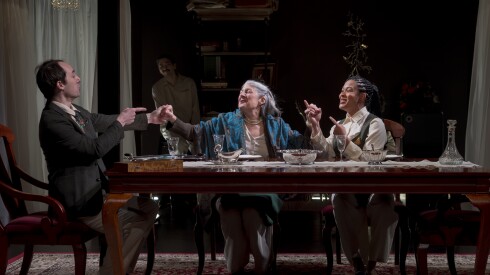
This production falls exactly into the trap of not moving on, choosing instead to linger, perhaps taking its cue from characters who complain that time “stands still” or “grinds on.” That fails to capture how, in the big picture that Wilder depicts, the sad moments are as momentary, as fleeting, as the joyful ones.
Fortunately, though, the production does find exquisite beauty in slowness and sadness. Joan Merlo, as elderly Mother Bayard and then a cousin left alone in the end, produces an aching poignancy as she slowly inches towards, literally, death’s door.