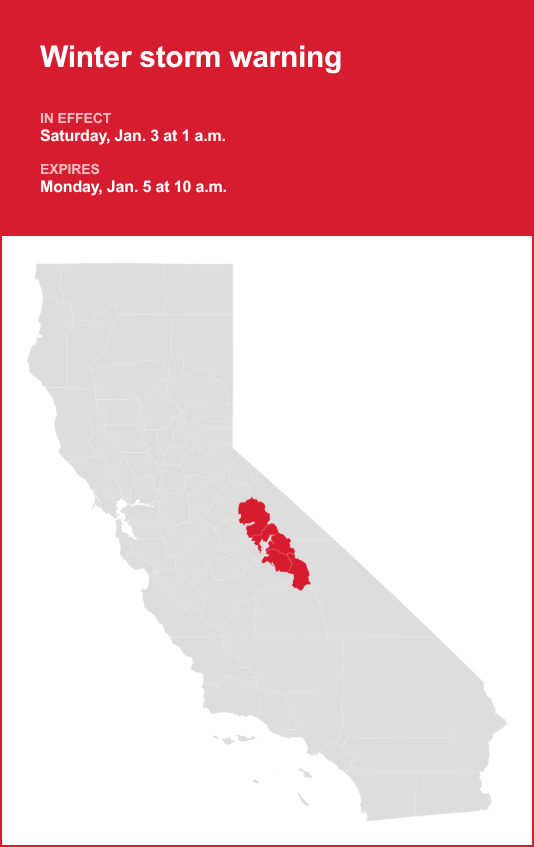
Yosemite, Upper San Joaquin River, Kaiser to Rodgers Ridge and Kings Canyon NP are included in a winter storm warning issued by the National Weather Service on Thursday at 2:25 p.m. The warning is valid from Saturday 1 a.m. until Monday Jan. 5, at 10 a.m.
The NWS Hanford CA says to anticipate, “Total snow accumulations between 6 and 18 inches between 6,000 and 7,000 feet. 3 to 5 feet of accumulated snowfall above 8,000 feet. Winds gusting as high as 45 mph.”
“Travel could be very difficult to impossible. The hazardous conditions could impact the Monday morning commute. Gusty winds could bring down tree branches,” the NWS said. “If you must travel, keep an extra flashlight, food, and water in your vehicle in case of an emergency. The latest road conditions for the state you are calling from can be obtained by calling 5 1 1. Persons should delay all travel if possible. If travel is absolutely necessary, drive with extreme caution and be prepared for sudden changes in visibility. Leave plenty of room between you and the motorist ahead of you, and allow extra time to reach your destination. Avoid sudden braking or acceleration, and be especially cautious on hills or when making turns. Make sure your car is winterized and in good working order.”
Emergency alerts in Southern California
For “considerable or catastrophic” hazards, emergency alerts will be sent to all enabled mobile phones in the area. To monitor lesser risk, residents are advised to sign up for county alert systems and to monitor agencies’ social media. How to sign up for alerts in your area:
Driving through winter: Expert tips from the NWS for a safe journey
Winter weather can make driving treacherous, leading to over 6,000 weather-related vehicle fatalities and over 480,000 injuries each year. When traveling during snow or freezing rain, prioritize safety by slowing down. In near-freezing temperatures, it’s safest to assume that icy conditions exist on roadways and adjust your driving accordingly. Be cautious of ice accumulating on power lines or tree branches, which can lead to snapping and falling hazards. If possible, avoid driving in such conditions. If you must venture out, opt for routes with fewer trees and power lines. Never touch a downed power line, and immediately dial 911 if you come across one. Here are additional winter weather driving tips:
Share your travel plans:
When venturing out of town in hazardous winter weather, be sure to inform family or friends of your destination, your intended route, and your estimated arrival time.
Prepare your vehicle:
Ensure your gas tank is full and equip your vehicle with essential winter supplies such as a windshield scraper, jumper cables, a small shovel, flashlight, cell phone, blanket, extra warm clothing, drinking water, and high-calorie non-perishable food.
Stay calm when stranded:
If you become stranded, remain composed. Inform someone about your situation and location. Avoid attempting to walk to safety. Indicate that you need assistance by attaching a cloth to your car’s antenna or mirror, and make your vehicle more visible by using the dome light and flashers
Be aware of snow plows:
Keep an eye out for snow plows and provide them with ample room to pass. Only overtake a plow when you have a clear view of the road ahead.
Check road conditions:
Before embarking on your journey, check the latest road conditions to make informed travel decisions.
Stay safe on wintry roads with these valuable winter driving tips from the NWS, and reduce the risk of accidents during challenging weather conditions.
For more local weather alerts, visit our Weather Advisory page