About a year ago, the composer Matthew Aucoin was working on a commission for the Chicago Symphony Orchestra. The dark winter felt like a dark time. He looked at the election results and felt the country was pointed in a “scary” direction.
Having already just a few sketches in place for the piece, he found the poetry of the Chilean dissident Raúl Zurita.
“I found that I needed to turn to the great South American writers in that moment,” Aucoin said. “They’re much wiser and more experienced than we are when it comes to making fearless but also inventive and life-affirming art under creeping authoritarian regimes.”

Zurita’s text brought the piece its voice. Even though Zurita wrote the text in 2003, referring back to his detention in the 1970s half a hemisphere away in Chile, Aucoin found resonance between Zurita’s experience and a U.S. government that would whisk people off the streets and send them to prison in El Salvador.
The finished piece, “Song for the Reappeared,” has its world premiere with the CSO from Dec. 4 to 7.
Zurita was arrested on the morning of the 1973 coup that brought the dictator Augusto Pinochet to power. He was imprisoned in the hull of a ship and tortured.
Zurita survived and was released, but many others detained under the Pinochet regime were killed, and their deaths for many years officially unacknowledged. Those victims were disappeared, in a novel, transitive use of the verb “disappear.”
In the half-century since , Zurita has become a literary giant in Chile, often spreading his poetry with grand gestures. In 1993, he arranged to have his poem “Ni pena ni miedo” etched into the Atacama Desert in letters whose penstrokes (or rather, bulldozerstrokes) are 100 feet wide. The whole 13-letter poem runs a full two miles.
He also had skywriting airplanes spell out lines from his “La Vida Nueva” over New York City in 1982.
When Aucoin first read from Zurita’s collection “INRI,” he was immediately inspired to use the text. “It just felt like a pure life force,” Aucoin said. He pulled three poems from the collection to supply the soprano’s text for the piece.
Aucoin, 35, has plenty of experience writing for the voice. A decade ago, a profile in The New York Times proclaimed him “opera’s great 25-year-old hope” in the headline. His 2020 opera, Eurydice, based on the play by Sarah Ruhl, played at the major opera companies of Los Angeles and New York.
He and Zurita corresponded in Italian — a language Aucoin picked up from working for the Spoleto Festival and the Rome Opera — and Zurita gave his blessing to use the texts. Aucoin says Zurita did not ask for any control over the project, because he believes the only copyright belongs to the ocean of language itself.
Zurita’s imagery spoke to Aucoin. “What he’d been through was so unspeakable that it has to become surreal,” Aucoin said. “Like it warps and melts reality. So it calls for an art that does that too, that melts the frame around the painting.”
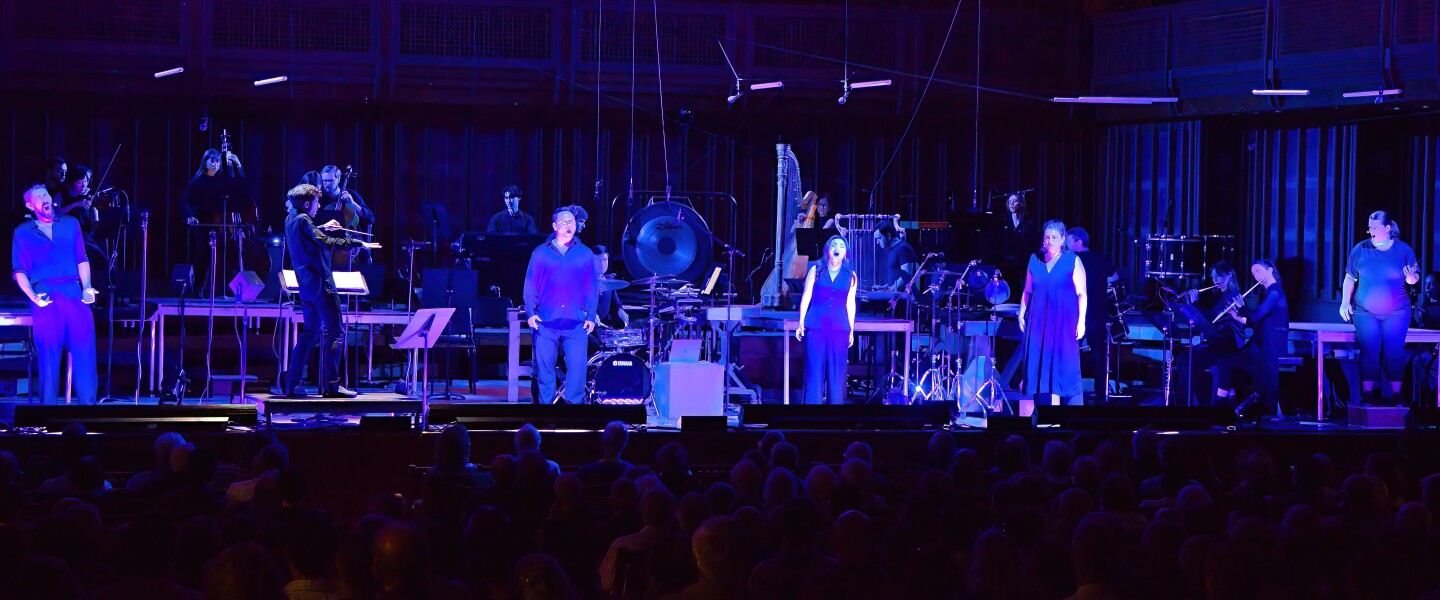
If the piece found its metaphorical voice through Zurita, it found its literal voice in the American soprano Julia Bullock, who is based in Munich, Germany. Aucoin kept her voice in mind as he was writing.
“Julia Bullock has this quality of being a truthteller in her singing,” he said. “She has this fierceness and conviction that is unique in my experience.”
The piece, composed as a sort of concerto for voice, gives Bullock plenty of runway for sweeping emotional statement. “I’m able to harness fury pretty well,” she said, “and just sort of launch it out into space or exorcise it out of myself, which has maybe a certain kind of power of confrontation that is not just easily glossed over.”
Aucoin also had in mind the particular sound of the CSO, an ensemble he knows well from serving as the Solti Conducting Apprentice with the orchestra from 2013 to 2015, under Riccardo Muti.
Aucoin is an admirer of Scott Hostetler, who plays the English horn and has a prominent role in the second movement of “Song for the Reappeared,” and the renowned brass section gets a star turn as well.
The piece is his first commission for the orchestra and is the only work on the 2025-26 season commissioned solely by the CSO.
The first movement of “Song for the Reappeared” sets the text of “El Mar,” opening with the image of “surprising baits” raining from the sky into the sea. The baits are the bodies of people killed by the government — the disappeared.
“There’s this kind of uneasy, hovering quality to the music, orchestral shapes suspended in the air with an ominous pulse underneath them,” Aucoin said.
In keeping with the classic concerto structure that unfolds across a three-movement pattern of fast-slow-fast, the second movement, “Una ruta en las soledades,” shows more tenderness. It’s here that Hostetler’s English horn shares a lyrical duet with Bullock.
Near the end of the movement, Aucoin calls for a big build in the brass. “I really let my inner Mahler run free,” he said. “[It’s] like mountains emerging out of the earth.”
The final, dance-like movement sets the poem “Rompientes,” meaning “breakers” as in waves. The orchestra spills over with energy and ferocity.
“It’s some of the most exciting writing that I’ve heard out of Matt since I’ve known him,” Bullock said of the powerful tripartite piece.
The text refers most directly to 1970s Chile, but it still alludes to humanity more broadly.
“We need to be reminded of this subject matter all the time because it is not unique to one place,” Bullock said. “It is not unique to one people.”