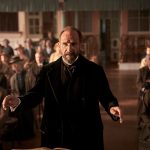
In “The Choral,” Ralph Fiennes plays Dr. Henry Guthrie, a talented and demanding musician hired by a small Yorkshire town’s amateur choral society when they lose their chorusmaster to World War I.
Director Nicholas Hytner and writer Alan Bennett team up for the fourth time on the film, which is set in 1916. Most of the young men in town have been claimed by the war as fighters and the dead. The choral group is in rough shape, a few older men scattered among the women singers.
Guthrie is looked upon with suspicion by most residents. He’d worked for years in Germany, conducting German musicians and singers, and frequently references his beloved German composers or drops the occasional Goethe quote, in the original German, in conversation.


Things don’t look good for the choral society. Pressured to abandon a familiar Bach piece for an English composer, Guthrie chooses Edward Elgar‘s demanding “The Dream of Gerontius.”
But as the odds grow longer for success, the singers refuse to let their dreams die. Elgar’s piece, based on a poem about the passage of a dying man’s soul from life to purgatory, is transformed into an allegory for the cycle of sorrow and acceptance the townspeople have felt with each young man lost to war.
“The amateur group has access,” Fiennes says of the singers’ feeling of connection to the music they have learned. “We can be part of it, you and I, who are delivering the post or going to the factory or doing what we have the job to do. We can be part of this.
“I think that’s incredibly enabling for people to feel, ‘No, we can own this,’” he says. “And Guthrie gives that sense of that they can inhabit. They can lay claim to a complex piece of music and it feeds their souls.”
That sense of a community embracing and embraced by the power and passion of music also appealed greatly to Hytner, whose previous collaborations with Bennett include the stage and subsequent film adaptations of “The Madness of King George,” “The History Boys,” and “The Lady in the Van.”
“That felt to me like the thing I’ve spent my life trying to do,” he says. “It is my direct experience that music, participation in it, and the experience of it, is as close as anything I’ve ever experienced that can draw people together.
“It’s an image of unity. It brings individuals together for a common purpose. And that sense that this disparate community, who joined the choir for all sorts of different reasons, some out of habit, some reluctantly, some because they think it’s a good way to meet girls, by the end are united in this common endeavor, this elevating endeavor.
“That spoke to me.”
In an interview edited for length and clarity, Fiennes and Hytner talked about the demands of making the film: incorporating so much music, mixing acting veterans with newcomers, coming together in communal singing and more.
Q: What was the initial thing that appealed to you as you read the script?
RALPH FIENNES: It was simple. You know, the First World War was a horror of loss of life and tragedy and senseless killing. We, and in England particularly, we have a legacy that is still felt.
Anything around the First World War has always got a sort of element of pain and tragedy around it. But then the idea that here is just the proposal of the script – the small town, the choral community they’re losing, their men they’ve lost. They want to keep singing.
So the essential proposal is there’s this devastating, terrifying war going on, and people want to sing, and want to sing the “St. Matthew Passion” [by Johann Sebastian Bach]. They may not be very good, but the community needs this. It’s a value in the community.
Q: How about for you, Nicholas?
NICHOLAS HYTNER: Well, I’m always interested in whatever [Alan Bennett] might be interested to write. This came in sketch form, really, 40 pages or so, but it was essentially there.
I immediately knew it addressed something that felt very important to me,” Hytner says. “The idea that a community under the kind of stress that this community’s under can find unity and meaning in their lives through singing, through art.
Q: As the performance finally arrives, it’s quite moving.
FIENNES: The whole, essential gesture of the screenplay was immediately affecting. And then along comes Dr. Guthrie who will give them the very challenging “Dream of Gerontius,” and they try, and then they do it.
So it was affecting on a number of levels: Nick, who I adore as a director, and Alan, who I’ve never worked with. This was a chance to be part of that, their collaborative spirits. It ticked so many exciting creative boxes for me.”
Q: Nicholas, tell me about blending filmmaking with music. I know you’ve directed a lot of opera, including performances that were filmed.
HYTNER: I’ve never filmed the opera myself. It’s been done by fantastically expert directors with multi-camera setups, which I can’t do at all. But yeah, the answer is that it needs real preparation. You need to know what you’re going to do.
I’ll give you an example. The rehearsal sequence, which starts in the rehearsal room and then goes out of the rehearsal room to see them all having their own private practice sessions between rehearsals. The ambition was to kind of to give a sense of a choral organism getting better.
What it meant was that the music had to be broken down very precisely, every shot preplanned. The editing had to be done even before it was shot because the music is the music. There’s no amount of manipulation in post-production that can pull the music together again if you haven’t taken it apart, knowing where the camera sits.
It’s having a kind of instinctive sense of where the camera moves, what it needs to look at based on a score rather than a script. I’ve not done it for a while, but I used to direct opera quite a lot. I’m perfectly OK with working from a musical score rather than the written word.
Q: And Ralph, you had to learn how to conduct? I’d think that would be challenging.
FIENNES: Yeah, it was hard. I mean, I think, of course, I assumed it would be hard, but I didn’t quite realize the sort of level of precision that’s needed to keep time and to change and shift. I’m in awe – I’m just working now on a project, and I’m directing an opera. So I’m sitting next to a maestro who is very meticulous about tempo. And I had to get a bit of that into Guthrie.
Nick got me in touch with a lady called Natalie Murray Beale, who’s a conductor. She’s known for having coached Cate Blanchett in the film “Tár.” She was a wonderful guide for me. But it was difficult.
Q: In addition to casting Ralph as Guthrie, you put together a cast that mixes very established actors with some who are making their debuts here. Talk about how they all came together.
HYTNER: Well, the older ones, honestly, I mean most of them I’ve worked with before in the theater. So a lot of them, it was me sending them an email or picking up the phone. The younger ones, they were all new to me. That was working with a casting director, meeting lots of people.
Q: What was the blending of different kinds of experience like?
HYTNER: I was a particularly satisfying part of the process, bringing those young actors, some of them on their very first job, to get them with more experienced actors who’d all worked together before.
All of them [the veteran actors] knew each other very well. Roger Allam and Alun Armstrong, they were in the original, very first cast of the musical “Les Misérables.” Roger was Javert, Alun was Thénardier. They’re both stalwarts of the British theater, as is Mark Addy, as is Ralph, as is Simon Russell Beale, as is Ron Cook.
They would sit around digs [their lodgings] exchanging theater memories and they have many of them. And the younger actors were drawn into that circle. It’s an experience that happens more in the theater than on a film set because a film set, when actors come together, it can be so brief.
Whereas over the course of a theater rehearsal period, in a rehearsal room, backstage, in a green room, actors really get to know each other and really, really become a community. So it was fun. There was a lot of satisfaction to be gained from that.
Q: It’s funny that Roger played Javert in the West End production, yet his character here can’t sing well at all.
HYTNER: He’s a bad tenor [Allam’s character Alderman Duxbury], and Roger’s a good baritone. So, Roger, like Clyde [played by Jacob Dudman] and Mary [portrayed by Amanda Okereke], the singing voices you hear are not their voices. But they all sang their parts, so that’s why the sync is so good. That’s why the illusion is, I hope, so good.
But in the case of Clyde and Mary, they needed to sound like really good young classical singers. And Roger needed to sound like a ropy old tenor.
Q: This is your fourth film with Alan Bennett?
HYTNER: It’s the fourth film. The first that didn’t start life on stage.
Q: So when you get a new script from him, what is it like to read it for the first time?
HYTNER: His first drafts are all, I mean, they come in a variety of forms. Like years back, the first draft of “The Madness of King George” and the first draft of “The History Boys” were immense.
This was a sketch. This was short, well, and not developed. He didn’t really know what it was. On occasion, he’s – we live quite close to each other, so he just shoves it through the letterbox. And on occasion, not very often, he’s given me a kind of embryonic look at something.
But there’s always such a rounded humanity. There’s always a wit. There’s always that wonderful sense of melancholy, a deep melancholy. A deeper awareness of mortality and the transience of the human experience can also go with knockabout humor or slyer, subtler humor.
I very much respond to the way he looks at the world and to the way he writes the kind of dialogue he writes.
Q: He gave this one to you early, and you talked about it for a few years before filming?
HYTNER: I didn’t really know he was working on anything. I think one of the reasons he gave it to me so early – he gave it to me two days before the first COVID lockdown. I guess we didn’t know when we were going to be able to get together again.
Q: How can singing, or any kind of participation in the arts, benefit a community in real life?
FIENNES: Well, it seems to me that the community, families, working people, the stresses and strains of life in the community, the quotidian life, suddenly a piece of music is a whole other. It gives access to the journey of people’s souls. It affects the spirit of the individual, and the individual in the collective.
It moves us. To be creatively a participant in making something collectively is a very strong feeling. It’s what you don’t get every day. It’s about how things touch you here. [He gestures to his heart.] Who can say what it does, what is that thing when you’ve sung something together?
I mean, it can be as banal as singing a Christmas carol together, but there’s something in here that shifts, and we leave behind perhaps our anxieties of the day. And when it’s in the community, that feeling is very, very strong.
HYTNER: You have to become one part of something greater than the individual. So in an age of division, music, the performance of music, communal singing offers a way, genuinely, of living in unity.