Nestled in Little Palestine, amid the Mosque Foundation and a cluster of Islamic schools along Bridgeview’s Harlem Avenue, sits a small brick building that most drivers pass without a second glance. There is no grand marquee, no billboard advertisement.
The school speaks for itself.
By 8 o’clock on a weekday morning, the parking lot begins to fill. Mothers in hijab unbuckle car seats. Fathers check their mirrors before pulling away. Children, three, four, five years old, tumble out of minivans and SUVs, backpacks bouncing, voices already bright with the particular energy of small people who have somewhere important to be.
At the door, Muallima Azizeh Taha is waiting.
She has been waiting at this door, at this school, for nearly 14 years. A Palestinian woman with a teacher’s patience and a mother’s warmth, she greets each child the same way she greeted the first one she ever taught here: with a smile, a soft word, a deliberate calm. “He is coming from his mom and dad back to me,” she says. “He has to feel safe.”
Boys and girls pour in past her, shedding backpacks and opening folders, settling into the small chairs and small tables built precisely for them. Within minutes, the school fills with a sound that does not belong to any ordinary American preschool. It rises from every classroom at once, the measured, melodic recitation of Quran in Arabic, young voices finding the ancient words, some stumbling, some soaring, all of them trying.
This is how every morning begins at MAS Quran Blossoms, a full Arabic immersion preschool in southwest suburban Bridgeview, one of the most densely Muslim communities in the United States. No English is taught inside its preschool classrooms. Children spend their days learning Arabic letters and Quranic verses, practicing Islamic duaas and nasheeds, tracing the curved forms of Arabic calligraphy with small hands that have never held a pen before.
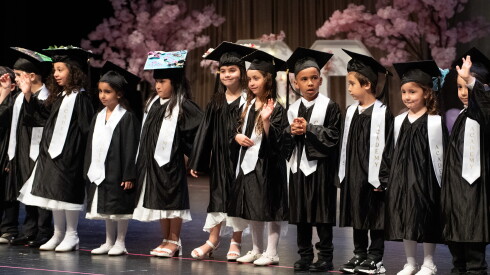
By the time they leave for kindergarten, many have memorized Juz Amma, the thirtieth part of the Quran, in its entirety. That is 2,423 words and 37 chapters. This year alone, 42 students completed that milestone.
For the families who chose this school, some of them driving an hour each way through Chicago rush hour, this is not supplemental to an American childhood. It is the foundation of one.
They are making this choice at a particular moment. The Council on American-Islamic Relations recorded 8,658 complaints of anti-Muslim and anti-Arab incidents in 2024, the highest number since the organization began collecting data in 1996. Anti-Muslim hate crimes in major U.S. cities rose 18% in 2024, the fourth consecutive year to witness an increase. The hostility landed close to home in April, when two men came to Bridgeview and filmed themselves making Islamophobic comments in front of the community’s newly unveiled “Welcome to Little Palestine” sign on Harlem Avenue.
These parents are not waiting to be accepted. They are building.
What they are building toward is something specific. Arabic is not, for these families, simply a heritage language or an academic achievement. It is the language of the Quran, of prayer, of 1,400 years of Islamic scholarship that connects Muslims across every ethnicity and nationality. For a Muslim child growing up in America, Arabic is the thread that holds together what can otherwise feel like two separate lives: the one lived at home and the one lived everywhere else. Without it, children recite prayers they cannot understand. With it, they carry their faith as something they inhabit rather than something performed for them.
Many of the parents making this choice understand the difference from the inside. They grew up here, Muslim and American, navigating childhoods in which that thread was thin or missing entirely. It’s not an isolated feeling. The parents describe their own Arabic as halting, their relationship to the Quran as incomplete, their childhood Islamic identity as something they had to work for rather than simply inhabit. Imanie Eldably, an Egyptian American school psychologist who moved back to Bridgeview from California specifically for MAS Blossoms, puts it plainly. “I couldn’t just be,” she says of her own childhood. “It was always something I had to consciously put effort into.” What she is giving her daughter, Eldably says, is what she never had: the freedom to simply exist in both worlds at once.

A language that belongs to everyone
The families who drive here come from across the Chicago metropolitan area, some traveling 45 minutes to an hour each way, navigating rush hour traffic and school pickups and newborns in car seats. They range from being Arab, South Asian, Turkish and Bangladeshi among others. They are physicians and pharmacists and product managers and school psychologists. Many grew up here, American-born children of immigrants, raised between two languages and two worlds.
What they share is a conviction that has only deepened in recent years: that giving their children Arabic, the language of the Quran, is not supplemental to raising them in America. It is essential to it.
“While Arabic is tied to a specific geography, it doesn’t belong to any one ethnicity,” says Omar Farooq, a product manager whose second child is currently enrolled at MAS Blossoms. “It is the spiritual heritage of every Muslim. It is our primary sacred language and, historically, the lingua franca that has allowed Muslims of all backgrounds to communicate for centuries.”
Farooq, who is not Arab, is also taking weekend Arabic classes at his local mosque. He finds himself regularly outpaced by his five-year-old. “I’ll find myself turning to her to ask, ‘How do I say, may I please have a napkin?’ or ‘What was the word for leaf again?’” he says. “My children have become a constant reminder of what a great teacher looks like. When I make a mistake or ask for help, they don’t judge me for what I don’t know. Instead they are just incredibly eager to teach me.”
Babrul Hussain, a business systems manager who immigrated from Bangladesh at age six, enrolled his daughter in the program at 18 months, making her one of the youngest students MAS Blossoms has ever accepted. She’s now five years old, and Hussain regularly turns to her for help with Arabic. “I use Google Translate to understand her homework,” he says.
His daughter requests to be awakened in the middle of the night to join her parents for suhoor and fajr. She asks to fast. She recites the 99 names of Allah by heart. “She’s learned more surahs than probably 50% of us Muslims have memorized,” Hussain says. “That’s inspiring. That’s when I know it’s worth it.”
Raya Hassan grew up in a Palestinian family that took Arabic seriously. Her father, an immigrant engineer determined to succeed in America, pushed his children into Islamic school programs and Arabic classes even as he worked to master English himself. Years later, he told her he wished he had spoken to them in Arabic more.
When it came time to choose a preschool for her daughter Zainab, Hassan was living in Deerfield, nearly an hour from Bridgeview on a good day. She and her husband had already decided to sell their house and move closer to the southwest suburban Muslim community, but the house hadn’t sold yet.
It didn’t matter. She registered Zainab anyway.
Hassan still tears up describing one of the moments when she knew the sacrifice was worth it.
Her newborn was crying. Zainab walked over to her baby sister and began reciting Surah Al-Fatiha. The baby stopped crying.
“She knows that Quran is soothing,” Hassan says. “And so right away she went and did that. I literally started crying.”

Dr. Busra Goksu is a physician from Turkey who came to Chicago with her husband, also a physician, to pursue their medical training. Their son Zahid is in his second year at MAS Blossoms. The commute from their home takes close to an hour in heavy traffic.
In Turkey, Arabic is the language of prayer and Quranic recitation, not of daily conversation. Dr. Goksu grew up able to read the Quran but not to understand it. She enrolled Zahid because she wanted something different for him. Recently, he has taken to watching an all-Arabic children’s cartoon and explaining Quranic surahs to her unprompted. “He says, this surah is talking about this topic, mama,” Dr. Goksu says. “When this happens, I’m like, okay. We did the right thing.”
A foundation for faith and identity
That feeling is familiar to Dr. Saba Saeed, a neurologist who drives from the northwestern suburbs with her daughter three days a week. For Dr. Saeed, the decision was rooted in what she herself did not have growing up. “The foundation from a young age,” she says. “The exposure at such a young age to language, it’s a building block that we just didn’t have that opportunity for.”
What makes MAS Blossoms work for non-Arabic-speaking families, says Dr. Saeed, is something that research has long documented. Bilingual children demonstrate better attention and task-switching capacities than monolingual children, with cognitive benefits appearing as early as seven months old. But the case for Arabic immersion here runs deeper than brain development. It runs through faith, identity, and a sense of what is being lost when a language is not transmitted.
As a neurologist, Dr. Saeed connects those threads deliberately. “If we don’t instill that identity from the beginning, that’s where the mental health crisis comes in,” she says. “If we are able to build it from the beginning, I think it will prevent the anxiety and depression that comes on in a lot of people later on.”
She pauses, searching for the precise clinical language, then lets it go. “I deeply believe it,” she says simply.

For Eldably, a school psychologist working in the same district she attended as a child, the stakes are personal and professional at once. She describes herself as a “cultural bridge” — someone trained to identify what children need to thrive and what puts them at risk.
“Right now, there’s a lot of effort to erase Islamic identity or put a bad name on it,” she says. “Once you have that strong foundation, built from a young age, it’s really hard for it to be impacted later on.”
Growing up, she says, she felt a persistent disconnect between her Islamic identity and the public school environment. “I was trying so hard to fit in,” she says. “Sometimes even resentment of my own culture. I didn’t want my daughter to have to feel that way and have to choose within her Islamic values.”
Research supports what she experienced: Children who lack a stable sense of identity are more vulnerable to anxiety, depression, and peer pressure. Eldably says children with a strong sense of identity tend to show greater resilience across the board.
“Having a strong Islamic identity is quite literally a protective factor,” she says. “It aligns them with who they are, and it protects them from stress, trauma, any hiccups on the road. It brings you back to your beliefs and your sense of purpose.”
What strikes Eldably most about her daughter, Layla, since enrolling at MAS Blossoms is something she struggles to describe clinically. “She’s just being,” Eldably says. “Whereas I felt, growing up, I couldn’t just be. It was always something I had to consciously put effort into. But she’s just being. She’s coming back using words, teaching me, correcting my pronunciation. I’m seeing her implement things I’m not explicitly teaching, which is really neat to see.”

The Soil and the Seed
The United States is in the grip of a caregiving crisis. Child care costs have skyrocketed. Culturally and religiously competent options are scarce. For Muslim families, finding an environment that reflects their values while meeting their children’s developmental needs has become its own form of labor.
MAS Blossoms, families say, resolves that tension in a way few institutions can. It is not a daycare. It is a school, one with a rigorous, play-based curriculum taught entirely in Arabic, in an environment where Islamic values are not a supplement to the day but its entire structure.
Abeer Jaber has been part of MAS Blossoms since its earliest years, first as a teacher for 13 years, now as principal for the past seven. She arrived in the United States in 1988, raised five children here, and went to school at night while her husband watched the kids, taking turns so neither fell behind.
She knows every lesson plan in every classroom. Every morning at 8:15 am, she walks through all eight of them, checking on teachers, checking on children, making sure everyone is ready “emotionally, mentally, everything.”

Under her leadership, the school has grown from a small program with a double-digit waitlist to a 115-student institution now adding second grade for the first time. The curriculum — covering Arabic language, Quranic memorization and recitation, Islamic studies, calligraphy, and nasheed — took seven to eight years to build from scratch. It belongs entirely to MAS Blossoms.
Interest in the school has only intensified in recent years as families sought out Islamic education, concerned about values instruction that conflicted with their faith, Jaber says. “A lot of people took their kids from public school and started looking.”
What keeps her grounded beyond the day-to-day is the students she has watched grow up. Some of the children she taught at three years old are now in college. Some are counselors at Muslim youth camps. Some lead Muslim Student Associations at their universities. Some have finished memorizing the entire Quran.
When asked what she wishes the outside world understood about her school, she pauses only briefly. “I don’t care what they think,” she says. “I know what we do. I know every word that’s been said in these classrooms.”
Then, softer: “I wish they knew how much care and love I give with these children.”
Similarly, Muallima Azizeh Taha, the teacher who greets the children every morning, says she wanted to teach Arabic “the right way: with passion, with care, with love.” She has been doing exactly that at MAS Blossoms since 2011. However, she did not start her career as a teacher. She raised her children first, and when they were grown she went to college to study early childhood education.
Ask her what she is trying to give a child beyond words and Taha answers without hesitation. “The first thing I want to plant in them is love of Allah and love of the Prophet,” she says. “When you feel that someone loves you, you accept from them. So they feel safe, they feel love and then they can accept what we teach them.”

The green folder holds the everyday homework for Quran Blossoms students: Arabic letters, sounds and sight words that help children build the foundation to read Arabic fluently. Step by step, those letters become words, then verses, then the ability to read and memorize the entire 30th juz of the Quran.
Tyler Pasciak LaRiviere/Sun-Times
Her philosophy of teaching is built on metaphor. Taha describes the children as fresh soil, never seeded before. She describes the work as planting. She describes what happens over years of instruction — a child arriving not knowing a single Arabic letter and leaving able to recite Quran with proper tajweed — as the fruit.
“Patience, amanah, love,” Taha says. “You mix them together and you bring a beautiful tree.”
On calligraphy, her approach is equally gentle. When a child picks up a pen for the first time and traces the curved forms of Arabic letters, she does not correct them. Not yet. “Whatever they write, I encourage them,” Taha says. “I’m not going to judge them. I’m not going to perfect it for them this time. Let them feel it.”
On nasheed, the Islamic songs woven through the curriculum, she starts with herself. “I enjoy it. I feel it. I go to their level and I sing it. From my heart,” she says. “When they see me happy, with movement, they start singing with me.”
This year, for the first time, Taha moved from teaching the youngest children to first grade. She is thinking about the children she first taught when they were three and what it means that some of them are now in her first-grade classroom. She is thinking about the non-Arab children, the South Asian children, the Turkish children, the Bangladeshi children, who came to her not knowing a single Arabic letter and left speaking it, reading it, singing it, praying in it.
“The seed I moved in the soil, it’s going to grow and blossom,” Taha says. “Alhamdulillah.”
Outside, in the parking lot of the small brick building on Harlem Avenue, another morning is ending. Children tumble back out into the world, backpacks bouncing, voices bright. They climb into car seats and settle into back seats. And some of them, without being asked, without being reminded, begin to recite.
This story was produced with support from the Round Earth Media program of the International Women’s Media Foundation along with The Solutions Journalism Network and Nova Institute of Health.