SPRINGFIELD — Illinois lawmakers were running the hurry-up offense Thursday as the clock winds down on their effort to advance property tax-incentive legislation intended to help the Chicago Bears build a new stadium in Arlington Heights and prevent them from moving to Indiana.
That was just one of several legislative footballs lingering well short of the goal line late in Springfield’s drive to the end of the spring session — chief among them, passing a roughly $56 billion state budget by the state constitutional deadline of midnight Sunday.
But Gov. JB Pritzker already has gotten a pair of key legislative wins through the uprights with regulations on auto and home insurance companies as well as the burgeoning artificial intelligence industry.
While a push for new progressive tax revenue streams was at the forefront of the annual spending tug-of-war among Illinois’ super-majority Democrats in a tight budget year, the Bears debate was proving divisive as ever in the five-year stadium saga.
A month after the House passed a sprawling “megaprojects” bill with numerous provisions seeking to draw support from across Illinois, lawmakers were considering paring down proposed legislation that would apply more narrowly to the Bears while punting on the statewide policy for which Pritzker has long advocated. Dozens of other states allow companies to negotiate discounted payments in lieu of taxes (PILOT) to local governments instead of their full property tax bills, as long as they’re investing in projects of $100 million or more.
Until this spring, the Bears had been completely blocked in their Capitol drive for PILOT legislation, which they say is needed to slash potential property taxes exceeding $100 million per year if they were to build a dome on the 326-acre plot they own in Arlington Heights.
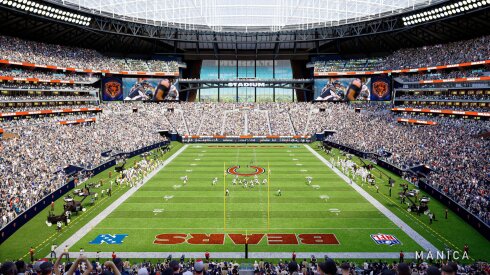
It’s that or taking the team across the border to Hammond, Indiana, the team has threatened, with the help of Hoosier lawmakers who have already passed a law that would pump upwards of $1 billion in taxpayer dollars into a stadium.
But a narrow Bears bill won’t be any easy sell for Chicago Democrats reluctant to pave the Bears’ path to the suburbs, nor for any lawmaker uncomfortable with helping out a franchise valued at $8.9 billion while Illinois homeowners deal with some of the nation’s highest property tax bills.
The bill that cleared the House tried to thread that political needle by directing half of PILOT payments to residential property tax relief programs, but analyses by the offices of Pritzker and Cook County Treasurer Maria Pappas determined such relief would be negligible.
State Sen. Bill Cunningham, the South Side Democrat leading his chamber’s megaproject discussions, said caucus members were still debating the floor for PILOT payments that companies like the Bears would pay, which is a mathematical conundrum in itself.
“We don’t know how many megaprojects there are going to be, and we don’t know how much the recipient in the megaproject is going to pay, so because of that, we have no idea of what the amount of money available for property tax relief is,” Cunningham said. “There’s three and a half days left, and I’m hopeful we’ll get to something.”
House sponsor state Rep. Kam Buckner, D-Chicago, took the legislative Christmas tree approach in drawing support with tax-incentive measures intended to spur economic growth in other parts of the state, including a revitalization effort for downtown Springfield. That measure for the state capital emerged in its own bill that cleared a key Senate committee Wednesday, potentially signaling the megaprojects pare-down.
“There’s still a chance that could be in a larger bill,” Cunningham said. “It could move either way.”
AI, insurance regulations pass, but housing deal uncertain
In addition to long sought regulations on big insurance companies, the General Assembly on Wednesday took its first regulatory steps to rein in big AI companies as they passed a bill to implement guardrails around AI models, mirroring similar legislation passed in New York and California.
The bill headed to the governor’s desk would require large AI companies to propose and adopt “safety plans” that will be reviewed and approved by a third party. Sponsoring state Rep. Daniel Didech, D-Buffalo Grove, said the legislation would prevent AI from leading to “catastrophic” disasters, like developing chemical weapons or urging teens to commit suicide.
The attorney general would review each large AI company’s performance every year and ensure they are complying with the adopted safety plan.
A Pritzker spokesperson said he’d sign the bill “to hold big tech accountable and prevent them from abandoning responsibilities to keep people safe online.”
But that legislation just scratches the surface of further guardrails being floated in Springfield. Other provisions making their way through the Legislature would push AI out of classrooms, mandate that chatbots connect suicidal users to mental help professionals and implement consumer protections to prevent AI from being used to maximize prices for landlords and ticket resellers.
Those measures were included in a package that passed the Senate last week with broad bipartisan support, and awaited action in the House.
The AI and insurance regulations marked wins for the governor, whose other key legislative priority was still being wrangled over: implementing statewide zoning regulations in an effort to bolster affordable housing stock. Pritzker’s plan aims to cut red tape and speed up developments by putting deadlines on municipal zoning decisions.
But the Illinois Municipal League, a group representing local governments across the state, came out swinging with concerns that the governor’s plan undermines local control. The IML countered the governor with their own plan that aims to make new housing developments cheaper by reducing property tax and sales tax on building materials.
A group of Senate Democrats sought middle ground with a package last week incorporating parts of Pritzker’s plan with additional provisions to ensure affordable housing, but its fate was far from certain with some 72 hours left in session.

Budget talks
With all those legislative wheels turning, Democrats were still busy behind closed doors hammering out the final details of their most pressing task, passing a state budget for the fiscal year beginning July 1.
Earlier this month, legislators filed a 3,178-page bill outlining more than $53 billion in spending that won’t ruffle many feathers in Democratic flocks, but the final $2 billion-plus in appropriations — not to mention new taxing sources — promise for late nights and early mornings in the Capitol through the weekend.
Citing stiff economic headwinds and federal funding uncertainty under President Donald Trump, the $56 billion plan Pritzker proposed in February was mostly a maintenance budget, with budget officials announcing even less wiggle room last month — revising a revenue forecast down by $149 million.
Along with shifting gambling taxes and corporate income tax deductions, Pritzker is pushing for more revenue with a tax on social media companies to help make ends meet, a measure facing a court challenge for a similar tax introduced last fall in Chicago. And as Democrats nationwide harp on affordability issues heading into midterm elections, the governor has suggested the state could suspend the scheduled two-cents-per-gallon increase in the gas tax.
Progressive Democrats are calling for bigger swings to get ahead of a projected $1.5 billion deficit facing the state in 2028, including by closing offshore tax loopholes, taxing gains on billionaires’ assets, slapping larger levies on Big Tech companies and breaking step with federal tax carveouts for big corporations. Such measures could generate some $4 billion per year, proponents say.
“Right now, there is an invisible pipeline draining resources out of our communities because of the way our laws are written,” state Sen. Lakesia Collins said. “Closing these corporate loopholes keeps our state’s finances stable without asking working families to dig deeper into their pockets.”
Illinois House Speaker Emanuel “Chris” Welch has advocated for a surcharge tax on millionaires, but it wasn’t clear if any progressive revenue options would make it to the finish line.
Republicans complained the state already taxes and spends far too much — and they are too often left out of the process. They called on Democrats to share their full spending plans before the usual middle-of-the-night legislative scrambles all too familiar to Capitol denizens.
“When major spending items are added at the last minute without adequate time for lawmakers or the public to review and examine them, it undermines the confidence in the process and creates understandable skepticism about how taxpayer dollars are being spent,” said state Sen. Seth Lewis, R-Bartlett. “Transparency should not be an afterthought. Illinois families have to live within a budget every single day.”