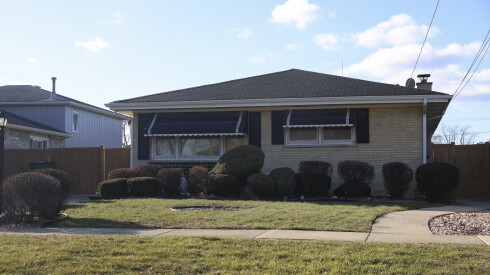
Armando W. Saleh, a former Cook County employee turned lobbyist, got more than $20,000 in property tax breaks meant for low-income senior citizens — even though voting records and other government documents say he’s 56 years old.
How? Saleh submitted a passport to the Cook County assessor’s office that showed him as being 15 years older, according to a Chicago Sun-Times investigation of the government office.
The passport, issued in March 2021, was among many documents used by Saleh, a former chief of staff to a Cook County commissioner, to secure 69 tax breaks that saved him a total of more than $80,000 under Assessor Fritz Kaegi and two predecessors in that elected position going back to 1998.
It’s unclear why the three assessors kept approving tax breaks on Saleh’s two homes despite a state law that limits those exemptions to just one, an owner-occupied home.
Saleh is now the latest of more than a dozen homeowners who have lost their tax breaks following Sun-Times investigations of the county office. The others include former Ald. Walter Burnett, Mayor Brandon Johnson’s former budget director Annette Guzman and the estate of a dead mobster — who kept getting tax breaks in his name even years after he died.
Property owners must sign applications swearing that they were eligible to get the tax breaks and acknowledging that they could be charged with perjury if they filed a false claim.
But that’s been an empty threat under Kaegi, a lame duck who lost his latest reelection bid.
“The assessor’s office has not referred any erroneous exemption cases to the state’s attorney’s office for prosecution” since Kaegi took office in 2018, according to Christina Lynch, his office’s legal director.
But now Kaegi’s office says it’s weighing whether to ask Cook County State’s Attorney Eileen O’Neill Burke to investigate Saleh’s tax breaks.

It’s hard for county assessors in Illinois, particularly in the Chicago area, to catch people who illegally collect residential property tax breaks. Kaegi’s office relies on whistleblowers to flag relatives, friends and neighbors who might have gotten tax breaks they weren’t entitled to, according to a recent report from the Cook County inspector general’s office.
Kaegi’s baffling decision
The Sun-Times unearthed Saleh’s illegal exemptions nearly two years ago by examining the assessor’s database, looking for red flags. That showed he was taking tax breaks on two homes — including senior exemptions, for which you have to be at least 65 years old to qualify. Saleh and his wife weren’t old enough to qualify. They still aren’t.
In 2024, Kaegi ordered Saleh to repay $101,807 to cover 34 tax breaks, penalties and interest he got on his Gage Park two-flat and another in Lawndale over the past seven years. That’s all that Kaegi could claw back under state law.
Saleh, who’s now a registered lobbyist for PepsiCo, repaid the money without putting up a fight.
But then in 2025, Kaegi’s staff made a baffling decision. It went ahead and renewed Saleh’s tax breaks on both buildings. That cut his property taxes by a total of $2,392 last year, money the office now says he will have to reimburse the county treasury.
“We also have a photocopy of a U.S. passport on file for Armando Saleh, turned in with an exemption application, that shows he has a birth year of 1955,” Kaegi spokesman Christian Belanger says. “That would make him eligible for the senior exemption. If you have reliable information from voter registration records showing that he isn’t that age, please pass it along to us.”
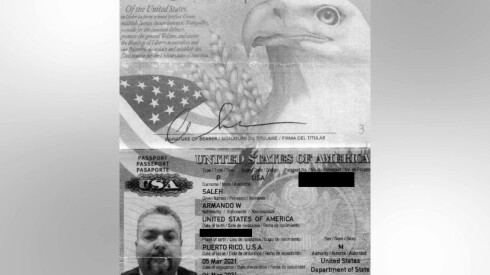
But, according to voting records from the city of Chicago and other government records, Saleh was born in August 1970, which makes him 56 years old. And his wife Maria Manzano Saleh is 55. They jointly own both homes that have gotten the tax breaks they had to repay. No one else is listed on the deeds for those properties or the mortgages.
Saleh didn’t return messages seeking comment about the passport that Kaegi’s staff relied on to award him senior tax cuts, including the lucrative assessment freeze for seniors with household incomes below $65,000.
“On behalf of Mr. Saleh, we have no comment on your requests,” says his lawyer Ricardo Meza, a former state of Illinois executive inspector general.
More erroneous tax breaks
Saleh is among more than 9,000 Cook County homeowners Kaegi says have had to repay a total of $59 million in erroneous tax breaks they received. In most cases, they had to pay penalties and interest.
Last year, Kaegi’s office approved a variety of tax breaks to 63% of Cook County’s 1,586,788 residential property owners, county records show, shifting $1.58 billion in taxes onto other property owners, including residential and commercial landowners.
With so many tax breaks granted each year, it’s difficult for Kaegi’s staff to ensure that all of those taxpayers are entitled to those exemptions, especially those based on income, because they have no authority to review income-tax returns.
“It’s always going to be a constant cat-and-mouse game with people who try to game the system,” says Patrick Hynes, the Lyons Township assessor who is aiming to become Cook County’s next assessor following the Nov. 3 election. Hynes defeated Kaegi in the Democratic primary election last spring. No Republican is seeking to run the office, though Libertarian candidate Nico Tsatsoulis is on the ballot.
Still, Hynes says, “We have to do a better job of identifying them. I’m the bureaucratic administrator to administer these [tax break] laws that were handed down by” Illinois legislators.

A history of wrongful tax breaks
Saleh was a 22-year-old graduate of Loyola University Chicago in August 1993 when he and his wife bought their first home, a two-flat on South Troy Street in Gage Park, public records show. They paid $144,000, largely financed with a mortgage.
A year later, they got their first property tax break, the basic homeowner exemption given to anyone who owns and occupies a home. It cut their property tax bill by $403.
After Saleh landed a job in 1998 as an assistant to then-Cook County Commissioner Joseph Mario Moreno — later promoted to be his chief of staff — he began to get two additional tax breaks from then-Assessor James Houlihan.
Besides the homeowner exemption, the young couple, who were raising two small children, started collecting the senior citizen exemption along with the low-income senior assessment freeze. Those three tax breaks saved them $661 in taxes, which, like all tax breaks, was money that was shifted to other taxpayers.
Kaegi’s office says it can’t find any records to show how the Salehs qualified for those senior tax breaks, which they kept receiving over the next several years under three assessors: Houlihan, Joseph Berrios and Kaegi.
Altogether, county records show, the Salehs got 40 senior tax breaks on their Troy two-flat between 1998 and 2023, cutting their real estate taxes by $22,023 — $7,413 from the senior exemption and $14,610 from the low-income senior assessment freeze given to people 65 or older with a household income under $65,000.
In a brief interview in October 2024, Saleh defended getting the senior tax breaks on his two-flat, saying, “Yeah, but my parents live there.”
Armando and Maria Saleh are the only people listed on the deed and the mortgage, but a man identified as Ahmad Saleh submitted an application for the senior tax breaks on that property on March 11, 2024, according to Kaegi’s records.
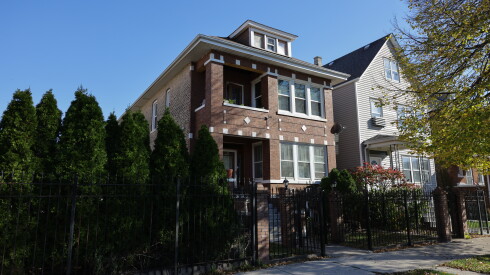
The application doesn’t spell out Ahmad Saleh’s relationship to the property owners or why he was applying for tax breaks on property he doesn’t own.
The application says his household income is $43,574, low enough to qualify for a senior assessment freeze, lowering the property taxes on Armando Saleh’s house.
It’s one of six applications submitted under Ahmad Saleh’s name between 2012 and 2023, according to Kaegi’s records. Those applications list four different birthdates for Ahmad Saleh. The first one says he was born in 1925. The next two say he was born in 1945. The fourth says he was born in 1941. The fifth says 1945. And the most recent one says he was born in 1956.
Chicago election records show Ahmad Saleh, a naturalized citizen born in what used to be Palestine in 1925, was registered to vote from Armando Saleh’s Gage Park house starting in 1996 until his voter registration was canceled in 2012 — the year he allegedly started applying for the senior tax breaks.
Another property, more tax breaks
Armando Saleh got a job as a community relations officer for the Chicago Transit Authority in 2001, when he and his wife bought another two-flat, on the 2500 block of West Flournoy Street in Lawndale. They paid $150,000 for the building, financing it with a mortgage for $256,800, county records show.
As with their home on Troy, Armando Saleh and his wife are the only people listed on the deed and the mortgage.
Nine years later, they started taking homeowner and senior exemptions on the Flournoy building at the same time they also were getting those tax breaks on the Troy home, despite the Illinois law that allow people to collect residential tax breaks on only one property.
Altogether, Cook County records show, the Salehs got more than $58,000 in tax breaks on the Flournoy property between 2014 and 2023.
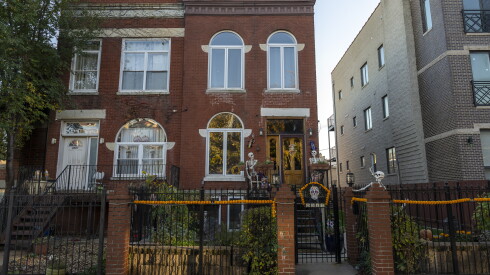
The original application for the Flournoy tax breaks was submitted in 2010 under the name Melba Saleh, who, according to voter records, is an 82-year-old woman registered to vote from Armando Saleh’s home on Troy. Their relationship isn’t clear.
Five more applications were submitted under the name of Melba Saleh between 2014 and 2019, though the applications have different birthdates. Three say she was born in 1943, and the others say 1942, according to the assessor’s records.
Then, in 2022, Kaegi received an application for tax breaks from Armando Saleh, who included a copy of a U.S. passport stating that he was born in Puerto Rico in 1955, which would qualify him for senior tax breaks dating to 2021.
City voting records, though, show he was born in Puerto Rico in 1970, meaning he’s too young to get senior tax breaks.
Based on Saleh’s passport, Kaegi kept granting the homeowner and senior exemptions along with the senior freeze. This saved Saleh $26,007 in taxes on the Flournoy property, where he said he was living, though he was registered to vote at his home on Troy.
After the Sun-Times reported on Saleh’s property tax breaks in November 2024, Kaegi ordered him to repay all of the senior tax breaks he’d gotten on both homes since 2017, along with homeowner exemptions he got on the Flournoy property.
Five days after the Sun-Times story, Saleh paid the county $86,948, including penalties and interest, for the tax breaks he took on the Flournoy property, along with $14,960 for the senior tax breaks he got on his Troy property.
Income-tax problems
While Saleh received all of those erroneous exceptions to reduce his property taxes, he also was facing income-tax problems with the Internal Revenue Service and the Illinois Department of Revenue, according to liens filed with the Cook County clerk.
The IRS filed a lien against Saleh in 2007 to collect $103,397 in income taxes it said he owed from 2001 and 2003. The IRS released that lien in 2013.
The Illinois Department of Revenue filed a lien against Saleh in 2010, seeking to collect $8,740 in income taxes from 2001. It’s unclear whether Saleh paid those taxes. The lien has never been released.
The IRS filed another lien against Saleh in 2019, saying he owed $35,886 in income taxes from 2014, 2015 and 2016. That lien hasn’t been released.
Nearly a year after Saleh repaid the erroneous tax breaks on both two-flats, the county sent him new tax bills last fall, granting him a homeowner and senior exemption on each two-flat.
That snafu by Kaegi’s office lowered the taxes Saleh paid last fall, saving him $1,196.64 on his Gage Park two-flat and $1,195.76 on the Lawndale two-flat. Kaegi’s office says Saleh will have to repay those tax breaks.
Saleh isn’t receiving any exemptions on his two property tax bills that are due Oct. 1.
Now that he has lost all of his exemptions, the real estate tax bills on his two properties have soared since the Sun-Times investigation two years ago. This year, Saleh owes $5,005.22 in taxes on his Gage Park two-flat, up from $1,652.05 two years ago. The tax bill on his Lawndale two-flat is $10,499.97, compared to $1,780.44 two years ago.
More property owners we found who got erroneous tax breaks
Over the past five years, the Chicago Sun-Times has found more than 10 property owners who have collected more than $495,000 in Cook County property tax breaks that they shouldn’t have gotten.
Those taxpayers have had to repay those tax breaks along with penalties and interest totaling $945,758.
Here’s a look at some of those cases:
- Jill Fitzgerald, an 86-year-old widow who died this past spring, saved nearly $240,000 in taxes on her $7 million lakefront mansion in Winnetka between 2020 and 2024 by collecting the low-income senior citizen assessment freeze, signing documents that showed her income was less than $65,000. After a Sun-Times investigation in 2024, Cook County Assessor Fritz Kaegi determined that Fitzgerald had gotten those tax breaks at the same time that she sold two apartment buildings for $2.5 million. She had to repay $393,919 for the erroneous tax breaks, along with penalties and interest.
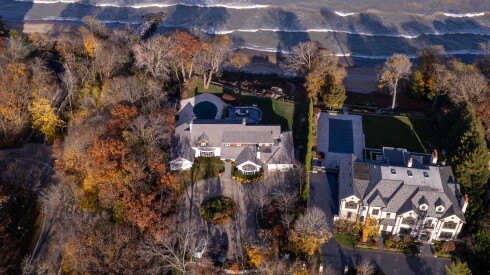
Jill Fitzgerald, the owner of this home (center) on Sheridan Road in Winnetka, received massive property tax breaks under Illinois’ low-income senior citizens assessment freeze, a program that allows people 65 and older with a household income of no more than $65,000 to get tax relief on their primary residence.
Sun-Times file photo
- Barbara and Martin Israel had to repay $119,806 in property taxes, penalties and interest for wrongly collecting the low-income senior assessment tax break in 2019 and 2020 on their $3 million condo in Water Tower Place with stunning views of Lake Michigan.
- Then-Ald. Walter Burnett Jr. and his wife Darlena had been collecting homeowner exemptions on their house and a rental property, the Sun-Times reported five years ago, though they can claim an exemption only on one property. Kaegi made them repay $4,718 in tax breaks they received on their rental property along with $5,727 in penalties and interest.
- Annette Guzman, who recently resigned as Mayor Brandon Johnson’s city budget director, had been wrongly taking homeowner exemptions on her Bronzeville home as well as a South Loop condo for five years until the Sun-Times raised questions earlier this year. Guzman ended up repaying $3,432 in tax breaks she got on her South Loop condo along with $2,405 in penalties and interest, according to Kaegi’s records.
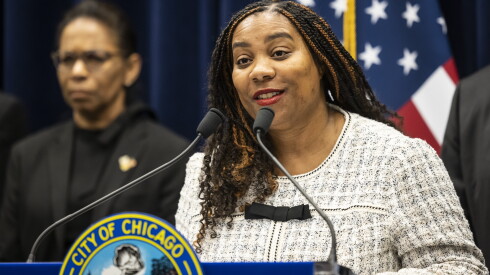
But Kaegi’s office then renewed her homeowner exemptions on both her house and the condo, according to her tax bills that are due Oct.1. Each exemption will lower her tax bill by $688 this year. Kaegi’s office says she will have to repay the tax break on her condo.
- Convicted mobster Joseph Lombardi died in 2013, but his senior citizen tax breaks on his Bridgeview home continued for six years — until the Sun-Times found that someone had kept filing applications in his name. Kaegi’s office ended the tax breaks five years ago, filing a lien against the home to recover $16,271 in back taxes and interest. Cook County finally received the money this past spring, after the federal government foreclosed on the home.