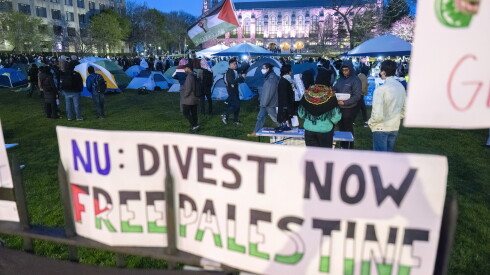
In May 2024, when Northwestern University made a deal with pro-Palestinian student protesters to dismantle their encampment, Fox News headlined its story this way: “Northwestern professor, whose school gave in to anti-Israel agitators, is son of notorious terrorist radicals.”
Even when Zayd Ayers Dohrn is secluded in his ivory tower along the shores of Lake Michigan and minding his own business, he can’t escape the taint of his parents’ revolutionary past.
“I of course had nothing to do with that deal and nothing to do with the protests,” said Dohrn, a playwright, screenwriter and the aforementioned Northwestern academic.
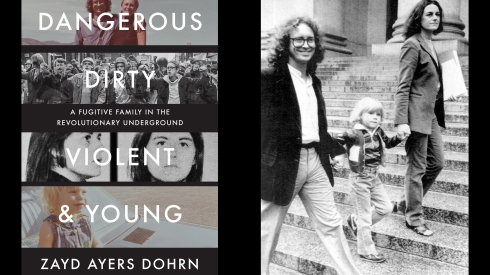
In his memoir, “Dangerous, Dirty, Violent, & Young,” published in May 2026, Zayd Ayers Dohrn recounts his childhood as the son of Weather Underground revolutionaries and the family’s life as fugitives. Bill Ayers (left), Zayd Dohrn and Bernardine Dohrn walk outside federal court in New York in 1982.
Provides; AP Photo/David Handschuh
Dohrn, 49, has come to accept as “inevitable” that anyone writing about him will dust off the exploits of his parents, Bill Ayers and Bernardine Dohrn, leaders of the Weather Underground, a militant leftist group that went to war with the U.S. government in the 1960s and early ’70s. His mother was at one point on the FBI’s “Ten Most Wanted” list.
But despite his mother’s hopes that he would follow in her revolutionary footsteps, he became a writer and an academic who still struggles with how his parents were willing to risk everything — including tearing the family apart — to fulfill their radical ambitions. He lays bare those feelings in “Dangerous, Dirty, Violent, & Young,” Dohrn’s memoir about his parents and the family’s life as fugitives, published earlier this year in May.
The book comes on the heels of “Revolution(s),” Dohrn’s first musical and a collaboration with Rage Against the Machine’s Tom Morello, which premiered at the Goodman Theatre last year.
Dohrn calls America’s wealth gap “grotesque,” but his liberal worldview is less rigid than that of his parents, often in surprising ways.
Campus “trigger warnings” and “safe spaces” are well-meaning concepts that went too far, said Dohrn, who is tall and angular but also bears a striking resemblance to his mother.
“Then it was institutionalized, and now kids get indoctrinated by deans giving orientations about safe spaces and they react against that,” Dohrn said, calling such orientations “ridiculous.” “My students find it deeply patronizing and absurd.”
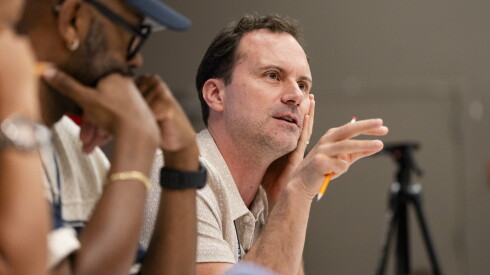
Dohrn explores his ambivalence toward so-called hate speech on university campuses in his new play, “The Humanities,” which opens Sept. 13 at Victory Gardens Theater, and deals with the fallout after a controversial speaker is invited to lecture at an elite university.
“The play is in miniature sort of a metaphor for the country, as represented by the university as a place of competing identities that are struggling to form this more perfect union and divided against itself in so many ways,” Dohrn said.
While you can imagine a young Bernardine Dohrn heckling (or worse) Luka Jarry, the fictional right-wing provocateur invited to the play’s fictional Lincoln University, Dohrn sees shades of gray.
“I could get better crowds elsewhere. A higher honorarium anywhere… But this is more important. To me. To all of us. Because where else do people care so much? You know? I mean where else are people so ready? To be changed?” Jarry says shortly after he arrives on campus.
Said Dohrn: “Generally speaking, my feeling is that you meet hate speech with more speech, and we have to find a way to have a healthy enough civic discourse that we can allow bad people to say bad ideas and then combat them in the kind of sphere of intellectual discourse.”
Does that mean sometimes giving protesters the boot?
“If they disrupt the speech to the point where it’s impossible to hear, you have to,” he said.
A childhood among radical outlaws
Our conversation shifts to Dohrn’s parents and his book about their revolutionary lives, a fascinating and also deeply disturbing read.
Before he was 5 years old, Dohrn — thanks to his dad’s instruction — knew how to instantly spot danger.
“A Black guy and a white guy rolling by together, in Harlem? In 1981? Unless they’re Gene Wilder and Richard Pryor, they’re probably cops,” Dohrn writes of his early childhood on the East Coast.
Dohrn’s parents never wasted an opportunity to try to mold their son’s young mind.
“When I begged for a G.I. Joe action figure for my birthday, [Dohrn’s father] tried to explain to me that G.I. Joe was a recruitment tool for the U.S. military, a symbol of American imperialism and macho gun violence — the embodiment of everything our family was fighting against. I didn’t care,” Dohrn writes.
Dohrn returns often to the subject of the peril he and his younger brother, Malik, faced simply by being in the back seat of the car with their outlaw parents, whose campaign against the U.S. government included blowing up buildings (remarkably, no one but three of their own Weather Underground accomplices were killed).
At one point in the book, Dohrn asks his father how lucky he feels for not having to spend decades in prison or destroying his family.
“Every f___ing minute,” replies Bill Ayers. “Every minute. I am 76 years old, and I have felt the most vivid sense of having survived and squeaked through again and again and again.”
But Dohrn said that as a child, he never felt unloved or neglected.
“In a larger sense, their goal was to make the world a better place for me. It’s complicated, but I don’t see them as selfish, neglectful, abusive, cruel,” he said.
Ayers, now 81, is retired, after a career as a professor in the University of Illinois-Chicago’s education department. Bernardine Dohrn, 84, is a retired Northwestern University law professor. They live in Hyde Park. She has been diagnosed with dementia, her son said, but was still able to read Dohrn’s book and watch his plays.
Dohrn and his novelist wife, Rachel DeWoskin, have two grown children of their own, daughters. One is studying journalism in college; the other is in design school. Neither of them grew up on the run.
“Our family dinners, the conversations are … more about art and less about politics, but they are still intense conversations about the state of the world … and what is each of our obligation to the future,” Dohrn said.
As a parent, Dohrn said he was far less “doctrinaire” than his own parents, although he said he and his wife have raised their kids with a similar sense of “racial and gender justice.”
But how would he feel if his family’s radical tendencies resurfaced in, say, a vote for a high-profile Republican?
“That would be difficult,” Dohrn said, chuckling. “Of course we want our kids to be free thinkers, we want them to be happy, we want them to find lives that they feel are charged with meaning.”