On a tree-lined street on Chicago’s South Side, Darren Hightower rearranges some items in the backseat of his decades-old Chevy Trailblazer. This SUV is where he’s been sleeping most nights recently.
“I just lay my seat back in here, crack my windows [open],” he says. “I probably got some clothes back there, but I don’t make it look like I live in there.”
Hightower is one of dozens of former residents of 7500 S. South Shore Dr., a troubled apartment complex in Chicago’s South Shore neighborhood that was raided last September by federal agents during Operation Midway Blitz, the Trump administration’s sweeping enforcement campaign.
Not long after the raid, a Cook County judge ordered Hightower and dozens of other residents to vacate the building, calling it a “fire trap.” Judge Debra Seaton said she was protecting residents from danger.
“This court is not making anybody homeless,” she said.
Hightower, 41, begs to differ. Now, nearly a year after the raid, he and many of his neighbors are still stuck in limbo, unable to secure housing and unsure of where to go.
The raid was one of the definitive moments of Operation Midway Blitz. After midnight on Sept. 30, allegedly acting on a tip from building management, federal agents rappelled down from helicopters, ransacked the building, and zip-tied residents, including many U.S. citizens. The government said it was going after members of the Venezuelan gang Tren de Aragua, but no criminal charges have been filed against anyone who was arrested that night.
The raid set off a chain of events that laid bare the precariousness of Chicago’s housing system for the city’s low-income renters: the lack of affordable apartments for both migrants and U.S. citizens, the disinvestment from out-of-town landlords, the neglect from property managers, a broken and inefficient courts system, and a virtually nonexistent safety net for the working homeless.
Hightower has experienced all of the above.
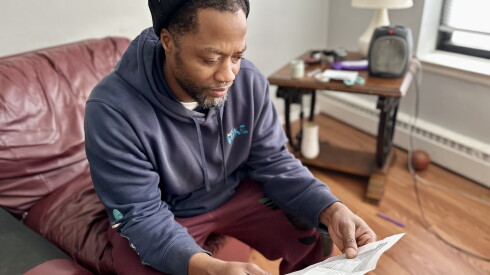
The search for a home
On a freezing day a couple of weeks before Christmas last year, he put most of his belongings in storage and moved out. He and dozens of others scattered throughout the city, many of them finding shelter in hotels paid for by Catholic Charities.
The funds only covered two weeks, so after he left the hotel, Hightower headed to a friend’s place. He stayed there for a few months but wore out his welcome, and has been crashing on couches or sleeping in his truck for the past few months.
The housing search has been brutal, Hightower says. His work schedule makes it hard to go to apartment showings, the application fees are high, and landlords don’t call back. But the biggest problem is the sky-high rents — especially for the “slum-like” apartments he’s seen.
“You go to some of these places, you can see five guys sitting out here selling, you can see the infestation from pests and rodents,” he says. “Some people may call me picky, but I’m not gonna go somewhere I’m still gonna be uncomfortable and be paying a bunch of money. That doesn’t fit well with me at all.”
Hightower adds that landlords are charging $1,000 to $1,200 dollars for a studio, which is well over his budget, after a wrist injury at his warehouse job resulted in reduced hours. He feels demoralized to have a job and still not be able to afford a clean and safe home.
“When you have somebody who’s actually working, and they’re still out on the streets, still don’t have any foundation for themselves, it sucks,” he says.
Years ago, he was approved for a subsidized apartment through the Chicago Housing Authority. But he still sits on a wait list. When Hightower logs into the CHA portal, it shows an estimated wait time of “more than 25 years.”
“It is what it is,” Hightower says. “They may call me sooner, they may never call me. I can’t wait on that. I just have to keep trying to figure it out for myself.”
When asked if he would consider going to one of the city’s homeless shelters, he shakes his head. Hightower has been in homeless shelters before, as a kid, and doesn’t want to go back.
“A shelter is like prison in its own way,” he says. “[There are] rules and regulations you have to abide by. You might have a time that you have to be there in the evening, you can’t be there during the day, you have to protect your possessions. It’s not something I would wanna go through again.”
So for now, he chooses his car.
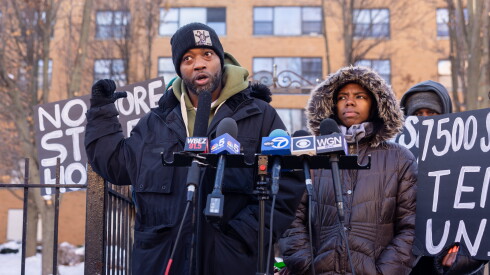
Resident Darren Hightower speaks during a press conference at the 7500 South Shore apartment complex on the South Side, Monday, Dec. 8, 2025. The complex was raided by federal agents on September 30th during Operation Midway Blitz and now tenants are being forced to vacate by the end of the week. | Candace Dane Chambers/Sun-Times.
Candace Dane Chambers/Sun-Times
The cost of homelessness
Jonah Karsh, a housing organizer with the Metropolitan Tenants Organization (MTO), says Hightower is not the only resident from the South Shore building still struggling to secure housing.
As of March, Karsh says, at least 17 families from the South Shore building were still without permanent housing, staying with relatives and friends or living in their vehicles. A handful of people had found new places to live, especially if they had housing vouchers through CHA. Dozens more were unreachable, with many phone numbers disconnected.
“The overwhelming feeling was dejection and resignation,” he said of his conversations with former tenants of the building.
Karsh says the immigration raid was an “extraordinary” event, but what happened in the building before and after was “not unusual at all.” The conditions there and the aftermath reflect the intractable and systemic housing problems in Chicago, he says, and usually, “the tenants are the ones who pay the price.”
Darren Hightower says what happened to the tenants from 7500 S. South Shore Dr. could have been prevented.
“[There’s] a ton of things that could have been done to avoid people thrown out on the street or forced out of their homes,” he says.
Hightower believes the Wisconsin-based landlord, Trinity Flood, could have invested in the building instead of milking it for profit. The old property managers could have repaired broken elevators and provided security. The judge could have ordered the court-appointed receiver who replaced the property manager to fix the hazardous conditions. She could have given residents more time to find new homes.
But none of that happened, Hightower says, and now he and others bear the cost of homelessness.
Not having an apartment has taken a toll on his sleep, his eating, and even his work, he says.
But the hardest part is how helpless he feels. Hightower takes pride in doing things for others and doesn’t want his loved ones to know what he’s going through. He says without the foundation of a home, he “can’t do anything for anybody” — not for his siblings, his nieces and nephew, or for his friends.
Despite feeling this way sometimes, Hightower tries to look on the bright side.
“I still have my job, I still have my vehicle, I still have my health, I still have my looks — look at me,” he says, laughing.
He’s not sure where he’ll be when the cold weather sets in, especially since his car has been giving him trouble lately. But he hopes he will find an affordable apartment before it gets too chilly.
For now, he says, “I’m a rolling stone — doing what I gotta do and staying where I can just to get by.”