As the sun sets on Saturday night, Chicago’s Columbus Drive will come alive with a fire-breathing dragon, giant animal puppets, and scores of drumlines and dance troupes.
The annual Arts in the Dark parade, now in its 12th year, is not your typical parade. No politicians, no beauty queens, no groups in matching T-shirts tossing candy in the hot, noon sun. Instead, this night of spooky festivity is all about putting on a performance and celebrating parading as an art form, said Mark Kelly, the event’s co-founder and artistic director.
“It’s about as close as you’re going to come to Mardi Gras in Chicago,” said Kelly, the city’s former cultural commissioner. “It’s not Mardi Gras, but it sort of captures that.”
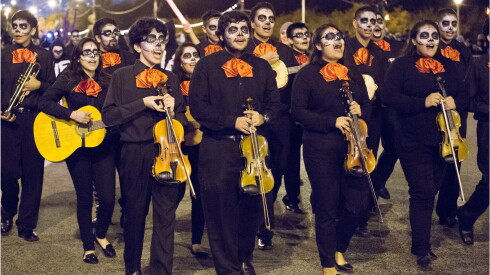
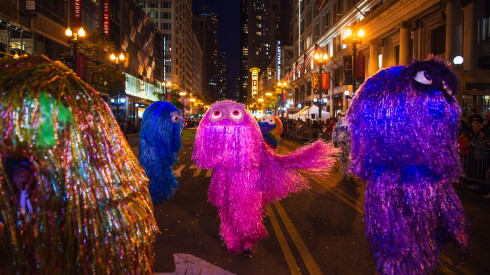
Last year, both rainy weather and Operation Midway Blitz dampened the parade’s festive flare. But one year later, there’s an enthusiastic spirit among the roughly 100 groups set to participate. In total, they’ll bring nearly 5,000 performers, ranging from high school marching bands to an all-women lowrider car club. Plus, there will be giant alebrijes, a 60-foot glow worm, circus acts and ballet folklórico dancers.
It’s meant to celebrate the city’s vibrant diversity. Plus, for Kelly, it’s a chance to embrace Halloween as an artist’s holiday.
“It’s the purest of all of the holidays in this country, and we’re declaring it as ours,” Kelly said. “Think of it as, if Pride is a celebration of queer culture in Chicago, Arts in the Dark intends to be a celebration of the creative life of our city.”

Chicagoans have embraced the celebration in droves. After being held for several years on State Street, this year’s parade will move east to Columbus Drive to accommodate the crowd, which regularly measures around 100,000 people.
On Tuesday night, about 100 participants filed into a Columbia College lecture hall for the parade’s kickoff meeting.
Costume and puppet-maker Heather Bielawski showed a video on her phone of a giant Highland cow, which will be among the about 60 animal puppets she plans to bring on Saturday night to help kick off the parade.
“That one is so close to being done, and it will be done,” said Bielawski, AKA Rogue Llama.
Bielawski is a veteran of this parade So, too, is Neil Verplank of Capn Nemo’s Flaming Carnival. Verplank’s parade plans this year include an approximately 25-foot-long sea serpent that breathes fire.
What does Verplank, a jack-of-all-trades artist and fire enthusiast, like about this event? “I mean, selfishly, they let me be in it,” he said.
Still, Verplank — who sits up front at Tuesday’s meeting and shows enthusiastic support as other groups in the room introduce themselves, by way of each reading a haiku — is set to hang it up after this year. Or, at the very least, scale back.
“This is probably the last year that I’m going to head up anything this big,” he said. “I’m kind of downsizing my life as I, you know, am no longer entirely young. But never say never.”
For Jazmine Cooper, who is here with CICS Wrightwood Dance Ensemble, this parade is a chance for her young South Side dancers to have a serious audience.
“My students don’t get that much exposure being on the South Side of Chicago,” Cooper said. “The fact that we get this opportunity every year and we bring it every year with a different theme, it’s just super exciting.”
This year, their theme is a blend of 1970s meets Soul Train meets vampires and monsters. The exact kind of off-the-wall, no-limitations creativity that this parade encourages.

In the 12 years since it started, Kelly says the performance aspect has only grown stronger. Rather than a disjointed parade of 100 separate groups, Kelly sees the event as one large choreographed show.
“You are a theater production,” he told participants Tuesday. “Each of you bringing something magical to the street: More spectacle, more puppetry, more choreography, masks and costumes are getting stronger. It’s truly going to be a brilliant evening.”
The room is buzzing with energy. But Kelly is also aware of who isn’t here. He says the city’s largest, most established arts organizations — what he calls the “big dogs of our cultural world in Chicago” — haven’t embraced the parade the way smaller, neighborhood groups have.
“I think they’re supremely challenged by this,” Kelly said. “Like, ‘what do you mean we’re going to parade? We don’t do that.’ But as we go forward, I want every cultural organization to feel that they need to be in the parade. Because if this is our Pride parade for cultural life in the city, everyone needs to be part of it.”
Courtney Kueppers is an arts and culture reporter at WBEZ.