People across the greater Chicago area on Tuesday were dealing with the effects of the heavy thunderstorms and four confirmed tornadoes from the day before.
A clear, sunny day brought some relief, as floodwaters receded, basements could at least start to dry out, damages were assessed and power was being restored across the region.
Officials said the communities hit hardest during Monday’s storm include Chicago Heights, Maywood, Crestwood, Bolingbrook, University Park, Libertyville and portions of the South Side.
The four tornadoes touched down in the south and west suburbs, survey teams with the National Weather Service confirmed Tuesday afternoon and evening.
One tornado hit south suburban Lansing, while another passed through south suburban Country Club Hills, Hazel Crest, Harvey and Homewood. Both tornadoes had gusts topping 110 mph, according to the weather service.
The other two tornadoes hit west suburban Glen Ellyn and south suburban Orland Park, each with winds reaching a max of 85 mph, according to the weather service.
Big wind gusts were recorded elsewhere across the city and suburbs, topping out at 82 mph recorded in Waukegan, according to the weather service. Midway Airport recorded winds of 73 mph, and O’Hare Airport saw 65 mph winds.
The weather service said it also confirmed damaging straight line winds in Carol Stream and Downers Grove, and that surveyors would continue to assess the damage across the region.
Besides the damaging wind, the downpour flooded hundreds of basements.
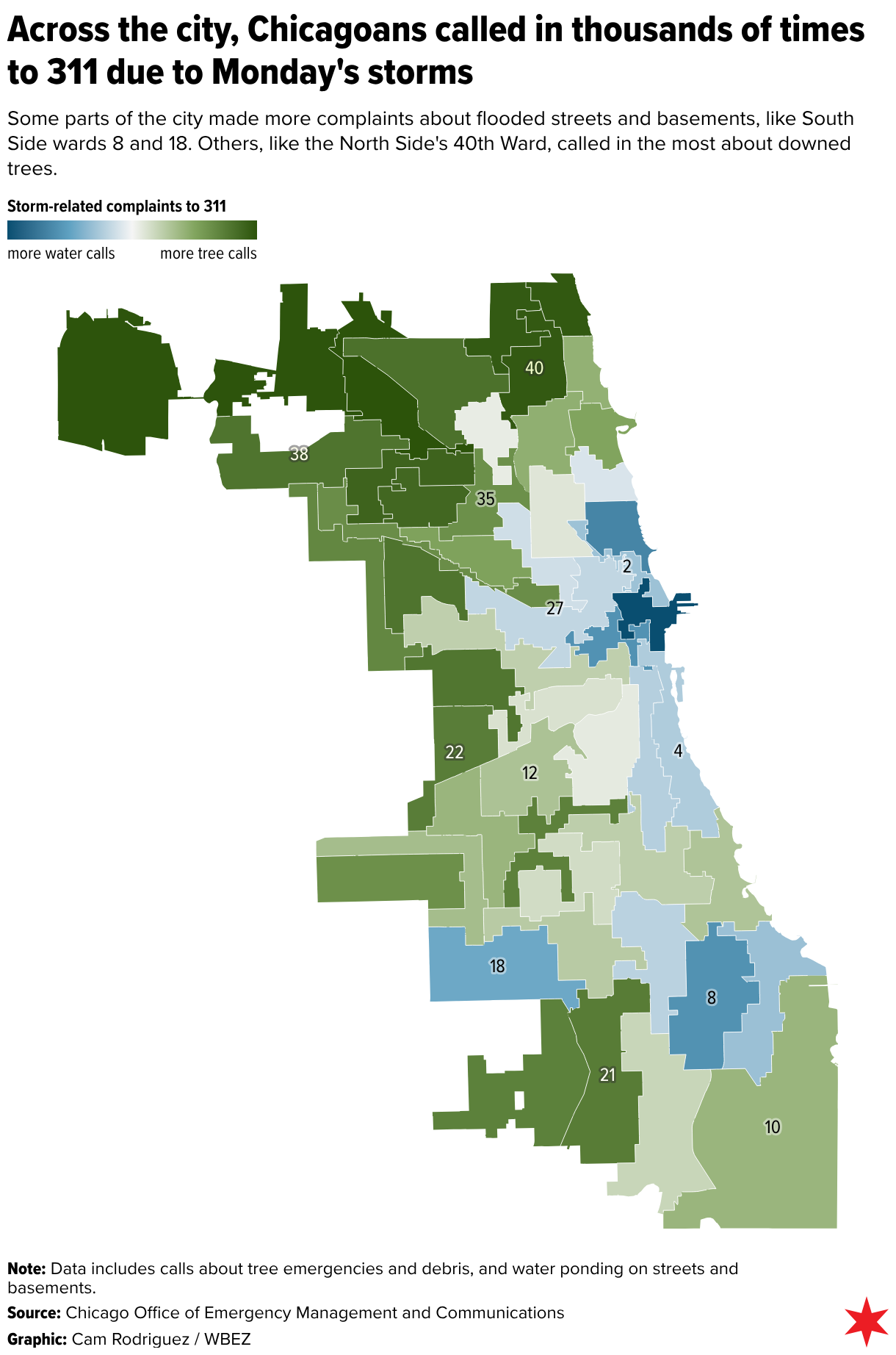
Chicago reported at least 599 flooded homes, according to the city’s Office of Emergency Management and Communications. Among Chicago’s wards, the one with the most reports of flooded basements was the 8th Ward on the Far South Side.
In some pockets of Cook County those 2 inches of rain fell in just two hours, according to the Metropolitan Water Reclamation District.
The heavy rain overwhelmed some streets and drainage systems. Chicago’s official climate station at O’Hare measured 1.76 inches, while Midway received 2.94 inches. Much of the Chicago area saw 2 to 4 inches of rain.
The two major reservoirs managing that rainfall both are filling, with one nearing capacity according to the MWRD, with McCook Reservoir about 93% full, storing about 4.8 billion gallons. The Thornton Reservoir, to the south, is about 42% full, storing nearly 3.6 billion gallons.
In Downers Grove, meanwhile, crews on Tuesday recovered the body of a contractor trapped in a Downers Grove storm drain during the storm.
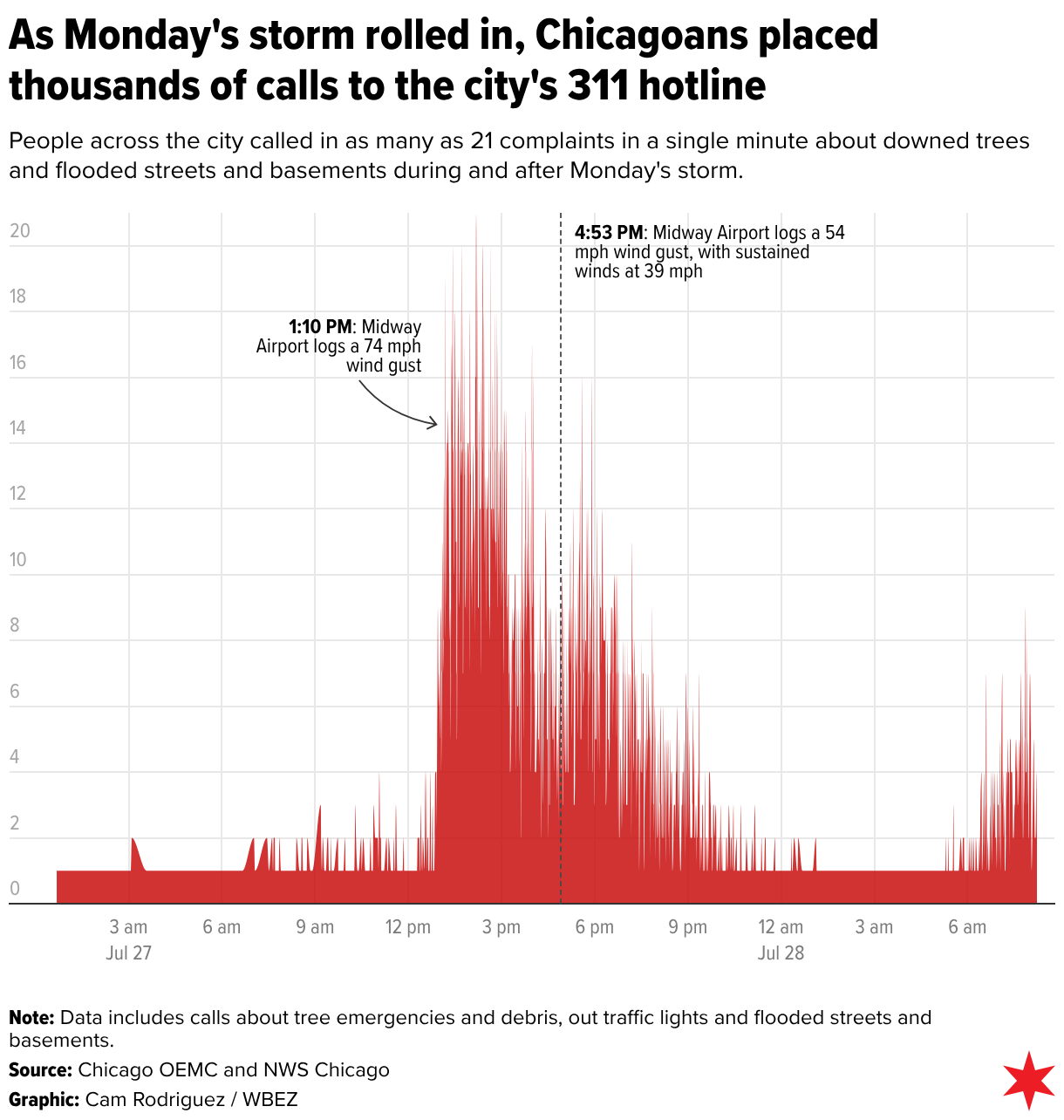
Besides all those flooded basements, Chicago also reported receiving 2,322 calls about trees that were down or damaged, and 973 reports of tree debris. Add that to the roughly 40,000 requests for service involving downed or damaged trees, or tree debris, the city received from June 10 through July 7, when several intense storms hit the city.
Chicago officials also said the recent storm led to 623 reports of water on streets and 47 flooded viaducts around Chicago as well as 310 traffic signals out; 220 streetlights out; 160 downed wires; and 116 damaged streetlight poles as of Tuesday afternoon.
According to ComEd, more than 530,000 customers lost power as a result of the storm. By Tuesday morning, crews had restored electricity to nearly 300,000 customers, according to ComEd. The utility expects that by noon Wednesday it will have restored power to about 80% of those who lost their electricity. The rest of ComEd customers will have power restored by 10 p.m. Friday, according to the utility.
In south suburban Crete, Kristin Webster said she heard wind and rain whipping through her neighborhood Monday afternoon. By the time the storm passed, much of the village lost power, and for Webster, it still hasn’t been restored.
Webster, 46, observed several downed trees in the area, including two that crushed her neighbors’ cars. But the most frustrating part of dealing with the storm’s aftermath has been how long it’s been since the initial damage.
“Nobody should be put in the situation where they can’t have the normal comforts of home, especially 30 hours later,” she told the Chicago Sun-Times. “I’ve never seen anything like this.”
Webster said she anticipates throwing away refrigerated food that will go bad before power is restored, and she plans to drive 40 minutes south to a friend’s home that has power in order to refrigerate some medication.
In a post on social media, ComEd acknowledged the frustration people without power are facing, but said the severe weather is nearly unprecedented, and it will take time to restore power to everyone.
“When storms cause this level of damage across dozens of communities at the same time, restoration becomes significantly more complex,” the post reads.
Additionally, AT&T has reported wireless disruptions primarily within Cook and DuPage counties. An AT&T spokesperson said “we are working as quickly and safely as possible to restore service.”
The Illinois American Red Cross has also opened two shelters, in Steger and Gurnee, to help those affected by the storm. According to regional communications director Connie Esparza, many Illinoisans have come to the shelter for access to electricity and food, with some staying overnight.
As cleanup efforts continue, officials are urging residents to avoid downed power lines, report hazards and use caution while traveling through areas still affected by flooding, fallen trees and power outages.