The “picker” arrived late in July at a Michigan estate sale in search of albums and mid-century furniture. But in a hallway leading to the garage, he stumbled onto something else: a small painting that depicted nine shells.
Intrigued, he took a chance on it, paying $30.

It turned out to be a big find, an unlikely discovery of a prime work by Gertrude Abercrombie (1909-1977). The Chicago painter created distinctive, introspective works that merge the real and dream-like – enigmatic self-portraits, barren landscapes, empty interiors and quirky still lifes.
The newly uncovered work, titled “Alderman Merriam’s Shells” (1951), is scheduled to be sold Thursday in a post-war and contemporary art auction at Freeman’s in New York. It is estimated to fetch $150,000 to $250,000.
“It’s two things,” Zachary Wirsum, a senior vice president at Freeman’s, said of the buzz around the painting. “Everyone loves these discovery stories, that kind of ‘Antiques Road Show’ moment, the big aha. And it’s also just an exceptional example.”
After some initial research, the consignor of the 8-by-11-inch work, who wishes to remain anonymous, altered a family vacation to visit a touring Abercrombie retrospective, “The Whole World is a Mystery,” that happened to be on view at the Milwaukee Art Museum this summer.
While there, he found a photograph of “Alderman Merriam’s Shells” in the exhibition catalog that was featured alongside a 1952 Chicago Tribune review of the artist’s exhibition at the Newman Brown Gallery. The image even showed the actual shells that are depicted in the work.
The final authentication of the work came from Susan Weininger, a professor emerita of art history at Roosevelt University and an expert on Abercrombie. The painting had been originally traded to a doctor in Kalamazoo, Mich., for medical services, and it remained in his collection until the estate sale.
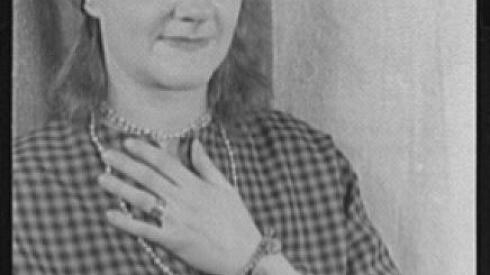
A native of Texas and the daughter of opera singers, Abercrombie spent most of her life in Chicago. Her undergraduate degree was in romance languages but she also studied commercial art at the American Academy of Art in Chicago and won awards in 1936 and ’38 in annual exhibitions of Chicago-area artists featured at the Art Institute of Chicago.
In 1948, she married her second husband, music critic Frank Sandiford, with Dizzy Gillespie performing at their wedding. They lived a bohemian lifestyle in which jazz artists like Sonny Rollins, Max Roach and Jackie Cain came for jam sessions in the couple’s Hyde Park home.
Abercrombie did have some solo shows, but she mostly sold her work at art fairs and through a gallery at Marshall Field’s department store. The artist had what Wirsum called a “cult following” among local artists and collectors but gained little in the way of national acclaim in her lifetime.
Her work could still be found at garage sales and thrift stores in the 1970s, ‘80s and even into the early 2000s, but her acclaim and the prices of her art have risen dramatically. This past March, a 1956 painting titled “Little Owl and Moon” sold for $256,000 at auction.
Eric Crosby, director of the Carnegie Museum of Art in Pittsburgh, has always been interested in artists who have eluded easy categorization and challenged standard assumptions about American art history. He sees Abercrombie as one of those artistic outliers.
Crosby co-organized a touring retrospective that opened in January 2025 at the Carnegie Museum and traveled to other two venues, including the Milwaukee Art Museum, where it ran earlier this year.
Abercrombie’s paintings are often described as surrealist, and Crosby understands such characterization. But he sees her work as more autobiographical and personal rather than surreal, which suggests a play of the unconscious.
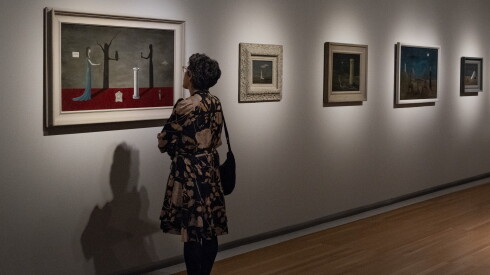
Eric Crosby co-organized a touring Abercrombie retrospective that opened in January 2025 at the Carnegie Museum in Pittsburgh, pictured here. After witnessing the enthusiasm around the exhibit, he is not surprised that the story and sale of “Alderman Merriam’s shells” has generated so much interest.
Zachary Riggleman/Carnegie Museum of Art, Pittsburgh
“I think Gertrude Abercrombie,” he said, “is quite conscious about the staging of her scenes and the objects she brings into constellation, and each one has the feeling of a musical chord or a tone poem or some other register beyond the visual.”
When considering the history of 20th Century American art, Crosby said, the focus for too long has been on New York City. But curators are increasingly looking at what was happening elsewhere, especially in Chicago.
“The unique conditions in Chicago during Gertrude Abercrombie’s time,” he said, “her relationship with other painters, writers and poets and particularly her close relationship with Black jazz musicians created a really fertile artistic context.”
Crosby witnessed the enthusiasm around the Abercrombie retrospective, so he is not surprised that the story and sale of “Alderman Merriam’s shells” has generated so much interest. “There is something about this artist that people find uniquely fascinating,” he said. “When a new painting is revealed, people are attracted to the news of it. It’s wonderful.”