American robins are so seemingly ubiquitous in the Chicago area, and across the United States, that they’re often not given a second thought. Estimates put their North American population somewhere between 350 million and 400 million.
Hundreds if not thousands of robins are known to descend each fall on a natural area near Horsetail Lake in the south suburbs, showcasing their vast numbers and often-overlooked beauty as they gobble up native berries. And a single Chicago or suburban park could feature dozens of the songbirds at any given time, hopping around, pecking for food.
Yet there are signs of decline for the winged creatures, known for their orange chests, sky-blue eggs and piercing, happy whistle.
Their numbers are believed to be down across the Midwest and much of the country, with an estimated drop of about 10% to 20% in the Chicago region between 2012 and 2022, according to the Cornell Lab of Ornithology eBird database that relies on on-the-ground observations and computer modeling.
The North American Breeding Bird Survey, which is overseen by the U.S. Geological Survey and involves thousands of observers counting birds along designated routes each year, shows that in 2024 the “relative abundance” of robins in Illinois was at the lowest point since 1984. Their numbers are down more than 26% in Illinois since 2000, the survey found.
Wildlife experts agree there’s likely a decline, while acknowledging there’s not yet enough scholarship to fully understand what’s occurring, and why, particularly in urban areas like Chicago.
“I think so much of science” can be “biased toward species that are on the brink,” says Emily Williams, an avian ecologist specializing in robins and studying at Georgetown University.
“I think we should really be paying” more “attention to the common species,” according to Williams, who says that what’s known about changes in the robin population should serve as a “massive warning bell.”
Besides their obvious aesthetic and importance to ecosystems, robins can be indicators of larger environmental problems affecting not only wildlife, but also humans — with studies in Michigan, for example, using the birds as a gauge for lead levels in the ground.
The toxic metal can harm child brain development, and in polluted areas it can permeate the soil where earthworms, a favorite food source for robins, reside.
A study published in 2019 in the Wilson Journal of Ornithology observed that “robins could serve as sentinels of environmental change at a continental scale.”
Recent research also suggests that migratory patterns are likely changing for robins in parts of the country, with more of them appearing to stay put in the traditionally cooler areas throughout the year, including the Midwest, rather than heading south for more warmth during the winter.
Some estimates have roughly a third of robins sticking in parts of the Midwest over winter, though the same robins might leave one year but stay another — likely depending on not only acceptable temperatures, but availability of food, including invasive species such as berry-producing honeysuckle.
Some robins also may be deciding to migrate on the fly, so to speak, later in the season.
“Robins have a versatile migration system where they don’t necessarily leave at a scheduled time like more stereotypical long-distance migrants might,” says ornithologist David Ziolkowski of the USGS. “They can make decisions when to leave based on what local weather conditions are like… they could ostensibly decide to stay longer, or shorter” in places including Chicago.
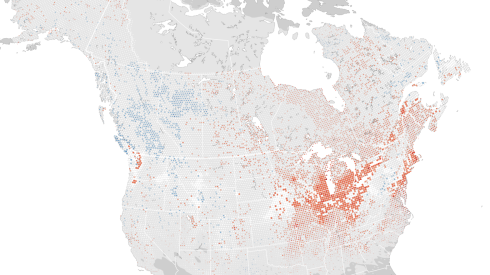
From 2013 to 2023, the number of robins counted in Illinois by volunteers as part of the National Audubon Society’s annual Christmas Bird Count, conducted in December and January, was up more than 5% each year, on average.
While some of them may be local birds staying year-round or leaving later in the winter, other robins migrating from further north “are coming to Chicago” and finding “the winter climate is warm enough” that they may stay throughout the winter, says Stephanie Beilke, senior manager of conservation science for Audubon Great Lakes.
“Their ability to overwinter is also influenced by food availability, not just temperature.”
Chris Anchor, a senior wildlife biologist at the Cook County Forest Preserve District, says: “When I was a child they’d typically migrate… now, they only go as far south as they have to.”
The broad implications of such changes aren’t yet clear, though there are challenges, and perhaps a few benefits, associated with it, experts say.
A potential upside: earlier breeding and nesting in places such as the Chicago region could ultimately mean more robin eggs overall since mothers can give birth to several “clutches” in a given season and, the longer the season, possibly the more eggs and new birds.
A potential downside: while climate change translates into warmer temperatures, it also is bringing more unpredictability in weather. So an unexpected, prolonged subzero period in the middle of winter, for instance, could be a death knell for robins that remained local.
A project that got underway earlier this year involving the Windy City Bird Lab and the Illinois Audubon Society is counting migratory birds in Chicago, and researcher Mike McBrien says so far they’ve counted more than 125,000 birds from an observation point near Burnham Harbor, with more than 3,600 of them robins.
Given how fresh that initiative is, it may take another few years “to give you a more hard line of how they’re doing,” McBrien said of the robins.
Among the most understudied areas of robin concentrations are urban areas such as Chicago, said the Field Museum’s Douglas Stotz, an ornithologist.
Any decline in robins fits into a larger problem for birds, whose numbers are plummeting amid climate and habitat changes often brought on by humans, experts say.
A 2019 scientific study “documents a long-developing but overlooked biodiversity crisis in North America — the cumulative loss of nearly 3 billion birds” since 1970, with the population loss “not restricted to rare and threatened species,” but also “many widespread and common species that may be disproportionately influential components of food webs and ecosystem function.”
“Extinction of the passenger pigeon (Ectopistes migratorius), once likely the most numerous bird on the planet, provides a poignant reminder that even abundant species can go extinct rapidly.”
Relying on USGS data, Princeton University’s Gates Dupont and Andy Dobson published a study last year that concluded “the most common species caused most of the total losses in abundance” of birds in North America over the last 60 years.
While some other common birds are worse off than robins, the robin population nationally, and in the Eastern Tallgrass Prairie that includes Illinois, are among those that appear to be sliding after peaking two decades ago, the study found. However, the numbers were above where they were in the late 1960s when the USGS began collecting data.
Among the things that scientists believe are affecting bird populations:
- Pesticides are killing off insects that birds would traditionally eat, limiting food sources.
- Natural areas are being developed commercially or into farmland.
- Buildings in Chicago and beyond are serving as kill zones as birds slam into them during flight, with volunteers for a group called the Chicago Bird Collision Monitors looking for survivors that tumble to Loop sidewalks during migratory periods after impacting high-rises and can hopefully be rehabilitated.
The organization’s Annette Prince says of robins: “We do find them in collisions, but in no more frequency than previously… all birds are at a risk right now.”
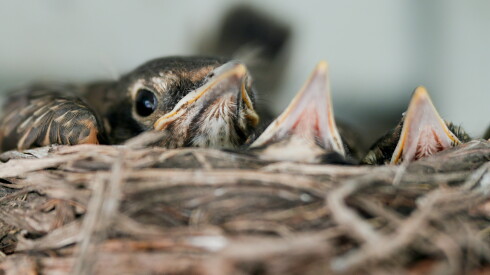
The modern trends suggest that “common birds” may not “always be common,” says Andrew Farnsworth, a visiting scientist at the Cornell Lab.
Referring to the robin, Farnsworth added: “Is it in free fall? Probably not. But are there warning signs? Yes.”
Beyond addressing the larger environmental problems leading to population decline, there are things that regular folks can do to help robins and other songbirds, experts say.
Decals and other objects can be placed on large windows at home to reduce the chances of birds slamming into them.
Native greenery can be planted that attracts and sustains robins and other native species.
Cats should be kept indoors, given their tendencies to devour birds — including a mother robin that Williams said she had banded and been studying in suburban Washington, D.C., in recent years.
And if you find a robin egg?
If the nest is right there and you can safely return it, then that’s probably fine, experts say.
But most of the time the best response is probably to do nothing.

Says Mark Hauber, a professor of animal behavior at the City University of New York’s Graduate Center: “If it’s fallen, chances are it’s broken or cracked.”
That means “that egg isn’t going to be viable,” says Hauber, a former professor at the University of Illinois in Urbana-Champaign.
Plus, if it’s cracked, bacteria can get in there, and if you put it back in a nest it could “infect the other eggs.”
Or just as bad, the smell from a rotting egg could lure in more predators who then gobble up the viable eggs, Williams said.
She said people shouldn’t underestimate the positive impact songbirds have on our mental health, noting: “Our outside environment” would be “a lot sadder without the songs of the robin out your door.”