The door, disguised as a bookcase, stands ajar, spilling a muted light and offering a peek into a hidden chamber.
It is the kind of secret place to tempt a child’s curiosity.
But once inside, the visitor is transported not to a cozy refuge, but to the darkest of times — of blackout screens, food rationing, the threat of machine gunfire outside and constant fear.
“Not being able to go outside upsets me more than I can say, and I’m terrified our hiding place will be discovered and that we’ll be shot. That, of course, is a fairly dismal prospect,” wrote the girl who would spend two years in that secret annex, 13-year-old Anne Frank.
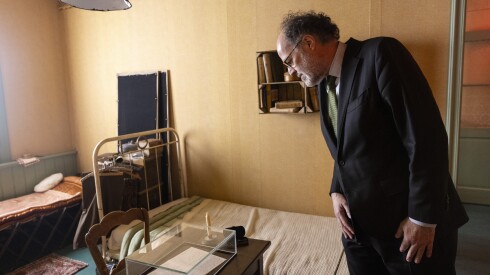
The full-scale recreation of the Frank family’s hideout during World War II in Amsterdam is the extraordinary centerpiece to the Griffin Museum of Science and Industry’s “Anne Frank The Exhibition,” opening Friday and running through early 2027.
“It is meticulously recreated. It is what it was when they were in hiding,” explained Ronald Leopold, executive director of the actual hideout in Amsterdam, which has been preserved as a museum.
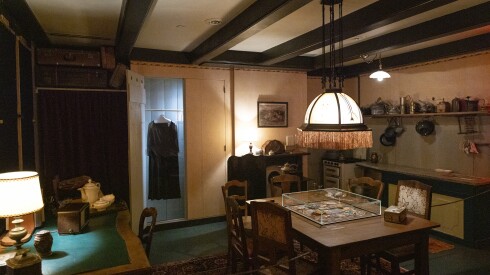
Even the annex’s gloomy light, falling on stark wallpaper and narrow cots with scuffed metal frames, feels like it has been somehow time-traveled from the Nazi-occupied Netherlands. The spartan furnishings are not original but are from the World War II era.
But sprinkled among them, visitors will find, behind clear plastic cases, genuine artifacts belonging to the Frank family, including Anne’s first photo album.
In a room before visitors enter the annex, they see a smiling Anne, her blue eyes radiating hope and possibility. On the walls surrounding her face: Giant projections of her diary words appear, the fountain pen ink looping across the projected page with a scratchy urgency — as if the teenager somehow knew her eventual fate.
The exhibit, much of it presented on somber matte-black walls, tells the story of Anne’s early life in Frankfurt, Germany before the family, fearing the rise of the Nazi regime, moved to the Netherlands in the early 1930s. But in 1940, the Nazis occupied the Franks’ adopted homeland and began imposing ever more onerous restrictions on Jews. When Anne’s older sister, Margot, received a summons on July 5, 1942, to report for transportation to a German labor camp, the family packed up and took refuge in the hideout above a company where Otto Frank, the girls’ father, manufactured pectin (an ingredient in jams and jellies).
The Franks — Otto, Anne, Margot, and the girls’ mother Edith — would spend 25 months cooped up with four other Jews in hiding. They survived for so long with the help of some of Otto’s non-Jewish office workers.
In her diary — written in Dutch — Anne describes her fears, extreme boredom, her longings, hopes for the future.
“While she is being known as the face of the Holocaust, it is incredibly important for us to present her not as a victim. This was a girl who loved life, who radiated life. … She was so much more than a victim,” said Leopold, who also helped oversee the Chicago exhibit.

In Anne’s room, we see magazine clippings of Hollywood movie stars plastered on her walls. Scattered throughout the annex are objects of hope for a life after the war: a bicycle, a party dress.
And in the pages of her diary, we see Anne’s resilience: “It’s really not that bad here, since we can do our own cooking and can listen to the radio in Daddy’s office. … We also have a supply of reading material, and we’re going to buy lots of games. Of course, we can’t ever look out the window or go outside. And we have to be quiet so the people downstairs can’t hear us.”
On Aug. 4, 1944, an SS officer and three Dutch collaborators arrived outside the hiding place, taking an hour before they discovered the secret bookcase door. All eight people inside were arrested and taken away. To this day, it is not known if someone betrayed the Frank family and their housemates.
Anne and Margot were taken to Bergen-Belsen, a concentration camp in northern Germany, where they both died of typhus in early 1945. Edith was taken to Auschwitz, where she died of starvation. Of the eight people inside the annex, only Anne’s father survived. In 1945, the Soviets liberated Auschwitz, and Otto returned from there to Amsterdam.
It was in that city that 70,000 Jews were taken out of their homes within a period of 16 months in order to be murdered elsewhere, Leopold said.
Otto returned to an empty annex, the Nazis having taken everything away. But before they cleared it out, friends of the Franks retrieved as much as they could, including Anne’s writings.
That annex, unlike the recreation in Chicago, is empty — just as it was after Otto returned from Auschwitz.

Near the end of the “Anne Frank The Exhibition” presentation, dozens of editions of Anne’s diary are displayed. The presentation also shows the letter from a New York publisher who turned down the opportunity to take on the project, one that has to date sold more than 30 million copies.
Manuel Martinez/WBEZ
“In Amsterdam, it’s very much about absence: Who is not there anymore, what is not more anymore,” Leopold said.
Otto rarely spoke about his own pain at the loss of his family.
“He was able in one way or another to cope with his loss and to transform it into a mission for the future,” Leopold said.
Part of that mission included publishing his youngest daughter’s diary. Toward the end of the exhibit, there’s a letter from a New York publisher declining the offer to take on the project.
“It seems to me unlikely that the [diary] would have a large enough sale to cover the present high cost of production,” the publisher wrote.
Since first being published in 1947, the diary has appeared in more than 70 languages and sold more than 30 million copies.
The exhibit is $19 for adults and $15 for children, not including general admission to the museum. Parental caution is advised. There are, among other things, some grainy black-and-white images of mass killings of Jews.
For more information, go to griffinmsi.org.
CORRECTION, 4-30: The description of artifacts in the exhibit has been updated. The exhibition is an extra charge, not included with admission to the museum as previously stated.