A five-year stadium odyssey could finally come to a head this spring for the Chicago Bears.
The team has secured a sweetheart deal from Indiana lawmakers that would help them build a new dome in Hammond, leaving it up to Illinois legislators to decide on property tax incentives that could at least keep them in their home state, if not their home city.
Here’s what’s at stake with the political football sitting at the goal line as the clock winds down on the legislative session in Springfield.
Why do the Bears want to move?
To make more money. Soldier Field is the smallest stadium in the NFL, and the Bears rent it from the Chicago Park District. Owning a bigger dome would allow the team to sell more tickets and rake in more revenue from concerts and other events.
Where could the Bears go?
Arlington Heights or Hammond, Indiana, are the only choices at this point, according to the team. But they’ve waffled on their preferred destination over the past few years.
The Bears explored a bevy of options across the suburbs and made a full-court press for a new lakefront dome near Soldier Field that was soundly rejected by Illinois lawmakers. Then they leaned heavily toward Arlington Heights but, absent legislative support, announced last fall they were seriously considering crossing the state line to Indiana.
But they’re definitely leaving Chicago?
Yes, barring a sudden change of heart. Mayor Brandon Johnson cheered alongside Bears president Kevin Warren for their lakefront proposal in 2024, but Gov. JB Pritzker and legislative leaders threw cold water on that expensive pitch before the Bears’ press conference even ended. It would’ve required about $900 million in taxpayer funding and at least as much in other infrastructure spending.
Cook County Board President Toni Preckwinkle and other local leaders wanted the Bears to build on the old Michael Reese Hospital site in Bronzeville, but the team says it’s too narrow for an NFL stadium, and they haven’t identified any other workable sites within city limits.
Johnson is still working on a Hail Mary pitch to keep the Bears in the city, but he hasn’t built up much Springfield clout in his term.
Why would the Bears move to Arlington Heights?
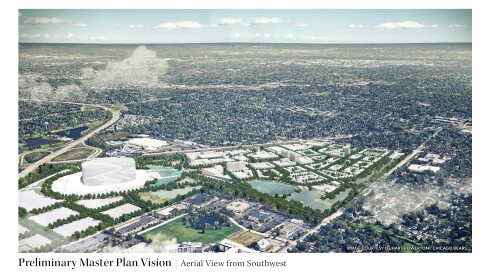
The team paid $197.2 million for the shuttered Arlington International Racecourse in 2023, and there’s no shortage of money-making opportunities across its 326 acres. A new stadium would take up less than half the site, which they’ve envisioned as a mixed-use development with retail, restaurants and residential areas.
It’s also closer to their Halas Hall training facility, which the Bears renovated in 2019 at a cost of more than $100 million. And while Chicago is a Bears town across the board, a huge portion of their fan base lives in the northwest suburbs.
So why haven’t they built a stadium in Arlington Heights already?
Their property tax bill would be astronomical. The team already isn’t thrilled with the $3.6 million they’re paying annually on the vacant Arlington site, and without a change to state law, they’d easily owe upwards of $150 million in property taxes each year when it’s fully developed.
That’s why they want Illinois lawmakers to pass so-called megaproject legislation, which allows companies to negotiate discounted payments in lieu of taxes (PILOT) with local taxing bodies, saving them hundreds of millions of dollars over the next four decades.
What’s on the table in Indiana?
A tantalizing deal for the McCaskey family. Hoosier lawmakers authorized a new stadium authority that could put at least a billion taxpayer dollars into a dome in Hammond, backed by a slew of new taxes on admissions, hotel stays, food and beverages, plus a toll hike.
The Bears, who have committed to spending $2 billion on stadium construction wherever they end up, would retain all revenue generated by the dome and have the option to buy it for a buck once 40-year bonds are paid off by taxpayers.
While many Springfield observers view the Indiana threat as a leverage play for the team to get what it wants in Illinois, the bottom line makes it a tempting proposition.
So why haven’t they left for Indiana already?
The Bears are still going through their due diligence evaluating the Hammond site at the Lost Marsh Golf Course. It’s built over an old industrial dump within sniffing distance of an oil refinery, and situated near a Superfund site flagged by environmental regulators for toxin-tainted soil.
Logistical hurdles aside, the team would also face public blowback for leaving behind not only Chicago but the state that has supported a franchise now valued at nearly $9 billion.
Will the Bears get their megaproject legislation from Springfield?
That’s the billion-dollar question. The megaproject bill that passed the Illinois House last month marked the first significant legislative win for the team after four fruitless years of lobbying Springfield, but it’ll have to be significantly overhauled to pass the Illinois Senate or become palatable for the Bears. The bill sponsored by state Rep. Kam Buckner, D-Chicago, included a number of late additions without consulting the team, Senate leaders or Pritzker’s office.
The main sticking point is a provision calling for half of PILOT payments to be directed toward property tax relief for average homeowners. The governor’s office says that relief would be negligible, and from the Bears’ perspective, it would wipe out much of their potential PILOT savings.
State Sen. Bill Cunningham, the South Side Democrat leading talks in his chamber, said he’s optimistic they’ll find common ground in the next few weeks.

What are the political stakes?
No Chicago legislator wants to be held responsible for letting the team leave the city. That’s also true for progressives, though they are wary of giving any help to a multi-billion dollar corporation while everyday costs rise for average residents.
Pritzker doesn’t want to be remembered as the governor who lost the Bears, and while he’s long pushed for megaproject incentives, he also doesn’t want to be viewed as securing a handout for a lucrative pro sports franchise.
Nor does Johnson want to go down as the mayor who lost the Bears, although he can pin much of the blame on his predecessor, Lori Lightfoot. The question for Johnson is whether his effort to tank the Arlington Heights deal is worth pushing the Bears across the border.
What will it cost taxpayers?
Indiana taxpayers would be on the hook for a whole suite of new taxes to build the Bears a stadium, but it’s harder to pin down the full cost for Illinoisans.
An estimated $855 million in public dollars would be needed to install sewers, water mains, traffic upgrades and other infrastructure to support the Arlington Heights development. But a lot of those projects have already been earmarked and will be done regardless of whether a dome gets built, Pritzker has argued.
Beyond that, megaproject legislation would save the Bears hundreds of millions of dollars that would otherwise be going to local school districts and other taxing bodies. But the officials from the team — and other big businesses that might be incentivized to make big investments and create jobs — are quick to point out the schools are missing out on even more money without big projects raising property values.

What will happen to Soldier Field?
The Chicago Fire will play at Soldier Field until their new, privately funded stadium is finished in the South Loop in 2028.
Soldier Field is still the city’s premier summer concert venue, and Johnson’s administration is looking to secure $630 million from the state for renovations to keep it viable even without 10 or so Bears games on the calendar.
Taxpayers are still footing the bill for the field’s 2003 renovation, with some $467 million in bonds still outstanding.
When will the Bears make a decision?
Soon … probably. Warren has said they’ll name their destination in late spring or early summer. That’s coming from the executive who previously said he wanted shovels in the ground by the end of 2024, and again in ‘25.
But with Indiana’s offer in hand — and under pressure from the NFL to pick a lane — the stadium saga finally appears to be nearing a climax. The team won’t make any announcement until after they see what they get from Illinois lawmakers, whose spring session concludes May 31.
Bills can still move in Springfield after that date, but with a higher threshold for passage that would suggest season-ticket holders should start mapping out their Indiana commutes.