VILNIUS, Lithuania — The cafes and bars in Vilnius, Lithuania’s capital, bustle with fashionably dressed 20-somethings listening to music, sipping mango matchas and drinking local craft beer — what you’d expect in one of the most vibrant economies in Europe and a place recently pegged as having “the world’s happiest young people.”
Thirty-six years after becoming the first Soviet republic to declare independence and more than two decades after joining the European Union, Lithuania is home to six tech unicorns, startups valued at more than $1 billion.
It’s also a place where as prosperity has risen, voter participation has dropped.
But over the past 10 months, Lithuania has shown it hasn’t lost its pro-democracy roots. Thousands of Lithuanians have taken to the streets, most recently in April, to stand up for democracy and freedom of expression, after a right-wing populist party in the government’s ruling coalition tried to control the country’s Ministry of Culture and threatened the independence of its public broadcaster Lithuanian Radio and Television.
Povilas Ušinskis, 18, traveled two and a half hours to march under drizzly skies in Cathedral Square in April. He was marching in support of LRT’s editorial independence, during a protest with an estimated 25,000 people.
“It’s every citizen’s right, and in a way, a responsibility,” Ušinskis says.
Protester Milda Valančiauskienė, 53, worries about the rise of authoritarianism around the world.
“We Lithuanians, we feel when it’s dangerous,” she says. “We feel it’s approaching, even before the real action happens.”
The small country of 2.8 million people — slightly more than Chicago’s population — has some lessons for the U.S. about democracy as it celebrates its 250th anniversary.

|
Ashlee Rezin/Sun-Times

|
Ashlee Rezin/Sun-Times

|
Ashlee Rezin/Sun-Times

|
Ashlee Rezin/Sun-Times

|
Ashlee Rezin/Sun-Times

|
Ashlee Rezin/Sun-Times

|
Ashlee Rezin/Sun-Times

|
Ashlee Rezin/Sun-Times

|
Ashlee Rezin/Sun-Times

|
Ashlee Rezin/Sun-Times

|
Ashlee Rezin/Sun-Times

|
Ashlee Rezin/Sun-Times

|
Ashlee Rezin/Sun-Times


Lithuanians say democracy requires work.
Juozapas Labokas, 38, a high school civics teacher in Vilnius, teaches his students about the history of democracy, the U.S. Constitution, Lithuanian and international law and about the EU and NATO.
“They have to learn how to cast their vote, how to read the laws and other related things that make them citizens,” he says.
Democracy needs community-building, like helping a neighbor or talking face to face, he tells students.
It’s “us acting together, trying to make our living environment a bit better than it was yesterday,” Labokas says. “Lose your smartphone and your social media and go meet each other, face to face.”

|
Ashlee Rezin/Sun-Times

|
Ashlee Rezin/Sun-Times

|
Ashlee Rezin/Sun-Times

|
Ashlee Rezin/Sun-Times

|
Ashlee Rezin/Sun-Times

|
Ashlee Rezin/Sun-Times

|
Ashlee Rezin/Sun-Times

|
Ashlee Rezin/Sun-Times

|
Ashlee Rezin/Sun-Times

|
Ashlee Rezin/Sun-Times

|
Ashlee Rezin/Sun-Times

|
Ashlee Rezin/Sun-Times

|
Ashlee Rezin/Sun-Times

|
Ashlee Rezin/Sun-Times

|
Ashlee Rezin/Sun-Times

|
Ashlee Rezin/Sun-Times

|
Ashlee Rezin/Sun-Times

|
Ashlee Rezin/Sun-Times

|
Ashlee Rezin/Sun-Times

|
Ashlee Rezin/Sun-Times

|
Ashlee Rezin/Sun-Times

|
Ashlee Rezin/Sun-Times

|
Ashlee Rezin/Sun-Times

|
Ashlee Rezin/Sun-Times

|
Ashlee Rezin/Sun-Times

|
Ashlee Rezin/Sun-Times

|
Ashlee Rezin/Sun-Times

|
Ashlee Rezin/Sun-Times

|
Ashlee Rezin/Sun-Times

|
Ashlee Rezin/Sun-Times

|
Ashlee Rezin/Sun-Times

|
Ashlee Rezin/Sun-Times

|
Ashlee Rezin/Sun-Times

|
Ashlee Rezin/Sun-Times

|
Ashlee Rezin/Sun-Times

|
Ashlee Rezin/Sun-Times

|
Ashlee Rezin/Sun-Times

|
Ashlee Rezin/Sun-Times

|
Ashlee Rezin/Sun-Times

|
Ashlee Rezin/Sun-Times

|
Ashlee Rezin/Sun-Times

|
Ashlee Rezin/Sun-Times

|
Ashlee Rezin/Sun-Times


Bloody Sunday
Lithuania is filled with people who talk about the “before,” the years under Soviet occupation, and the “after,” or the period since the early ’90s.
Artūras Pakėnas, 70, who works as a driving instructor in Vilnius, remembers the perilous time around independence — a fight assisted by diaspora Lithuanians in Chicago, who number around 60,000.
Lithuanians had been organizing for years before they declared their independence on March 11, 1990. The Soviet government responded with an economic blockade, then sent tanks and troops.
On Lithuania’s “Bloody Sunday,” Jan. 13, 1991, Soviet soldiers killed 14 Lithuanians who were trying to stop the seizure of the Vilnius TV Tower.
Other Soviet troops tried to storm the parliament building, but 50,000 citizens became human shields and protected the building.
One of them was Pakėnas, who was at a friend’s birthday party when things started to unravel.
“From what I saw on TV, this was not going to be good, and I needed to go out,” he recalls through a translator, while sipping coffee at a sunny cafe in a Vilnius shopping mall.

He says he joined the crowds massing around the parliament building. They felt safety in numbers, despite the carnage at the tower about 4 1/2 miles away.
“Even Russian soldiers wouldn’t dare to just go through those crowds,” Pakėnas says.
That summer, when Pakėnas was working in his new job as a customs officer at a newly established border post, Soviet special police murdered seven Lithuanian officers at the post. Pakėnas worked the previous shift and escaped his colleagues’ fate.
As he talks, shoppers stroll by heading to stores like Michael Kors, Tommy Hilfiger and H&M.
Pakėnas recalls a time when the choice at small Soviet-era shops were “the 22-ruble shoes” versus “the 17-ruble shoes.” Back then, he knew about a more colorful world from Western films and magazines.
“The problem was it was unattainable,” he says. “You couldn’t reach that world.”

‘Just flowers’
Nearly every Lithuanian Gen Xer or Boomer has stories about the country’s struggle for independence.
Audronius Ažubalis, 68, a member of parliament, was a journalist in August 1989, when the Lithuanian independence movement Sąjūdis, working with groups in Latvia and Estonia, organized the Baltic Way demonstration.
The organizers — before cellphones existed in Lithuania — got 2 million people to join hands in a human chain on a highway spanning 419 miles through three Baltic countries to protest Soviet occupation.
Ažubalis recalls driving with friends and family about 15 miles outside of Vilnius to find a free space in the protest.
“We were afraid for any kind of provocations,” he says.
When a small plane flew over the long line of people and started dropping objects, everyone tensed up.

“It was just flowers from the air. It was great,” he says.
A year and a half later, Ažubalis was working as the press secretary for Vytautas Landsbergis, the independence leader and first speaker of the newly reconstituted legislature, when Soviet troops tried to seize the building on Bloody Sunday.
Crowds of civilians held them off.
“Our main advantage at that time was that we were so united,” says Ažubalis, who later served as foreign minister.
Gintautas Bartkus was also in the parliament building, working as a lawyer to help draft the country’s commercial code, a necessary step because under the Soviets, there was no free market.
Bartkus, 60, went on to be a visiting lecturer at the John Marshall Law School, now University of Illinois Chicago School of Law, and served as Lithuania’s justice minister in the early 2000s. He’s now a law professor at Vilnius University.

He recalls a colleague smoking in their office at the parliament building when they heard a commotion. “Someone came and knocked on the door and said, ‘Guys, can you stop smoking? We’re making a Molotov cocktail next to your door.'”
The lawyers stepped out and saw a row of incendiary devices in the hallway. They decided “maybe it’s not the time for drafting the laws,” Bartkus says, and joined the protesters outside.
Bartkus says a democratic system won’t fall apart at once.
“It’s incremental. Each day, step by step, you can lose small parts,” he says.
Actor and director Audronė Bielinienė, 60, who has made two documentaries about the Lithuanian diaspora, says citizens who may have been complacent about civic participation have woken up since Russia invaded Ukraine in February 2022.
Voter participation in parliamentary elections — which hit a high of 75% in 1992, the first election after independence — had fallen below 50% several times since 2004. It rose to 52% in the 2024 election. Turnout for the first round of the presidential election, also in 2024, reached almost 60%.
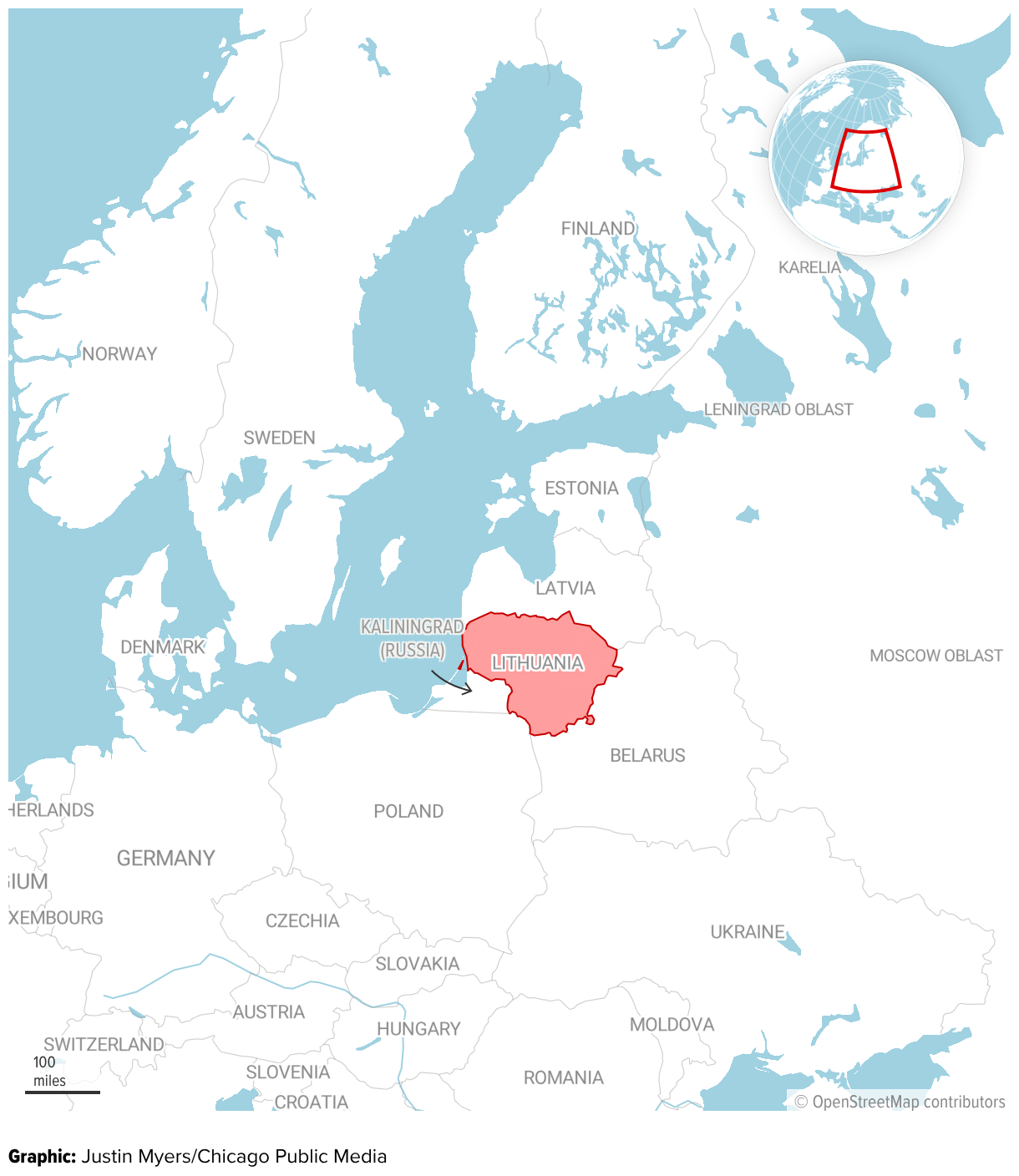
“We are a small country, and we are surrounded from two sides by unfriendly neighbors,” Bielinienė says, referring to Russia’s Kaliningrad and Belarus. “They don’t let us forget that.”
But, she adds, that’s had a positive effect: “We have become more and more active.”

An ongoing fight
Organizations that track democracy and authoritarianism worldwide rank Lithuania on the upswing and the U.S. as backsliding.
The V-Dem Institute at Sweden’s University of Gothenburg put Lithuania in the top tier as a “liberal democracy,” in a 2026 report ranking countries based on factors such as rule of law, freedom of academic expression, public deliberation and media censorship.
It downgraded the U.S. to an “electoral democracy” for the first time in 50 years. The report highlighted a “rapid and aggressive concentration of powers in the presidency” during President Donald Trump’s second term, along with a lack of legislative constraints. It said “the speed with which American democracy is currently [being] dismantled is unprecedented in modern history.”
The Washington, D.C.,-based nonprofit Freedom House gave Lithuania a higher score, 90 out of 100, on its 2026 Freedom in the World map, compared to 81 for the U.S.
Meanwhile, the percentage of Americans who see a democratically elected government as “extremely” or “very” important to America’s identity dropped from about 80% in 2021 to about 66% this year, according to an AP-NORC Center for Public Affairs Research poll. For Americans under 30, the drop is even more striking — only about half share that belief.
Lithuanians say there’s a direct line from their independence fight to the activism happening now.
Karolis Kaupinas, 38, a journalist turned filmmaker and playwright, was 3 years old in January 1991.
His dad had joined the mass of parliament defenders, while he was at home with his mom and grandparents. He remembers everyone watching the news on TV, until soldiers stormed the national broadcaster’s building and pulled the plug.
“The visuals of January 13 — the anchor on TV, who says [of the soldiers], ‘They are walking down the corridor. They’re approaching. They’re smashing the door,’ and then it goes off. That’s the first thing you remember,” he says.
Another image seared into his mind was the next morning, walking to the store with his grandmother and seeing sections of the sidewalk shredded by Soviet tanks.

Kaupinas has been busy with projects, including his new play, “Lithuanian Death Notices: The Story of a Performance,” inspired by a Facebook page he’d seen of a Chicago funeral home.
But in September, alarm bells from his childhood went off.
The populist right-wing party Nemunas Dawn, which had been invited into a governing coalition by the center-left Social Democrats, tried to take over the culture ministry. Then there was a legislative attempt to curtail Lithuanian Radio and Television’s editorial independence.
Kaupinas has helped lead protests for freedom of expression that have expanded across the country. Nemunas Dawn was kicked out of the government in June.
“I have two small kids now, and they’re going to live here after me. And if I want them to have a happy life … I need to leave it to them as good as I found it,” Kaupinas says.
As for Americans, he hopes they reflect on how fragile freedom can be.
“Two hundred fifty years of democracy — I’ll make it a bit blunt — makes you lazy,” he says. “Americans have been sent to wars, but they haven’t seen something like that on their own land for quite some time. I think it’s a natural cycle of a society to forget things that shouldn’t be taken for granted. That’s our danger as well. That’s why we are trying to remember that freedom of speech, democracy — that might disappear. It’s always easy to destroy things but very hard to create them, to rebuild them.”
Suburban hotline
Watching the recent protests from Chicago’s suburbs are George and Viligailė Lendraitis of Palos Heights and Rimas and Audronė Gulbinas of Winfield. The longtime friends helped play a role in bolstering Lithuania’s independence 36 years ago.
Like many Lithuanian Americans in the Chicago area, their family members fled the country and spent decades praying for its independence.
The language classes, dance troupes and summer camps they joined kept diaspora Lithuanians connected to the culture. That’s still the case: Several thousand people attended the Lithuanian Folk Dance Festival of North America in July at the McCormick Center.

|
Ashlee Rezin/Sun-Times

|
Ashlee Rezin/Sun-Times

|
Ashlee Rezin/Sun-Times

|
Ashlee Rezin/Sun-Times

|
Ashlee Rezin/Sun-Times

|
Ashlee Rezin/Sun-Times

|
Ashlee Rezin/Sun-Times

|
Ashlee Rezin/Sun-Times

|
Ashlee Rezin/Sun-Times

|
Ashlee Rezin/Sun-Times

|
Ashlee Rezin/Sun-Times

|
Ashlee Rezin/Sun-Times

|
Ashlee Rezin/Sun-Times

|
Ashlee Rezin/Sun-Times

|
Ashlee Rezin/Sun-Times

|
Ashlee Rezin/Sun-Times

|
Ashlee Rezin/Sun-Times

|
Ashlee Rezin/Sun-Times

|
Ashlee Rezin/Sun-Times

|
Ashlee Rezin/Sun-Times


In 1990, when it looked like Lithuania’s nascent independence movement might be crushed, the friends created the Lithuanian Hotline to push reports from Lithuania to U.S. government officials, the media and democracy supporters.
They established a command room at the Lithuanian World Center in Lemont, a 125,000-square-foot facility that hosts more than 50 Lithuanian organizations, including folk dancing groups, a Lithuanian language Montessori preschool and the Lituanica basketball club that helped produce Bulls star Matas Buzelis.
Illinois Bell hooked up the number they’ll never forget: 708-257-6777.
“We didn’t want any false information going out,” George Lendraitis, 77, says. “We were worried. We all have relatives there.”
The hotline transitioned to Lithuanian Mercy Lift, a massive volunteer effort to ship nearly $127 million worth of medicine, medical equipment and other humanitarian supplies to support Lithuania over the next 20 years.
At a 2010 farewell event in Vilnius’ Old Town, doctors, nurses and former President Valdas Adamkus — whose wife volunteered on the hotline when the couple lived in the Chicago suburbs — came out to thank the group.
“We were happy but exhausted after 20 years,” George Lendraitis says. “It was a big part of our life.”
Former Lithuanian President Dalia Grybauskaitė, visiting Chicago for the folk dance festival, called that Chicago support “very important” because it came from a Lithuanian community that also was a bridge to the West.
“For us, it was a dream about freedom, and this example of the U.S. was helping us to be strong,” she says.

Lithuanian World Center Executive Director Elena Reklaitis says Lithuanian Hotline and Mercy Lift were impressive in helping shore up democracy, considering they were run by volunteers with full-time jobs.
Now, many of Chicago’s Lithuanian Americans are tuned in to Russia’s war against Ukraine, she says.
“You see how wonderfully quickly and strongly Lithuania got their act together to be a true democratic republic. And now we see that they’re all facing yet another risk, and it’s frightening and it’s serious and it’s challenging,” she says.
Lithuania has been successfully convincing diaspora Lithuanians to return home to help offset emigration that occurred after it joined the EU in 2004.

John Howes, a 38-year-old lawyer from Washington, D.C., moved there in January with his Lithuanian wife. The couple had their first baby in May.
His Lithuanian American grandfather helped Lithuanian immigrants settle in the U.S. during and after World War II.
“The reason I’m able to live here and start a family here is not only because Lithuania is free and no longer under Soviet oppression, it’s because Lithuania is a member of NATO and the EU,” Howes says. “They can live in freedom. They can pursue their own goals. They can do what they want without some foreign government or some oppressor saying, ‘No, you can’t’ — stopping people wherever they want to go. So that [American] example of freedom and of democracy flourishing here in Lithuania is really critical.”
Tomas Morkus finished high school this year in Lithuania’s second largest city, Kaunas. He spent the 2023-24 school year studying at St. Ignatius College Prep in Chicago on a full scholarship. He’ll attend Brown University in the fall.
Having grown up hearing stories of relatives exiled to Siberia, Morkus says he recognizes that economic prosperity, democracy and defense are intertwined — and that they’re worth protecting.
In high school, he volunteered on numerous projects, including an EU initiative to teach younger kids about the importance of democracy.
“There are plenty of examples from history where authoritarianism wins against weak democratic institutions or a weak civil society, and then horrible things follow, whether it’s Soviet Russia, Hitler’s Germany or anywhere else,” he says.
Lithuanians, “still remember the days when they couldn’t stand up for themselves and they were shut down for what they say or what they do or what they express,” he says. “So I think definitely, the fight is there. The fight is actively going on. I’m proud to be a part of it.”
Contributing: Ashlee Rezin

When Soviet soldiers stormed a TV station
VILNIUS, Lithuania — On Jan. 13, 1991, Soviet troops stormed the building of Lithuania’s public broadcaster and pulled the plug during a live newscast.
A few minutes earlier, soldiers had begun shooting and driving tanks toward civilians who had gathered to defend the iconic 1,071-foot Vilnius TV Tower in another part of the capital. Fourteen people were killed and hundreds injured.
Archival video captured the moment, around 2 a.m., when Lithuanian Radio and Television anchor Eglė Bučelytė told viewers another group of soldiers had just breached their offices.
Soldiers streamed through the hallways.
“Dear people, this is the very last piece of information: The Lithuanian radio has stopped broadcasting, but television, as you can see, still is,” Bučelytė says.
But just as quickly, she’s gone; the broadcast shuts off.
Guoda Litvaitienė was a radio producer at LRT, assigned to work on programs for Lithuanians living abroad.
Litvaitienė, now 63 and editor-in-chief of LRT Radio, remembers the tense atmosphere that began two days earlier, when Soviet troops seized the National Defense Department building and the Press House, home to most of Lithuania’s newspapers and publishers.
Litvaitienė’s editor sent her and many other employees home, so she was glued to the same broadcast as everyone else in the country.
“It was horrible, and nobody knew what would be the ending — will they shoot or what? It was terrible,” she says.
The soldiers occupied the LRT building for more than seven months, beaming out Soviet propaganda.
But LRT’s journalists continued working from other locations. Within days, a makeshift TV studio and transmitter were set up at the barricaded parliament building in Vilnius, where legislators inside and citizens outside had managed to repel Soviet soldiers.
Litvaitienė’s public radio colleagues borrowed studios in Vilnius, offered by a library for blind people, and were able to continue broadcasting.
“Somehow [the public] knew where we were stationed, and they brought us cakes, some meals, flowers, money,” she says.
After the troops left, it took months to clean up their mess. Litvaitienė says employees found excrement inside destroyed audio equipment and archival tapes that were wrecked and lying on the floor.
The equipment was replaced, but the bullet holes in the building were left as a reminder for future generations.
A new battle over the future of Lithuania’s public broadcaster started late last year, after a far-right populist party installed one of their own at the Ministry of Culture. Parliament members tried to push through legislation that would freeze funding for public broadcasting, making it easier to fire LRT’s director general and compromise the broadcaster’s editorial independence.
Tens of thousands of people protested, and more than 145,000 people signed a petition in support of LRT’s independence.
The culture minister resigned after one week and was replaced, and some of the most controversial legislative proposals were withdrawn. The populist party was kicked out of the ruling coalition government in June.
But supporters of press freedom remain concerned.

|
Ashlee Rezin/Sun-Times

|
Ashlee Rezin/Sun-Times

|
Ashlee Rezin/Sun-Times

|
Ashlee Rezin/Sun-Times

|
Ashlee Rezin/Sun-Times

|
Ashlee Rezin/Sun-Times

|
Ashlee Rezin/Sun-Times


A community still thriving
VILNIUS, Lithuania — If there’s one idea Viljamas Žitkauskas would like Americans to know, it’s that the deep roots of the Litvaks — Lithuania’s Jewish community — didn’t disappear in World War II.
Rather, Jewish culture and creativity lives on in those who stayed after the Holocaust and in those who’ve chosen to return, Žitkauskas tells tourists on his Jewish history tours.
Lithuania had a thriving population of Litvaks, whose members included Rabbi Elijah ben Solomon Zalman, the famous 18th-century Talmudic scholar and mystic; artist Marc Chagall, born in Belarus to a family with Litvak roots; and the forebears of musicians Bob Dylan and Leonard Cohen.
Up to 95% of Lithuania’s Jews, about 195,000 people, were murdered by Nazis and their local collaborators when Germany occupied Lithuania from 1941 to 1944. Many historians view the killings as the beginning of the Nazis’ “Final Solution,” the genocide of European Jews during World War II.
Žitkauskas, who helped found the Vilnius Reform congregation Bnei Maskilim, says many tourists come to Lithuania to hear about the Holocaust but end up learning that Litvak history didn’t end there.
“For many people, they are coming to see the graveyard, and they’re realizing that it’s not really that. It’s a Jewish community, and there are people living here today, and it’s a big surprise for them,” he says.
Jewish people arrived in the 1300s, when it was the power center of the Grand Duchy of Lithuania — a sprawling, multiethnic empire that stretched from the Baltic Sea to the Black Sea and included Lithuania, Belarus, most of Ukraine and parts of Latvia, Poland, Moldova and Russia.
Signs of a Jewish presence are everywhere. Žitkauskas likes to point out the famous Vilnius Cathedral, adorned with figures of Moses, Abraham and Noah, Jewish figures from the Old Testament. Vilnius was also once called “the Jerusalem of the North.”
His family, with roots dating to the 1700s, escaped to Russia during the Holocaust but returned to Lithuania after the German army was driven out by the Soviets in 1944.
Žitkauskas was 10 years old when Lithuania declared its independence from the Soviet Union.
“I still remember the Russian tanks,” he says. “I’m still from the generation that really appreciates freedom.”
Žitkauskas offers tours for groups or individuals. His clients often hail from Israel, U.S., South Africa, Australia and Canada — places where Litvaks built new lives.
He tailors tours to visitors’ needs. If they’ve got old letters or diaries from ancestors who lived in the Baltic countries or Poland, he can take them to the places where their family members lived.
Some tourists want to dig into the history of famous Orthodox rabbis. Others want a more secular experience, like learning about Jewish art or comparing Lithuanian potato pancakes to the ones their Ashkenazi grandmother used to make.
“It’s very dependent on the needs and thoughts of customers — what they’re searching for,” he says.

|
Ashlee Rezin/Sun-Times

|
Ashlee Rezin/Sun-Times

|
Ashlee Rezin/Sun-Times

|
Ashlee Rezin/Sun-Times

|
Ashlee Rezin/Sun-Times

|
Ashlee Rezin/Sun-Times

|
Ashlee Rezin/Sun-Times

|
Ashlee Rezin/Sun-Times

|
Ashlee Rezin/Sun-Times


About this series

Chicago Sun-Times investigative reporter Stephanie Zimmermann and photo editor Ashlee Rezin traveled to Lithuania for two weeks in April as the Pulitzer Center’s 2026 Richard C. Longworth Media fellows. Their aim was to shed light on a region with strong Chicago ties and an increasingly important role on the world stage.
A member of the European Union and NATO since 2004, Lithuania is a paradox. Its economic growth is in Europe’s top 25%, and it has six tech unicorns, startups valued at more than $1 billion. Yet the country of 2.8 million people is located at one of Europe’s most vulnerable spots for military defense.
Zimmermann interviewed more than 50 people for the six-story series, from a former president and a current foreign minister to ordinary Lithuanians living at a time of both promise and peril.