Jessica Biggs found a dream school for her artistic daughter where she gets drama and visual arts classes and is in an after-school dance troupe.
It’s a fine and performing arts magnet school far from her home on the South Side.
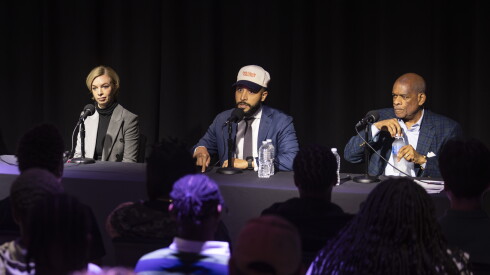
“She is incredibly talented, and as she was moving into middle school, we wanted to make sure that she was in a place that had programming that would be affirming to her, where she could really explore her creative self,” Biggs said at our recent forum for candidates running to be president of the Chicago Board of Education.
Biggs and her two opponents, Hilario Dominguez and Victor Henderson, say they want Chicago Public Schools to stay a district that offers a range of choices — including neighborhood, magnet, selective-enrollment and charter schools. But the candidates differ on how parents should go about choosing a school and how CPS should measure school quality.
The school board race has been dominated by political jabs and the district’s financial woes, especially in the citywide president’s contest. But school choice is an issue that is important to parents and that the school board can change.
Should CPS bring back ratings?
Three years ago, the school board decided to stop giving schools a singular rating. In the past, CPS gave the lowest-performing schools a “Level 3” while the highest-performing got a “Level 1+.”
Those ratings gave parents an easy way to judge schools as they made decisions about where to send their children. CPS also used these ratings for accountability purposes.
Now CPS parents can check 20 different measures on a school’s profile page, including proficiency on standardized tests, staffing levels and whether the school has adopted a high-quality curriculum.
Ten of the 44 candidates running for school board want to see the ratings return. That includes Henderson, a prominent attorney running for board president.
“Ratings, in and of themselves, are not bad,” he said at the recent forum. “It’s feedback, and we can’t be afraid of feedback. We can’t put our heads in the sand and be afraid to rate a school, a principal, a student, or even an Uber driver.”
Isaiah White, who is running to represent District 6a, which covers some of the Near North Side and Downtown, said parents need an “exhaustive, reliable, and easily parsable information on school quality.”
“Selecting an institution for your student is a monumental decision; CPS should do all it can to support parents in making an informed choice,” he wrote on our candidate questionnaire.
But most candidates, including Biggs and Dominguez, say giving a school a singular grade is too simplistic and doesn’t give parents a full view of all that’s going on. Biggs said the old CPS ratings, which were based on things like test scores and attendance, were more reflective of the resources CPS put into schools, rather than the education teachers and others provided.
“They’re really set up to pick winners and losers, and I don’t think that’s the responsibility of the district,” she said.
Ratings also became a self-fulfilling prophecy. Schools with low ratings often had a hard time attracting students and were left mostly with students who were struggling.
Dominguez said ratings disproportionately hurt schools serving low-income Black and Latino students. He likened them to standardized tests, noting that how questions are framed and words are defined can mean different things to different communities, which can show up in students’ scores.
He would like to see CPS move away from a system in which there are good and bad schools and everyone is competing to get into the coveted ones.
“We can’t keep playing ‘The Hunger Games’ to find a quality school,” he said. “Every family deserves a quality option in their neighborhood, and that’s what I’m going to fight for.”
Should CPS continue to be a choice system?
While Dominguez sees problems with the current system, he supports having options and concedes that, when his 1-year-old son goes to school, he will likely look at selective schools in addition to neighborhood options. Dominguez, the only board president candidate who went to CPS schools, attended a magnet elementary school and a selective-enrollment high school.
Most candidates agree with Dominguez that CPS shouldn’t eliminate school choice.
Only two school board candidates — Connie Anderson in the Southeast Side District 10b race and Emma Lozano in the Southwest Side District 7a race — said they wanted CPS to retreat from its choice system.
“While families value different programs, CPS should invest in every school so all students have access to strong academics, arts, enrichment, and support services close to home,” Lozano wrote on our questionnaire. “Every student deserves an excellent neighborhood school without relying on a complex choice system.”
While most candidates support some school choice, there’s varying views on privately managed charter schools, which have become an increasingly controversial part of CPS’ portfolio. Two decades ago, CPS was opening charter schools every year and parents flocked to them. They had lotteries and waiting lists.
But the powerful Chicago Teachers Union opposes using private operators to run public schools and has fought against charters. At the same time, the school district is losing enrollment, making it hard to justify opening schools. The last time CPS opened a new charter school was in 2019.
Groups that support charter schools and school choice have been major donors in this school board election.The political arm of the Illinois Network of Charter Schools has spent more than $2.3 million to support 19 candidates plus more than $600,000 to oppose Dominguez and Karen Zaccor, a retired teacher who opposes opening more charters and is running to represent District 4a on the North Side.
The group has not endorsed or spent any money supporting Henderson, a board member of the charter operator Urban Prep Academies. Henderson is the only candidate for board president who strongly supports charters and has indicated he is open to adding some. Illinois Network of Charter Schools officials did not respond to questions about why they have not endorsed anyone in the presidential race.
Most school board candidates — 27 of 44 — say they think the district should support charter schools that get into financial trouble, but just nine think that CPS should open more.