Venezuelans across Chicago say they’re hopeful for their homeland after U.S. military forces captured Venezuelan President Nicolás Maduro, who now faces criminal charges. But they also say they’re worried about how President Donald Trump is envisioning the transition, and they question whether he’ll act in the best interests of Venezuelans.
Trump announced Saturday that Maduro and his wife, Cilia Flores, were arrested after “a large-scale strike” in Caracas, Venezuela in an operation dubbed “Absolute Resolve.”
“Today we woke up to the best news we’ve ever received,” said Jessica, a Chicago woman who fled Venezuela eight years ago. “All of us Venezuelans fled our country because of [Maduro] because we were being persecuted, because they were threatening us.”
Jessica, 33, who did not share her last name for fear of compromising her immigration status, said she heard the news of Maduro’s capture from her family in Venezuela who were awakened by airstrikes.
She said she felt a mix of relief and worry, unsure what Maduro’s capture would mean for Venezuelans still in the country and for asylum seekers like her who fled for their safety.
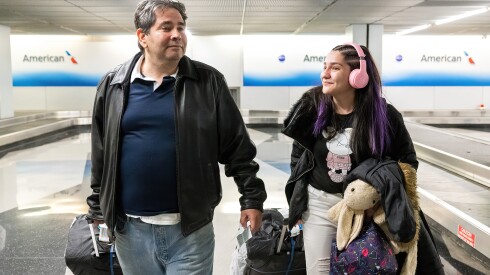
Frank Sandoval, an asylum seeker from Venezuela, reunites with his daughter, Massiel Sandoval, at O’Hare International Airport in 2023 after five years apart. In the wake of Saturday’s military operation, those who sought asylum in the U.S. are worried about what happens next.
Tyler Pasciak LaRiviere/Sun-Times
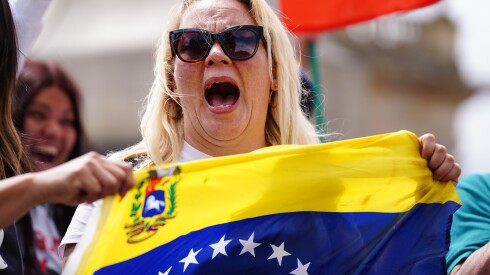
Trump said Saturday that the U.S. was “going to run” Venezuela in the aftermath of Maduro’s capture. He said Maduro would “eventually” be brought to New York to be tried on drug trafficking and money laundering charges.
“We’re going to run the country until such time as we can do a safe, proper and judicious transition,” he said during a news conference from his Mar-a-Lago club in Florida. “We don’t want to be involved with having someone else get in, and we have the same situation that we had for the last long period of years. So we are going to run the country.”
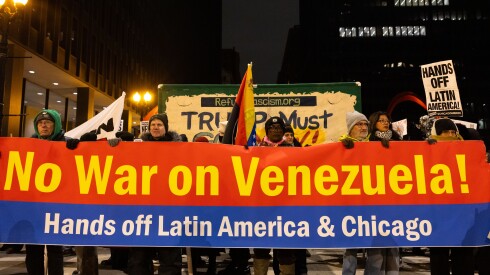
On Saturday evening, a couple hundred protesters gathered at Federal Plaza in the Loop to protest the U.S. action and to demand peace. They called for the removal of U.S. armed forces from Venezuela and an end to U.S. sanctions against the South American country and others in the region.
Trump said a group of leaders would step in to run Venezuela, including Secretary of State Marco Rubio and Defense Secretary Pete Hegseth, and added that the U.S. would be “very strongly involved” in Venezuela’s oil industry.
Some Venezuelans, like Andrea Bonilla of Uptown, were skeptical about Trump’s intentions.
Bonilla, 24, said Trump was “just looking for a way in” to take over oil production in Venezuela. “He thinks the oil belongs to the United States,” she said.
Jessica also said she believes Trump intervened for his own political gain, not for the good of Venezuelans.
“He’s not helping because they love Venezuela or because they care about the Venezuelan people,” she said.
Venezuelans in Chicago said Maduro’s rule brought devastation, costing lives and tearing families apart. And although his capture has brought moments of celebration, some said it also leaves them with lingering uncertainty about what comes next.
“Some people think it means Venezuela is free,” Bonilla said. “But governments don’t work that fast. No government has ever worked that fast in rebuilding. We are all hopeful, some of us are just a little bit more grounded.”
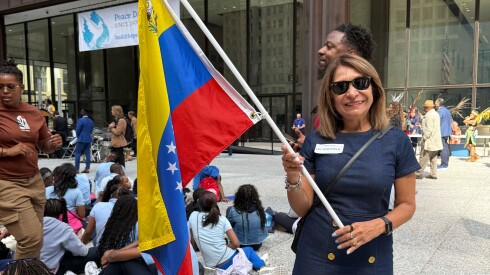
The road to freedom was long, and Venezuelans should be cautious about celebrating, said Ana Gil Garcia, founder of the Illinois Venezuelan Alliance. “They removed one of the ringleaders, but they didn’t remove them all, and these people have been in power for 28 years, and they have an armed population.”
Maduro’s capture has also raised questions about what will happen to asylum seekers. Despite his removal, Venezuela remains dangerous and unstable, some Chicagoans said.
Even with his capture, Bonilla said, she would not consider going back. “There’s nothing for us there.”
Bonilla and her family fled Venezuela when she was 14, fearing for their safety. She and her father now have legal residency, but Bonilla said her mother and brother still have pending asylum cases.
Frank Sandoval of Lockport, who came to the U.S. from Venezuela seeking asylum, was a lawyer and supported the opposition party while working in high-level government jobs. He fled in 2018 after getting threats following a demonstration at which he wore a T-shirt emblazoned with the words “Respect the constitution.”
He said Venezuelans who were granted political asylum or still have open cases could be compromised if the U.S. government decides that the danger they fled no longer exists because Maduro has been captured.
“There are still some of these people left who are delinquents, who are criminals, and who hold supposed government positions that they have appointed themselves to because nobody voted for them,” Sandoval said.
García said she fears Maduro’s capture could spark civil unrest and intensify tensions, putting Venezuelans from opposing political sides in conflict with one another.
She said those tensions would grow after Trump said Venezuela’s vice president, Delcy Rodríguez, had been sworn in as president and would work with the U.S., even as the U.S. recognized Edmundo González and María Corina Machado as the legitimate president and vice president following the 2024 election.
“That’s contradictory,” Garcia said. “How can I legitimize Maduro’s vice president when both she and Maduro are considered illegitimate in the eyes of the world?”
Despite the long journey to liberation ahead, Sandoval said he was optimistic about Venezuelans’ future.
“We continue to pray for the freedom of our homeland because freedom has not yet been won,” he said.
U.S. move sparks antiwar protest
At Saturday evening’s Loop protest, demonstrators held large signs reading, “No War on Venezuela!” and, “Hands off Latin America & Chicago.”
Protesters booed and yelled “shame” when speakers repeated Trump’s justifications for the attack, including Maduro’s drug-trafficking and money-laundering charges.
“Money for jobs and education. Not for war and occupation,” the demonstrators chanted.
Mitch Winkler, 30, saw a handbill about the protest and decided to join after work because when he saw the news about the strikes early Saturday he felt “pretty crestfallen.”
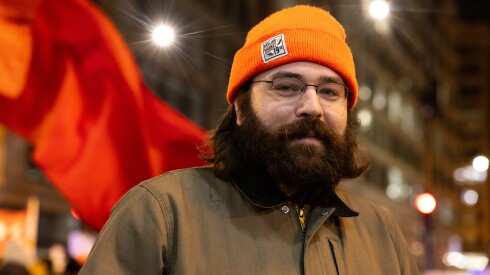
The Ravenswood resident said he thinks the attack and Trump’s plan to run Venezuela creates a “super slippery slope” and an “insane precedent” for the U.S. and other countries with large armed forces.
Winkler said he hopes for “not only a deescalation, but kind of the dismantling of the machine that’s moving us this way towards, I feel like, increasing violence domestically and abroad.”
“I feel like it’s a trend that you see not just in America, but that you see in other world powers, like posturing more aggressively than they did even 10 years ago,” Winkler said. “And I think that’s just incredibly disheartening because we just live in a world that’s so abundant. There’s no reason to be this aggressive to land strikes.”
The protesters marched through Downtown, by ice skaters at Millennium Park, shoppers on Michigan Avenue, and stopped in front of Trump Tower, before returning to Federal Plaza.
Illinois leaders criticize Trump for bypassing Congress
Meanwhile, Chicago and Illinois political leaders on Saturday criticized the U.S. government’s attack on Venezuela as unconstitutional because of Trump’s failure to consult Congress.
Their comments came as Trump, in his media briefing, briefly called out Chicago crime, Gov. JB Pritzker and Mayor Brandon Johnson.
“We also helped, as you know, in Chicago, and crime went down a little bit there,” Trump said in the briefing, adding it was a “very small” effort.
“We had no…no working ability with the governor. It was a disaster, and the mayor was a disaster,” Trump said in the briefing, asserting that they were “pulling out,” of Chicago.
In a post on X, Pritzker slammed the attack.
“Donald Trump’s unconstitutional military action in Venezuela is putting our troops in harm’s way with no long-term strategy,” Pritzker’s post read. “The American people deserve a president focused on making their lives more affordable.”
U.S. Sen. Tammy Duckworth, D-Ill., a combat veteran, was also among those critical of the attack. She called Trump’s actions “reckless” and “unconstitutional.”
“The American people believed Donald Trump when he promised on the campaign trail that he would get our nation out of foreign wars, but this morning we awoke to another stark reminder that he is — and has always been — a liar who has never cared about keeping his promises,” she said in a statement. “The Constitution requires the American people, through their elected representatives in Congress, to authorize any President to engage in acts of war—because they will be the ones to live with the consequences of the decision—and it is unacceptable for this President to deny them that responsibility.”
U.S. Rep. Chuy García, D-Ill., also criticized the failure to consult Congress. “Trump’s actions will not stop fentanyl trafficking, as Venezuela doesn’t produce any. Instead, in an imperialist assertion of hemispheric control, Trump’s actions open the doors to his own self-enrichment and that of his oil-executive donors,” Garcia said.
He called on House Speaker Mike Johnson, R-La., to “reconvene Congress so that we can be briefed on this matter and vote to oppose further attacks.”
U.S. Rep. Brad Schneider, D-Ill., a member of the House Foreign Affairs Committee, also said the capture of Maduro didn’t justify the administration’s actions.
“Nicolas Maduro has been indicted in U.S. courts for drug trafficking, stole the 2024 Venezuelan presidential election, and has denied the Venezuelan people their just democratic aspirations. He is unquestionably a bad actor who deserves to face justice,” Schneider said in a statement. “Those facts alone, however, do not relieve President Trump of his constitutional obligations or give him blanket authority to send the U.S. military into a foreign land.”
“President Trump owes the American people clear and convincing evidence that Maduro and the Venezuelan regime posed an imminent threat to the United States and our citizens, and a clear legal justification for using military force without prior authorization from Congress,” Schneider said.
“The President must also present Congress with a credible strategy for what comes next. The Administration needs to explain how it intends to prevent Venezuela from further collapsing, becoming a failed state, and potentially destabilizing the entire region—posing an even greater threat to the American people and our allies.”
Senate candidate and U.S. Rep. Robin Kelly, D-Ill., called Maduro an illegitimate and oppressive leader, but said, Trump “needs to stop acting like a dictator and start improving the lives of Americans, including people who actually voted for him, adding that the military strike does “nothing to lower the cost of living for Americans” and does “everything to enrich himself and his billionaire oil-executive friends. Our focus should be here at home, lowering costs of healthcare, housing, and groceries.”