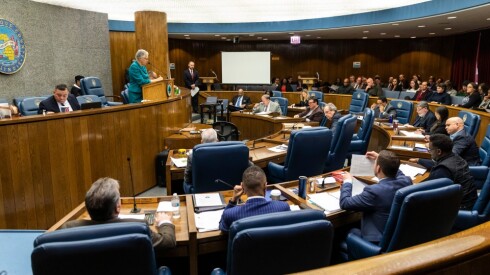
A coalition of community and advocacy groups is urging the Cook County Board of Commissioners to reject a proposed $1.12 million contract for the use of AI-powered surveillance technology at the county jail, arguing that officials should first address the number of deaths at the facility.
In a letter to commissioners, the Illinois Network for Pretrial Justice and 80 community, faith and policy organizations framed the conditions at the Cook County Jail as a “human rights crisis.” They urged the officials to delay a vote on a three-year contract with BriefCam until a review of the jail is completed.
Nine people died there last year, according to the Cook County sheriff’s office. Among them was Martinez Duncan, whose death was ruled a homicide by the Cook County medical examiner’s office.
A spokesperson for the sheriff’s office said the jail generates more than 1.8 million hours of video footage a month, and that the “overwhelming volume of data makes it impossible to have a human monitor every camera at all times.” The spokesperson said BriefCam will enable the jail staff to respond faster to medical emergencies and speed up investigations.
“If a person is found unresponsive due to overdose, jail staff could prompt BriefCam to identify all video footage of the victim for the past 12 or 24 hours in order to greatly reduce the amount of time needed to try to identify whether the victim was supplied narcotics by another individual in custody,” the spokesperson said.
“BriefCam’s object identification will be able to analyze the victim’s physical attributes and comb thousands of hours of video in minutes to produce the requested footage, saving valuable time.”
But advocates worry that BriefCam could also lead to jail staff misidentifying criminal activity.
“We’re really concerned about this technology creating situations where [deputies] are entering a highly charged environment, misconstruing what is actually happening at any point in time, and putting people’s lives at risk,” said Matthew McLoughlin, of the Network for Pretrial Justice.

Concerns about data collection
Facial recognition is a built-in feature of BriefCam. But the sheriff’s spokesperson said the office doesn’t plan to connect the technology to any biometric database, which the spokesperson said is necessary for facial recognition.
The spokesperson said all the data collected by BriefCam, and the servers on which it will be stored, will remain under the “sole control of the sheriff’s office and will not be accessible to or stored by any third-party entity.”
That assurance is drawing skepticism from critics like Stephen Ragan, a policy and advocacy strategist with the ACLU of Illinois.
“‘In light of the tech’s ability ‘to analyze the victim’s physical attributes,’ I don’t know how this is done without collecting biometric information and creating a database against which to match images with little oversight or accountability,’” said Ragan.
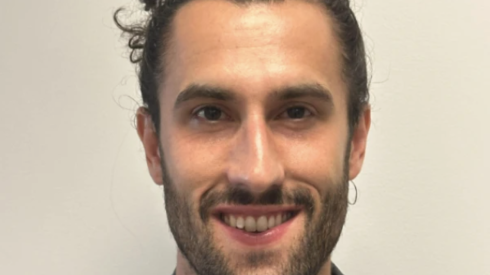
Ragan added that “object identification for things like gender, clothing, weight, height, gait, and other identifying characteristics are ways to work around biometric identification like facial recognition, but nonetheless raise similar concerns around accuracy and bias.”
Illinois law requires companies collecting biometric data to provide written notice, obtain written consent and develop a publicly available retention and destruction policy.
But Ragan said “those protections don’t apply in the same way when companies contract with government agencies, where you’re left relying on self-regulation.”
“Like, is this going to be the creation of a biometric database that law enforcement agencies can use to do facial recognition when individuals are no longer in jails?” Ragan said.
The sheriff’s office said all video footage would be stored for 30 days, unless it’s connected to an ongoing administrative or criminal investigation, and only authorized personnel would have access to the system.
BriefCam didn’t immediately respond to a request for comment.
Potential for misidentification
Ragan said platforms like BriefCam have the potential to lead law enforcement officials astray. He points to a case in Baltimore in which police responded to an AI-generated alert that misidentified a teenager’s bag of chips for a gun.
Ragan said real-world environments — including poor lighting or obstructed views in correctional facilities — can increase the likelihood of someone being misidentified by a facial recognition technology. Research shows that such tools misidentify Black faces at higher rates than other races, he said.
McLoughlin, of the Network for Pretrial Justice, said that’s problematic given that over half of the people incarcerated at the Cook County Jail are Black.
A spokesperson for the sheriff’s office said all alerts made by the BriefCam system would require human review before they are acted upon by the jail staff. They added that BriefCam “cannot be prompted to identify skin tone or color.”
But Ragan said he doesn’t see how adding a human into the loop will solve the inaccuracies that the technology is riddled with.
“It doesn’t necessarily make a whole lot of sense to spend taxpayer money on speculative technology, in particular when there are real civil rights and liberties at stake,” Ragan said.
A committee of the Cook County Board of Commissioners will consider the proposal Wednesday.