Eleven-year-old Ricardo Juarez stepped up to the people manning each table in the park across the street from his school and asked in a confident voice: “What do you do for the community?”
“I just want to listen and see how they can help us,” said Ricardo, who is a student at Orozco Academy in Chicago’s Pilsen neighborhood.
The tables, representing organizations like the American Red Cross, Pilsen Wellness Center, Family Focus and the Pilsen Neighbors Community Council, were set up as part of a civic day of action taking place Friday at schools, parks and other locations across the city.

Eleven-year-old Ricardo Juarez (center) and other fifth grade students from Orozco Academy speak with representatives from Instituto Health Sciences Career Academy during a community education and resource fair on Friday. It was part of a larger effort to mark May 1, or International Workers’ Day, which honors the struggles and victories of the labor movement.
Ashlee Rezin/Sun-Times
Chicago Public Schools reached an agreement with the Chicago Teachers Union to make May 1, also known as International Workers’ Day, a districtwide day of civic engagement. Some students took field trips during the school day, while others got civics lessons at school.
The CTU had wanted the district to cancel classes, but instead schools were open as usual and CPS agreed to provide buses and lunches. Some of those buses took students to a rally at Operation PUSH on the South Side and other community-based events, while others transported students to an afternoon rally in Union Park that marched to Daley Plaza.
Some CTU members said they were disappointed that CPS made it difficult to participate in field trips. Schools had to fill out 11-page safety plans, even if students were going just a few blocks away.
CPS officials said they worked until the early morning on May 1 to sign off on field trips. Ultimately, 40 field trips were approved, allowing 2,200 students to participate in off-campus activities.
Though numbers are still being finalized, CPS said that elementary school attendance was normal on Friday, while it appears slightly more high school students than is typical took the day off. Illinois law allows one excused absence for a civic event for middle and high school students.
About 13% of CPS teachers were out on Friday, which is more than previous days this week, according to the district. But school district officials said they “successfully maintained instructional coverage” by calling in 2,600 substitute teachers and sending central office staff to 76 schools.
Hancock College Prep teacher Andrew Martinek, who took a class of freshmen to Operation PUSH, said he was excited his students got to hear from public officials and activists.
“It’s just a chance for our students to identify their power,” said Martinek, who says his ninth graders are just “starting to discover their voice. “Anything that helps empower that and give them confidence so that they can speak truth to power as they get older, that’s exactly what it’s all about.”
Learning about community, and what it’s like to protest
At Orozco, a few dozen students filed out of the main entrance Friday morning and headed to nearby Harrison Park to learn about how local organizations and businesses work in the community.
The organizations handed out candy and small toys, but Ricardo said he wasn’t much interested in the goodies.
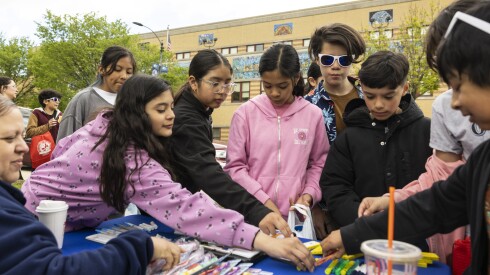
“I’m learning about how healthcare companies like Sinai or the Red Cross help people in need,” Ricardo said. “I’m learning things I didn’t know before.”
That includes the history of May Day and how the labor movement led to better working conditions and higher pay.
Around noon, students gathered on Orozco’s playground for a rally. They sat on the artificial turf field holding up protest signs they created in class earlier in the day.
Little voices chanted “no more ICE,” referring to the agency that has helped carry out President Donald Trump’s mass deportation campaign.
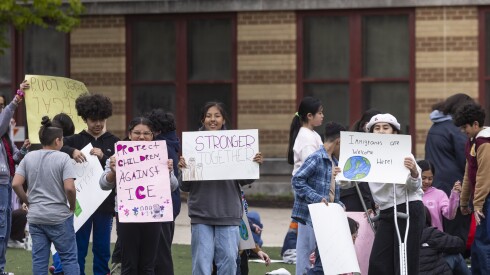
For some, like Ricardo, it was their first protest.
Pilsen was a hot spot for immigration enforcement activity in the fall. Staff said the school had to keep students inside several times during that period, so the issue was top of mind. Students who spoke at the rally focused on how they came from families of immigrants who worked hard to give them better lives.
“This is a great day to remind everyone that without immigrants, this country wouldn’t be what it is,” one fifth grader said.
A focus on improving neighborhoods and honoring blue-collar workers
The same morning in Kenwood, about 500 students, ranging from tiny kindergartners to high school students, filed into the old auditorium at Operation PUSH. Enthusiastic CTU members greeted them wearing their signature red T-shirts.
Speakers talked about workers rights and the current political climate, but their message was more about the need to be involved and the idea that young people should be listened to.
CTU President Stacy Davis Gates told the students they’d hear speakers talk about big ideas, but she wanted them to focus on what they want to see improve in their neighborhoods and schools.
She urged them to tell leaders “what they deserve.”
High schoolers from Hancock on the city’s Southwest Side were among the first to arrive. The day took on extra meaning for the students, most of whom are Latino. As is the case at many schools, Hancock students participated in a walkout earlier this year to protest the Trump administration’s immigration policies.
Freshman Joel Gutierrez said he chose to go on the field trip because it was a chance to go somewhere new. But he also said that May Day was important to him as a way to honor blue-collar workers, like his dad.
“He works in a factory and I know he works really hard for me,” Gutierrez said. “I appreciate that.”
Christian Martinez, who is also a Hancock freshman, supported CPS teachers who wanted to take the day to honor the work of labor unions. He said that teachers work really hard and most of them are good.
“I talked to my mom about it,” he said. “She was all for it.”
Some students miss school to have their voices heard
Drums, speeches, chants and chatter sounded across Union Park as thousands gathered for the annual May Day rally.
While many students traveled to the Near West Side park with classmates and teachers, others, like 17-year-old Isabella Lopez, skipped class Friday as part of a national “no work, no school, no shopping” boycott.
The Rickover Naval Academy junior wore Mexican and Puerto Rican flags draped around her shoulders to represent both sides of her family. Isabella said she attended the protest to speak out against the Trump administration’s harsh immigration policies.
She wasn’t concerned that her absence from school would count against her because it was for a good cause, she said, and people close to her know that.
“It was important for me to come here today to be a voice for people who feel silenced at home, who feel like they don’t have the right to talk or they’re afraid to be out here,” Isabella said.
Janiyah Haynes, a seventh grader at Funston Elementary in Logan Square, made her way to the protest with several dozen classmates after being in school, according to her teacher. Janiyah said they spent the day making posters and preparing for the rally.
Her sign read: “The power of the people is stronger than the people in power.”
Students said young people who attended the protests are learning that their voices matter and that they can influence what happens in the country. They disagreed with the idea that they should be in class and not out marching.
“Students also have a say in these things, too, because we are the future adults, the future generation coming up,” Isabella said.
And if young people want to make a difference and make positive changes, she said, “this is how we start.”