Melanny B. is about to celebrate a milestone.
But, instead of commemorating a master’s degree in higher education with family and friends, she’s planning to hide in the safest place she knows: her home.
Melanny, 31, came to the Chicago area from Ecuador when she was only 1 year old. She’s one of thousands of undocumented people who were brought to the United States as children and are awaiting their two-year renewals for the Deferred Action for Childhood Arrivals, or DACA, program.
“In a time when I should be celebrating, in a time where this is a huge accomplishment, I am kind of left to be at home and safe and not put myself in jeopardy,” she told the Chicago Sun-Times, speaking on the condition she not be named because she fears for her safety.
DACA recipients, often referred to as “Dreamers,” are seeing big delays, sometimes longer than six months, in renewals. Meantime, some have lost their jobs.
DACA recipients and immigration advocates view the delay as a way to force people out of the program that President Donald Trump has tried to stifle since his first term.
“Every day, I wake up with very much a lot of anxiety, a lot of depression,” Melanny said. “My nervous system has just been really out of whack since November [2024]. And every day it’s something new, with DACA always being in limbo.
“It’s something that is just constantly being layered, and it is just such a heavy and tiresome weight to carry for the last 12 years of my life.”
According to U.S Citizenship and Immigration Services, 80% of DACA renewals on average are taking four months to be completed. But there are unspecified processing holds being placed on applicants from certain countries, according to the National Immigration Law Center. Other delays are being blamed on biometric appointments, which had been paused during the pandemic.
The pathway for undocumented people who were brought to the United States as children began under President Barack Obama in 2012, and there are now more than 830,000 people who have become Dreamers. In Illinois, there were 28,330 people with active DACA status as of June 2024, according to the National Immigration Forum.
Trump targeted the program during his first term, ending applications for new DACA recipients. There have been a plethora of legal battles, with a federal judge in 2021 continuing a prohibition of new DACA recipients. Along with the delays in renewals, new data provided to members of Congress shows U.S. Immigration and Customs Enforcement arrested 261 DACA recipients nationally between Jan. 1, 2025, and Nov. 19, 2025 — with 86 deported.
The latest blow to the program came last month, when the Justice Department’s Board of Immigration Appeals issued a decision that DACA authorization can’t protect recipients from removal proceedings — setting the stage for more deportations.
‘My whole life is here’
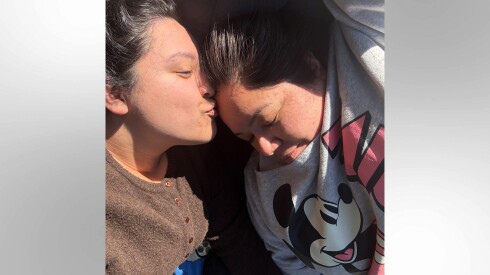
Within 24 hours, Maria de Jesús Estrada Juárez, 42, went from showing up to a routine immigration appointment in Sacramento, Calif., to having her feet and hands handcuffed and being loaded into a white van headed to Mexico.
Estrada Juárez, a DACA recipient, said federal immigration agents grabbed her finger to sign an electronic consent form against her will and that she she was told she was being deported based on a removal order from the year she came to the United States.
Estrada Juárez was picked up by family members and taken to Atlixco, a town in the state of Puebla, Mexico, where she hadn’t lived since she was 15.
Her mother served as her guide, telling her to avoid certain dangerous streets.
“It’s, like, I have to rebuild myself in another country that I don’t know,” Estrada Juárez said. “Because, even though it’s my birth country, do I feel like I belong in Mexico? I don’t.”
Estrada Juárez spent 40 days in Mexico, away from her 22-year-old daughter. They’d never been apart until then.
“It’s always been just me and my daughter, and being away from her was, I was really devastated,” Estrada Juárez said. “There were some times where I found it really hard to breathe. I had to take a lot of deep breaths in order for me to be able to breathe again because just the idea of, God, I didn’t know if I was going to be able to have a daily life with my daughter again. I felt like I was dead walking. She’s my whole life.”
Estrada Juárez posted an emotional TikTok video pleading for help. Her daughter found legal help for her mother, and a federal judge ultimately ruled that her DACA status protected her from removal — and she was reunited with her daughter.
“When, when I was pregnant, I didn’t know if it was a boy. I didn’t know if she was a girl, but I did know that I had a lot of love for her, and I was anxious to meet my baby and hold my baby for the first time,” Estrada Juárez said. “And when I saw my daughter again at the border, I felt the same way. I feel like I held my daughter for the first time ever.”
Estrada Juárez immigration battle isn’t over. She is awaiting a decision on a motion to reconsider a green-card denial that was based on the same removal order issued when she was 15, which she said she was unaware of.
She can’t work at her regular job as she tries to regain her status as a DACA recipient.
“If I have to start from the bottom, it wouldn’t be the first time, and I will do it,” Estrada Juárez said. “But I have to, I have to do it the right way… Do I trust the system the same way? No. Am I going to keep trying to remain in a place where I call home? Yes. Because my home is my daughter, and my daughter’s home is the U.S. I built the life here. My whole life is here.”
‘Definition of justice’
U.S. Sen. Dick Durbin said passing the Dream Act, which would allow undocumented people who were brought to the United States as children a path to legal citizenship, has been “at the top” of his list of priorities during his long career in the Senate. Durbin has introduced the Dream Act every Congress since 2001 and said he’s determined to give it one last try before retiring next January.
Durbin reintroduced legislation in December with co-sponsor Sen. Lisa Murkowski, R-Alaska.
“It’s real people who are counting on me to pass this legislation,” Durbin said. “Before I introduced the Dream Act, if you mentioned the Dreamers, people thought it was a 1960s rock ‘n’ roll band. Now, it’s become a definition of justice when it comes to immigration. That young people who are here, through no design of their own, are given a chance to contribute to this country and have a future in the United States.
“I think public sentiment is stronger in support of Dreamers.”
Legislators are left to navigate protections for DACA and Dreamers — a broader term for undocumented people brought to the United States as children — as the Trump administration continues to send mixed signals. Last year, the federal Department of Homeland Security urged DACA recipients to self-depor.
“Illegal aliens who claim to be recipients of Deferred Action for Childhood Arrivals are not automatically protected from deportations,” an agency spokeswoman told NPR.
That was even after Trump had this in 2024 of DACA recipients: “I want to be able to work something out.”
U.S. Rep. Delia Ramirez, D-Illinois, said calls have been coming in to her office from DACA recipients worried about their renewals. They’re being told to apply six months prior to their status expiring and that, in some cases, it’s taking longer, and they’re losing their jobs.
“They’re delaying, and I think they’re doing it on purpose because they’d like to see more DACA recipients lose status, so that makes them even more vulnerable for being targeted and deported,” Ramirez said.
She said she’s advising DACA recipients to speak with a legal expert, follow the rules and submit as early as possible.
“If they don’t submit, then they’re left completely out of status, and then, in that case, they’re now undocumented and vulnerable for deportation with no excuse from DHS,” said Ramirez, who points to contributions DACA recipients make to the United States, with Dreamers having paid more than $290 million in taxes and DACA recipients generating $2.1 billion for Social Security and Medicare.
“So, for those who don’t care about the morality, the individual person, the story about a 2-year-old coming with their family or unaccompanied young person, we should be asking ourselves the financial impact that a massive deportation campaign against Dreamers would have on the country as a whole and the impact that it would have especially for Dreamers that are in the healthcare industry,” Ramirez said.