Peoria, Ill. – Almost every morning, Mike Pierce can be found sitting at the same table at the back of Intuition Coffee and Juice. He orders a drip coffee, opens his laptop and gets to work.
Pierce is enrolled in an online master’s degree in education at the University of Illinois Urbana-Champaign. He’s also still technically in the custody of the Illinois Department of Corrections. After more than 20 years in state prisons, he’s been on work release since June 2024.
Pierce earned his bachelor’s degree while incarcerated, and as he neared the end of his sentence, he knew exactly what he wanted to do next: go to graduate school at the University of Illinois, the same school whose professors taught him while he was in prison.
But when he filled out his graduate application, there was a surprise waiting at the end — a note asking anyone with a criminal history to contact an office on campus. It’s a hurdle formerly incarcerated applicants encounter at the majority of colleges across the country.
A widespread practice
Lots of research has shown that getting an education leads to better outcomes for people getting out of prison – and makes it less likely for someone to get locked up again. Yet in Illinois, fewer than 2% of the more than 30,000 people incarcerated in the Department of Corrections are granted entry to the handful of in-prison college programs available to them, according to the Education Justice Project at the University of Illinois.
Even once people are done serving their sentence, they can still face obstacles getting a potentially life-changing education.
An estimated three out of four colleges and universities nationally ask about criminal history at some point during the admissions process, including 10 of Illinois’ 12 public universities, according to the EJP.
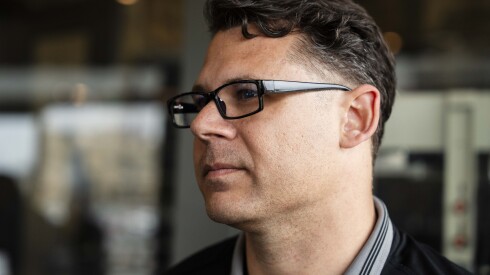
Mike Pierce, who is on work release in the custody of the Illinois Department of Corrections and is earning a graduate degree virtually at the University of Illinois Urbana-Champaign, answers questions from reporters in a coffeeshop where he usually studies in Peoria, Ill., Wednesday, April 1, 2026. | Pat Nabong/Sun-Times
Pat Nabong/Sun-Times
Most of the research on criminal history disclosure in college admissions has focused on undergraduate programs — much less is known about what happens at the graduate level. But what that research shows is the campus safety justification universities typically offer is not well-supported by evidence.
Ashton Klekamp, who leads policy and research at the Education Justice Project, said: “The vast majority of campus crimes are committed by people with no criminal history, and this sort of screening process does not actually support the goals it purports to.”
The research also shows the burden falls hardest on students of color, who are disproportionately represented in the criminal justice system. And simply having the question on the application discourages people from applying at all — a 2015 national study found that 60% of undergraduate students with criminal histories stopped filling out applications when they encountered the question.
Illinois has tried to change this. There have been several legislative attempts to ban the box in higher education admissions in the state. All of them have failed.
How education changed everything
Pierce grew up in a small town in southern Illinois. He dropped out of high school, got his GED and briefly enlisted in the military. In 2003, at the age of 20, he was incarcerated. Two years later, he received a 23-year sentence for murder, he said.
He started taking college classes about four years into his sentence, and education began to change his life, Pierce said In 2018, he was transferred to Danville Correctional Center, where he enrolled in courses through the Education Justice Project, the prison education program run by the University of Illinois.
In an email, Pierce described what that education had meant for him.
“Education … slowly gave me the ability to begin asking different questions — not just about what I had done, but about why I had lived the way I did, and what had shaped those choices,” he wrote. “That process did not excuse my actions, but it complicated them. It forced me to hold both accountability and context at the same time.”
A surprise at the end of the application
When he was transferred to the work release center in Peoria, he applied to graduate school. When he came to the request for him to email the details of his criminal history to an office on campus, he felt vulnerable.
What Pierce didn’t know was his disclosure would trigger a separate review by a committee that includes law enforcement, campus housing and representatives from the provost’s office — a group that can recommend barring someone from admission, regardless of how academically qualified they are for their program.
Pierce felt confident going into the process. Faculty in the College of Education had been supporting his application. Then the letter came — on a Friday night, four days before Christmas.

Mike Pierce, who is on work release in the custody of the Illinois Department of Corrections and is earning a graduate degree virtually at the University of Illinois Urbana-Champaign, shows his acceptance letter to a PhD program in a coffee shop where he usually studies in Peoria, Ill., Wednesday, April 1, 2026. | Pat Nabong/Sun-Times
Pat Nabong/Sun-Times
“I was wearing a button-up shirt, black tie, getting ready to go serve and bus tables in a five-star restaurant,” Pierce said. “I may have shed a few tears in a stairwell by myself when I read it.”
The committee recommended his application be denied. He had 10 days to appeal.
Pierce was still on work release, with limited internet access. He asked for an extension and scrambled to pull together support letters from his professors, from EJP staff and from others who knew his work. A month later, he got word the Graduate College had reversed its decision. He was in.
But the delay came with a cost. By the time Pierce had the documentation he needed, the deadlines for several scholarship opportunities had already passed. He sat out the first half of the semester and paid for his first course out of pocket.
‘Convince us’
At the University of Illinois Urbana-Champaign, the criminal history review process is run by Bob Wilczynski, who chairs the Criminal and Disciplinary History Review Committee.
“We want to know what you did. We want to know what you learned from it, and we want to know how it’s not going to be repeated,” Wilczynski said. “Convince us.”
Wilczynski acknowledges his focus is primarily on the students already on campus.
“A lot of times … I’m more focused on the community than I am about the applicant during the application process,” he said. “I really hadn’t fully reflected upon the experiences, especially that type of experience.”
‘I would feel like I was back in prison’
Paul Calvo spent eight years in federal prison, attended community college in California and graduated from Stanford in 2025. He applied to the University of Illinois Urbana-Champaign’s master’s program in electrical engineering last fall.
His application was cleared — but with a condition. He would be placed on “conduct probation” for the duration of his program, which meant he could be suspended or dismissed for any violation of the student code.
“My very first reaction was a sense of disappointment and hurt,” Calvo said.
In the years since his release, Calvo had tutored kids in his neighborhood and taught engineering courses to men inside prison. Calvo said he felt like the U of I’s attitude was to “forget everything that I’ve done for the community. We are going to focus on something that happened 18 years ago.”
“I would feel like I was back in prison” if he accepted that condition, Calvo said. “Any wrong thing that happens, I’m going to the hole.”
When told about highly qualified applicants like Calvo who are discouraged by the conditions, Wilczynski paused.
“They paid their debt to society, and they felt like we punished them again,” he said. “And that resonates with me.”
Calvo withdrew his application. He is going to Texas A&M in the fall. They never asked about his criminal history.
‘I don’t want people to be discouraged’
Pierce has a message for people still in prison who are thinking about graduate school.
“I’d love to see check the box go away. I’d love to see people considered on their merit before they’re considered on their past,” Pierce said. “But I don’t want people to be discouraged from trying.”
Pierce will finish his master’s degree this spring and walk across the graduation stage in May. In the fall, he will start a PhD program at the University of Illinois. This time, he was accepted on the first try.
Charlotte West is a reporter for Open Campus, a non-profit newsroom covering higher education in the U.S. She reports on higher education in American prisons and jails.