As a boundary-pushing pioneer of funk music, George Clinton imagined entire mythologies of beings from outer space.
He encountered them, too.
The pivotal moment occurred one morning in 1976, as he and bassist Bootsy Collins drove from Detroit to Clinton’s home in Canada.
“We saw a laser light, right out of the clouds, hit the ground,” said Clinton, now 85 and living in Florida.
A few miles away, that same piercing light struck their car, and dripped a mercury-like substance on the hood. Suddenly, it was nighttime, as though they’d sped through hours in mere moments.
“When we got to my house, my daughter said, ‘Y’all look like you’ve seen a ghost,’” Clinton said.
That experience is referenced in Clinton’s painting, “In the Daytime, Bobba!,” which depicts a white spaceship hovering over Earth and against an intense blue sky. It is displayed with other works in his art show, “Mothership,” which opened Saturday at Mariane Ibrahim Gallery in West Town, and remains on view through Sept. 5.
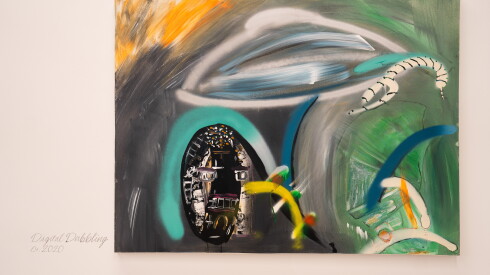
Though he is colorblind, he has created a variety of vibrant motherships using acrylic, spray paint and charcoal. The exhibit even includes a tiny replica of the iconic, $500,000 spaceship that he debuted on his P-Funk Earth Tour in 1976. Building upon the universe he created as the leader of Parliament-Funkadelic, his visual art underscores his contribution to Afrofuturism, a cultural movement that envisions a future of liberation for Black people.
“He is a pre-internet architect of Afrofuturism vocabulary and imagery,” said Mariane Ibrahim, a French-Somali gallerist who also owns spaces in Paris and Mexico City.
“To think about Black bodies in the cosmic [realm], as technological bodies, he was one of the first artists to engage with that. My parents used to look at him like, ‘He’s totally crazy.’ But this craziness had the color of my skin, so I felt entitled to be crazy as well, to free myself.”
From doodling dogs to displaying at Art Basel
Before he started painting, Clinton was a sketch artist, often doodling dogs alongside his autographs. The images became so popular, likely due to his 1982 hit “Atomic Dog,” that people sent him official commissions.
“Somebody paid me $15,000 to paint a dog,” Clinton said. “And then I sold another one for like $10,000.”
But it was during the pandemic that Clinton became more focused on visual art, using the downtime to hone his craft. He doesn’t consider his colorblindness to be a hindrance — or his eccentric fashion. While painting, he focuses on shading more than color, though things would get tricky when his kids and grandkids played pranks by switching the labels on his paint jars.
“I get away with it pretty good because nobody even knew I was colorblind for years,” he said. “Colors don’t clash, I guess, if you don’t know any better.”
Since securing an art manager and team, Clinton has displayed his art everywhere from Art Basel Miami Beach to the SCAD Museum of Art in Savannah, Georgia. Last year, his paintings of dogs were included in a group exhibition at Ibrahim’s Paris gallery.
“These portraits of dogs look so human,” Ibrahim said. “They have personalities. They have attitude. They also are very psychedelic and make you want to dive into his world.”

As he progresses in this new phase of his career, Clinton said he has been learning what the industry now considers high art; for example, he said he didn’t realize graffiti artists were being taken seriously by the art world until recently.
“Basquiat used to hang around with us,” he said. “We didn’t think of [graffiti] as fine art.”
As part of her mission, Ibrahim said she is trying to change who gets to make those determinations while increasing exposure to works by diverse artists.
“I think we have to democratize the way we are learning art,” she said. “In my youth [in France], I had absolutely no access to any form of Black art and Black artists. I’ve always had to make an extra effort to find artists that represented me.”
To that end, she said she shares Clinton’s rebellious spirit.
“He was a renegade,” she said. “He was an anti-system person.”

Defying categories and predicting the future
With his Parliament and Funkadelic bands, Clinton stood out by defying genre categories forced on Black musical acts. He also created a host of futuristic Black characters, including Star Child, Dr. Funkenstein and Sir Nose, that were brought to life on album covers by artists Overton Loyd and Chicago native Pedro Bell.
He also sang about everything from cloning to artificial intelligence (à la “the nosiest computer” lyric on the 1977 song “Funkentelechy.”)
“I love AI now,” he said, but refused to elaborate on how he is using it in his music today.
“I can’t give you the secrets,” he said.

Clinton said he has stayed relevant by changing with the times, whether it was pivoting from the “Motown Sound” to psychedelia or embracing the hip-hop artists who sampled his music. And today, he sees young people enjoying themselves at his shows.
“We’ve got fans from 12 to 112,” he said. “It’s like going to the circus. Grandparents can go, and parents and kids can go together.”
That cross-section of people was present at the opening of “Mothership” in Chicago, as people of all ages and races took selfies with Clinton. Older fans brought their kids and grandchildren. Some wore P-Funk T-shirts and brought their records for Clinton to sign.
Yvette Oduro, 56, of South Shore, said she had “chills” when she saw the music icon.
“I grew up listening to his records on my mother’s big green stereo that looked like a piece of furniture, perusing through all the album covers, and just imagining what was on the artist’s mind,” she said.
“He brought such an imagination of what it is to be Black and to transcend anybody else’s ideas of what that is. It made me think about my future in many different ways.”

Clinton is still inspiring others to consider the future through his paintings, which brought a feeling of positivity to Elisabeth Poorman, 42, of the South Loop.
“It’s an interesting thing to confront someone whose artistic output is so optimistic about the future at a time when people my age don’t feel optimistic,” said Poorman, who attended the event with her father, a 74-year-old P-Funk fan.
“It’s nice to see this kind of vision because I think we’re hammered with the feeling that things are very apocalyptic. Maybe it doesn’t have to be that way.”
