For many in Chicago’s LGBTQ+ community, Pride Month and beach season go hand in hand. This includes an important ritual: digging the rainbow gear out of storage bins, putting on flip-flops and heading to Kathy Osterman Beach.
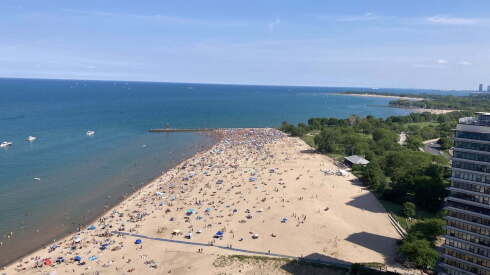
Colloquially known as “Hollywood Beach,” this vast patch of sand starts where DuSable Lake Shore Drive ends, extending from Hollywood Avenue to Ardmore Avenue, east of the Edgewater neighborhood.
Hollywood Beach is considered Chicago’s “gay beach.” Every spring and summer, hundreds in the LGBTQ+ community gather there to dance, play volleyball and soak in the sun and water.
“We always felt like this is just where we belong,” said Erin Stafford, who was enjoying the beach on a recent afternoon. Stafford has been coming to this beach with her partner Theresa Salus since before their 10-year-old son was born.
“We knew that it was the place where we could just be free … and meet other people who were queer,” Salus added.
But Hollywood Beach wasn’t always as crowded — or as gay — as it is now.
Originally called Ardmore Beach, it was developed as a northern extension of the Lincoln Park neighborhood in the 1950s. For decades after that, visitors to the beach were few.
That all changed in the summer of 1991, when a gay man brought a few friends to Hollywood Beach for a low-stakes game of volleyball. In the months that followed, more and more queer people began flocking to the beach. Eventually, one man’s search for a small, close-knit gay community ballooned into a place where hundreds of LGBTQ+ Chicagoans still find belonging.

The making of Chicago’s “gay beach”
“This is gonna sound egotistical, arrogant, but you can’t talk about this beach being gay without including me,” said Jerry Marcoccia.
Marcoccia, 69, moved to Chicago in 1981. At the time, 10 years after the Stonewall uprising in New York, Chicago’s LGBTQ+ community was in an era of grassroots organizing and community building. Gay nightlife was vibrant, but at the same time, people were battling the AIDS crisis. Many were sick and dying, with even more left grieving in their wake.
Maroccia worked for the USDA by day and struggled to fit in by night.
“What was I up to? Going to bars, looking for someone to fall in love with, and fall in love with me,” he said.
But Marcoccia wasn’t a drinker or a smoker, so the bars weren’t really his scene. In search of community, he spent time at the only established lakefront LGBTQ+ space at the time, the Belmont Rocks.
The Rocks were a section of jagged limestone slabs along the lakefront just south of Belmont Harbor, a “gay beach, which had no sand, which we claimed as our own,” explained Owen Keehan, an LGBTQ+ historian and author of “A Place for Us: Gay Life at Chicago’s Belmont Rocks.” Keehnen was a regular there in the 1980s and 90s.
According to Keehnen, during the early days of the Rocks (the 1960s), this was the only place queer people could go outside and feel free to be themselves.
“[It was] this place where you could do the same thing you did at the bars, but get together with your friends in the sunshine outside. That’s such a statement of empowerment,” Keehnen said.
The area was also discreet. People found pockets where they could sunbathe nude, have hookups and smoke marijuana, all under the radar.

But the Belmont Rocks weren’t Marcoccia’s scene either. They were so jagged, he once slipped and hurt himself. He also struggled to socialize there.
“I thought it was click-ish and unfriendly,” Marcoccia said.
In 1990, he bought a condo in Edgewater, close to Hollywood Beach but a good distance from the Rocks and Northalsted, the areas where LGBTQ+ life was most active. Marcoccia said people who knew him at the time were confused about why he would move so far north where “there’s nothing gay, no activities. There’s nothing to do.”
But his search for a place to socialize and proximity to a sandy, albeit unpopulated beach was the beginning of what would eventually become Chicago’s gay beach.
It all started in the summer of 1991, when his friends, Bob and Joe, would come visit from the suburbs on the weekends. One Sunday afternoon in July, they brought a volleyball set and played near the south end of the beach.
That first day, ten people joined in to play a version of volleyball known as “jungle ball,” which Marcoccia said is less intimidating. “You don’t have to set and bump; you just have to try hitting the ball over the net.”
The following Sunday, Marcoccia returned to the beach to play again. He never made a coordinated effort to publicize these beach volleyball games. But by the summer of the following year, dozens of queer people were coming to play every week.

“It was completely word of mouth,” Marcoccia said. “The thing kept on growing bigger and bigger, and I wanted it to be a friendly, social place.”
Every weekend from April to November, Marcoccia was on the beach at noon. One day in the summer of 1993, he put up a rainbow flag, both as a landmark and to affirm that this was a safe place for LGBTQ+ beachgoers, he said.
Marcoccia said during those first few years, people of varying backgrounds showed up, but mostly they were a close-knit community of gay men. For him, volleyball was an avenue to find belonging, build community and have fun.
“We would play music, you know, like ‘The Supremes.’ And we would say, ‘Stop in the name of love!’ when a hot guy would run by,” he said.
Marcoccia continued to invest in the community developing at the beach, buying more volleyball nets and balls. Sometimes he’d even invite beachgoers back to his condo to play board games after the volleyball was done. He also convinced then-alder Mary Ann Smith to install more net posts.
“Babble,” a gay gossip magazine, published a headline that read “Come out to Hollywood Beach and watch the boys play with their balls.” Marcoccia’s friend Bob made small handouts to pass around, inviting people to come play volleyball.

In 1993, the beach was officially renamed Kathy Osterman Beach, in honor of the late Edgewater alder. That year, she was also posthumously inducted into the Chicago Gay and Lesbian Hall of Fame as a “Friend of the Community.”
And the beach continued to gain popularity. People began posting about it on a digital bulletin board system called “Cockpit.”
“OSTERMAN BEACH IS HOT!” read one subject line in a message from July, 1994. “Osterman Beach (at the Hollywood Curve on Lake Shore Drive) is quickly becoming Chicago’s GAY BEACH! I counted over 400 gay men and lesbians enjoying the sand and water yesterday!” the message said.
“If you’ve enjoyed The Rocks in the past, you’ll LOVE Osterman Beach… Oh, yes. There’s also lots and lots and lots of MEN!” another post said.
Marcoccia said the growth of the beach made him realize the breadth of what he had created and how truly affirming this community had become for him.
“I was the center of it, which was reassuring and comforting to me, because I couldn’t be ignored,” he reflected.
But nothing lasts forever.

Jerry Marcoccia holds a plaque of appreciation given to him as a gift in the ‘90s on Wednesday, May 20, 2026 at Kathy Osterman Beach in Edgewater. Marcoccia started the volleyball group because he was looking for a sense of community, and each year more people would come out to play.
Anastasia Busby/For the Sun-Times
Hollywood Beach gets more popular, more competitive
Things were changing. The beach that had attracted a close-knit group of roughly 50 gay men for volleyball in the early 90s became packed with large crowds.
“I have nothing to do with this beach anymore,” Marcoccia said.
Marcoccia started to lose interest in the beach around 1998, after people started bringing their own nets and using every post to play competitive volleyball with official rules, not the “jungle ball” he preferred. Because he has a problem with depth perception, the games were inaccessible for him, he said.
He also felt the overall vibe at the beach had become impersonal, unfriendly and at times even disrespectful.
“People would ask for equipment like I was there to serve them,” he said.
When volleyball was no longer the main attraction, Marcoccia said people would use the posts as bike racks or sunbathing spots. When he asked them to move outside of the volleyball area, they refused, he said, although there was plenty of room for them elsewhere.
For Marcoccia, Hollywood Beach was changing for the worse. All his hard work started to feel thankless. He had built this community from the ground up. Now, people were running with it and leaving him behind.
By 1999, Marcoccia had stopped going to Hollywood Beach altogether.
While he feels it’s no longer the tight-knit community it once was, what he started continues to offer a sense of belonging to hundreds of LGBTQ+ Chicagoans.
Belonging at Hollywood Beach
Adam Rhodes, a Chicago-based culture writer and investigative journalist, is one Chicagoan who feels that way. Rhodes wrote about Hollywood Beach for the “Chicago Reader” in 2021. He loves going each summer because of how inclusive it feels.
“The first time I came to the beach, I saw different gender expressions, different body types, different races, ethnicities, abilities, you know, I saw queer families, groups of queer friends, like having a good time.”
But, like Northalsted and other LGBTQ+ spaces on Chicago’s North Side, that sense of inclusivity can be complicated. Its location can be a barrier to queer people on the city’s South and West Sides.
Bryanna Turner is a regular at Hollywood Beach and lives nearby. But she’s from Chicago’s South Side, where most residents are African American. She said if she hadn’t moved to the north side, the beach would be too far away to visit. Now, she just wishes there were more people like her at the beach.
“When I look around in the crowd, I see a lot of gay white men,” she said. “This isn’t necessarily a Black, lesbian beach.”
Adam Rhodes said that as a queer Latino man, he feels welcome at Hollywood Beach. He thinks it’s more inclusive than it used to be, especially when it comes to the full spectrum of the LGBTQ+ community and marginalized people in general. He points to the rainbow-painted pier light at the end of the beach’s metal pier, which has the word “GAZA” written across it. Other parts of the beach have anti-ICE stickers and Rhodes said he’s seen Black Lives Matter graffiti.

As for Jerry Marcoccia, although he’s no longer a regular, the welcoming community he built there still leaves him awed, impressed and proud.
“It perpetuates itself now. I wonder, 50 years from now, would it still be Chicago’s gay beach, or what would evolve?”
The answer to that is up to the community that keeps it going.
More about our question-asker:

Rebecca Kling does advocacy work for transgender rights. She lives in Andersonville, where she loves biking along the lakefront and going to the farmers market.
“Being in a city that has so many delightful things to do is a really great way to balance out some of the heavier and harder stuff that I’m dealing with professionally,” she said.
One of her favorite activities is visiting Kathy Osterman Beach, a place that has awed her more than once.
“Seeing all of these people, many of them men in very, very small bathing suits, and dance parties, and volleyball, and people in the water and people not in the water, and people being seen and seeing each other; it was just such a striking moment of like, ‘Oh this is the gay beach!’” she said.
Rebecca said learning more about Chicago’s LGBTQ+ history feels particularly important in the current political climate, where people ultimately working toward the same goal have seemingly diverging ideologies.
“There’s been community disagreement for as long as there’s been community, and how do we keep organizing with each other and advocating through disagreement?”