The Murphy Auditorium inside Chicago’s Driehaus Museum is an unusual room with a lot of churchy touches. Choir stalls line the back wall, a pipe organ console sits parked at the side of the balcony, and a large stained-glass window identifies the space’s former owner, the American College of Surgeons.
The artist Brendan Fernandes first saw the space during its renovation. The Driehaus’s executive director, Lisa Key, showed it to him with a new-toy glee — the museum had recently acquired the building that houses it. Fernandes read the hint and asked if he could make something here.

“She was like, ‘What are you thinking?’” Fernandes recalled. “And I was like, ‘I’m thinking a lot.’”
Although couched modestly, “a lot” neatly summarizes what Fernandes does. He brings many arts to his art, including dance, visual arts, design and textiles, and he collaborates with other artists and performers across genres, making him a popular name this month as the city’s largest art fair and several satellite events unfold across the city.
He is a subverter of forms, determined to work across and through any restrictions that might bind him or categories that might bound him. Unbound and unbounded, Fernandes is in the broadest sense an artist.
Take his work unfolding at the Driehaus, where he is now artist in residence. The residency takes the name “In the Round,” referring — typically — to many things at once, such as theater in the round, where the audience surrounds the actors, and sculpture in the round, where a piece of visual art is intended to be viewable from all 360 degrees of perspective.

Performers dance around 12 mirrored benches arranged in a dodecagon, designed to occupy the center of the auditorium’s main level.
Brendan Fernandes: In the Round, Driehaus Museum, 2026. Photo by Robert Chase Heishman for Bob. Dancers: Hanna DiLorenzo, Nick Kearns, Xenia Mansour. Courtesy of the artist, Monique Meloche Gallery (Chicago), and Susan Inglett Gallery (New York).

Periodically from this week through November, the space will be prepped for performances of “Score for the Murphy Auditorium.” At a recent preview, seven dancers performed semi-improvisatory contemporary dance, part of which followed a flocking pattern, where a lead dancer created a short series of steps that the others learned and mimicked, and then the lead rotated to another dancer.
The dancers danced around 12 mirrored benches arranged in a dodecagon, designed to occupy the center of the auditorium’s main level. They left handprints, footprints and humidity marks on the surfaces, prompting murmurs in the audience about whether there’s a Windex budget. The dancers sometimes wielded quilted textiles, and original music was piped in alongside.
Although few artists work in this hyperintersectional way, for Fernandes, 46, it feels more like a continuation of the childhood sense of curiosity and experimentation. “As a young kid, I was always dancing and drawing and painting,” he said. He was born in Nairobi, Kenya, and moved while still a child to the suburbs of Toronto. His high school offered extensive arts opportunities, and he studied ballet.
Doing his BFA at York University in Toronto, he did both visual arts and dance. “I was always told you can’t do both. You have to pick one or the other.”
A hamstring injury meant he really couldn’t do both. For an MFA program at the University of Western Ontario, he practiced only visual art. But then post-MFA he enrolled in the Whitney Museum of American Art’s famously cross-disciplinary Independent Study Program, where he realized the falseness of the binary of visual art on one side and dance on the other.

He cites “Encomium” as a breakthrough work for shattering this binary. In it, Fernandes loosely choreographed instructions for two male dancers to assume poses they hold until they cannot any longer. The instructions quote Phaedrus’s speech on love in Plato’s “Symposium,” creating a symbolic register about Fernandes’s relationship to dance. “It was sort of like a breakup letter to myself,” he said.
In Chicago, where he is now based, he continued to play with the idea. In “72 Seasons,” created for the Lurie Garden in Millennium Park in 2021 during the COVID-19 pandemic, Fernandes placed ballet dancers in the gardens and cued their steps with placards embedded in the soil like plant identifiers. The choreography was inspired by the Japanese calendar of microseasons.
“There were people coming to the garden, not expecting a contemporary art or dance experience, but stumbling upon these cues,” said Stephanie Cristello, a curator who works often with Fernandes. “It has been a constant of our collaborations together — how can we infuse these small unexpected moments of dance or contemporary art into the everyday?”
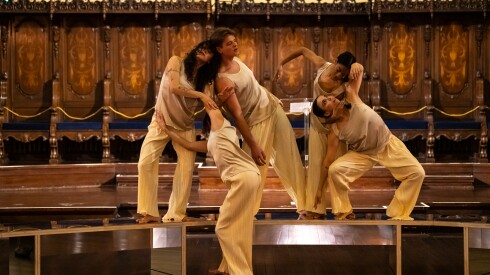
Cristello is also the curator for In the Round. She said the performance-installation in the Murphy Auditorium blurs these boundaries as well, not hewing to the conventions of a dance show — the audience doesn’t come at a designated time, doesn’t sit in a seat, and doesn’t see a beginning, middle and end. “You’re walking into essentially a moving sculpture,” she said.
“I call this thing queering architecture or queering space,” Fernandes said. “So within the moniker of queer — outside of gender and sexuality binaries — it’s this idea of being a nebulous kind of entity that is constantly in flux and in change that is self-evolving. It’s always becoming something else.”
As Fernandes’s residence unspools, museum visitors during the active weeks in May, September, October and November can visit the space even outside of the performance times and potentially see rehearsal or projects produced by subsets of the dance corps, a cadre of freelancers Fernandes has worked with several times.
And because of the improvisatory elements, it’s always different. Or put another way, it’s never totally bounded.