After an emotional and racially charged debate, Mayor Brandon Johnson’s fourth veto survived an attempted override Wednesday, preventing the City Council from making it more difficult to issue city debt by raising the threshold for approval from 26 votes to 30 votes.
Retiring Ald. Marty Quinn (13th), who championed the reform, fell one vote short of the 34 votes he needed to thwart the mayor’s veto. The final vote was 33 to 17, allowing Johnson to avoid what would have been a humiliating defeat by the slimmest of margins.
“There’s no secret that there are a number of members of City Council still adjusting to a progressive agenda,” the mayor said at his post-Council meeting news conference.
“Last I checked, 26 votes is still a majority, and that still exists.”
Prior to the vote, Budget Committee Chair Jason Ervin (28th) had delivered an impassioned speech, accusing his colleagues of targeting Johnson because he is Black.
His voice rising, Ervin asked his colleagues, “Who gives away power?… Nobody gives away power and I didn’t come down here to give up mine.”
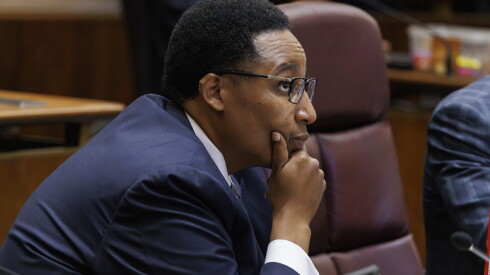
Ald. Jason Ervin (28th), shown during Wednesday’s Chicago City Council meeting, opposed efforts to override Mayor Brandon Johnson’s veto of a measure intended to make it harder for the city to borrow money. The ordinance would have required a three-fifths vote of the Council, not just a simple majority, to approve such borrowing.
Anthony Vazquez/Sun-Times
“Why do the rules need to change?” Ervin continued. “You want to call it independence. [But] it’s ironic that we only talk about independence and executive oversight when the person sitting up there looks like me.”
“It happened under [Harold] Washington. It happened for about 15 minutes under Lori Lightfoot and it’s been going pretty much all the term under Johnson. Three Black mayors. And all of the sudden the rules.. become an issue. Call it independence. You want to call it reform. You want to call it checks and balances. But again, where was that concern before under Daley, under Emanuel …”
North Side Ald. Maria Hadden (49th) stuck with the mayor, saying she still “drives around the city and sees huge swaths of the city that have been neglected and just tossed aside.”
Hadden called Quinn’s proposal “a distraction,” but at the same time, she warned Johnson his own failure to collaborate with the Council had all but invited alderpersons to push back.
“We wouldn’t be here having this conversation and you having to have a veto if we had better relations with Council and your office,” Hadden told Johnson. “We need the fifth floor — we need you and your team — to hear these concerns.”
Downtown Ald. Bill Conway (34th), a former investment banker who teaches college finance, said the notion that requiring 30 votes instead of 26 votes “will somehow delay infrastructure investment simply doesn’t square with the facts.”
“This is about the difference between borrowing to build our city’ s future and mortgaging the city’s future,” Conway said. “Our predatory borrowing of money has pushed obligations onto future generations. We are those future generations, and the bills are coming due.”
It’s the second time Quinn has tried and failed to override a Johnson veto. The first time, the mayor vetoed a citywide ban on hemp products that Quinn championed. Though he failed again, Quinn said he made his point about the danger of borrowing more money and, increasingly, structuring the repayment schedule to postpone the day of reckoning.
Last year, the Council almost blocked an $830 million general obligation bond issue that included a back-loaded repayment schedule raising the overall price tag to $2 billion.
“This has been a really good fight on behalf of the taxpayers of Chicago. We’ve had some really good conversations about the city’s debt. You couple that with our pension obligations, that’s 40% of our operating budget. That’s real. It’s not gonna change,” Quinn said.
West Side Ald. Emma Mitts (37th) supported the override despite what she claimed were unspecified threats to withhold money for people in her ward affected by devastating flooding in 2023.
Without naming names, Mitts said she had been approached by “bullies” who warned her that, “If you don’t vote on this, you won’t get that.”
“One thing that I’m very passionate about is you messing with my community,” Mitts said.
Other action at Wednesday’s meeting
The Council also agreed to expand citywide a so-called “Smart Streets” program using surveillance cameras on CTA buses and Chicago Department of Transportation vehicles to catch motorists parking in bus and bike lanes and provide photo evidence of those violations for automatic ticketing. The pilot program, confined mostly to downtown areas, has so far generated $4.5 million in parking fines.
Alderpersons also confirmed new members for the Board of Ethics, as well two new members of Johnson’s cabinet: Fleet and Facilities Management Commissioner JuanPablo Prieto and Human Resources Commissioner Tiheta Hinton.
During Tuesday’s confirmation hearing, Prieto promised to cut skyrocketing vehicle and fuel costs by reducing the number of vehicles permanently assigned to city employees and forcing more employees to use pool cars instead.
Johnson’s appointment of Renee Hatcher, daughter of former Gary, Ind. Mayor Richard Hatcher, to succeed Mary Richardson-Lowry as corporation counsel was pulled amid complaints that Hatcher lacks the experience needed for the job. Also, the Council voted down Johnson’s appointments to Chicago Housing Authority board seats. Some Council members have seen Johnson’s proposed CHA appointments as his attempt to get rid of the agency’s executive director, Keith Pettigrew.