A largely vacant River North building has been sold to a local real estate investment firm that plans to convert the building into apartments.
Concord Capital purchased the building at 226 W. Ontario St. for about $4.1 million, according to Drew Millard, principal of the firm. The private sale closed July 14.
Prior to the sale, the building was owned by Onrio Management Corp. As of Tuesday, the management firm was still advertising the building as for sale on its website, pitching 226 W. Ontario as “[combining] the sturdy elegance of early 20th-century design with the conveniences of today.”
Crain’s Chicago Business reported that the late Michael Wellek, owner and operator of several adult entertainment clubs in the Chicago suburbs, was tied to Onrio.
Concord plans to turn the structure, also known as the Leahy Building, into 70 apartments, with 10 of them in a two-story addition atop the building’s existing structure. Those residences will include private outdoor spaces, Millard said, in addition to rooftop terraces.
The building’s occupancy was “very low” prior to the sale, said CBRE Vice President Dominic Soltero, who represented the seller. The nightclub Sound Bar — also owned by Wellek before his death — operates on the building’s lower floors.
Millard said the nightclub, where a security guard died in 2019 after a shoot-out between patrons, will vacate the building in eight months, but the firm plans to begin construction before then. Sound Bar is in the building’s basement, Millard said, and that, coupled with the nightclub’s operating hours, means it shouldn’t be impacted by the construction.
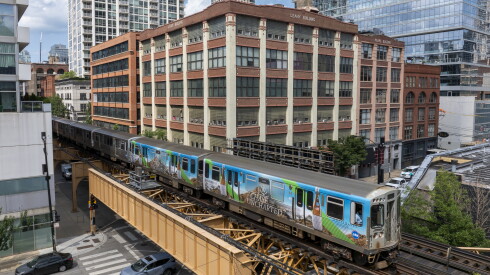
Millard said Sound Bar being the only current tenant is a huge boon for the firm. One of the many difficulties of converting an office building can be navigating the leases of existing tenants. Often, a building must be vacated before demolition and interior work can begin.
Millard said the firm also was attracted to the Leahy Building for its prime River North location and size. Many office buildings don’t work for residential because the floors are too wide, Millard said, which limits how many windows can be put in each unit.
Concord plans to call the residential building Leahy Lofts. The building stands at six stories and 48,000 square feet and will include a mix of studios, one-bedroom and two-bedroom units, as well as one-bedroom units with dens.
The basement already has some lounge space built out because of Sound Bar, but Millard said he isn’t sure if his firm will use it. The basement will house multiple amenities, such as a gym, resident lounge, co-working center and bike storage room.
The Leahy Building joins an emerging pipeline of River North office buildings going residential. Concord is finishing the conversion of 223 W. Erie St., next door to the Leahy Building. And in May, Path Construction and WindWave Real Estate welcomed the first residents at 111 Point, the former Salesforce office building in River North.
Concord is working on nine office-to-residential conversions in Chicago, Millard said. The projects span from River North and Streeterville to one in Printers Row.
Despite the limited number of buildings available for conversion, Millard believes more projects will join the conversion pipeline over the next two years.
“The competition is definitely stepping up. However, there’s only so many office buildings to convert,” Millard said. “We’ve got our eye on a bunch of others, but this isn’t going to last five years because we’ll run out of them.”
CBRE’s private capital and land services team has completed six office-to-residential conversion deals in the past year, according to the firm. Soltero said many of those deals are in neighborhoods like River North and Streeterville, where some companies are fleeing for trendier business corridors in Fulton Market and West Loop. But demand to live close to downtown is still there, and he said more conversions can help meet it.
“The young generation still wants to live in a very live, work, play atmosphere,” Soltero said. “It’s very lively [in River North], and it’s getting better and better.”
The $20 million project is privately funded and doesn’t require the city to sign off on a zoning change, Millard said. The firm hopes to break ground in October after demolition and complete the project in spring 2028.