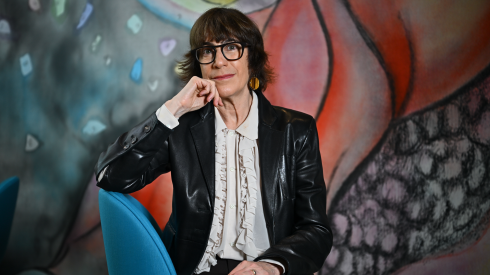
Madeleine Grynsztejn can point to many successes as she looks back on her 18-year tenure atop the Museum of Contemporary Art Chicago. But perhaps her most far-reaching achievement has been pledging that 50% of all artists featured in exhibitions, acquisitions and programming identify as women.
The museum announced its commitment in 2015 and formalized it five years later with a dedicated philanthropic fund.

Grynsztejn, who is stepping down at the end of year as director and finds herself taking stock of her ambitious tenure, believes the MCA is the only art museum in the country to make such a commitment. The museum did so, she notes, before the #MeToo movement gained force in 2017, and before the Time’s Up group founded by Hollywood celebrities a year later began raising money for victims of sexual harassment.
“This is not woke,” she said. “This is fairness. This is equity. This is serving our public. We are a public trust, and our public is 50-plus % female.”
Who will succeed Grynsztejn and carry the effort forward at the MCA is the subject of much speculation in art circles. During her tenure, which has at times been controversial, Grynsztejn has constantly worked to stretch the notion of what an art museum can be with a motto of being “artist activated and audience engaged in equal measure.”
That’s an important motto for the MCA, which is not Chicago’s largest art destination but has continued – under her leadership – its longtime “first of firsts” practice of seeking out new artistic talents and being the first museum to showcase them.
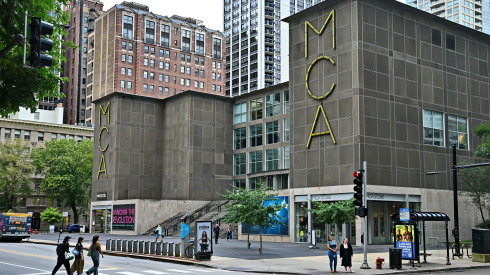
In honor of Grynsztejn, the MCA announced last week the creation of the Madeleine Fund for Women Artists, which will be funded by a $5 million donation from board member Leslie Bluhm on behalf of her family. As its name suggests, it will provide support for the collection and exhibition of works by women artists.
Throughout her time at the MCA, Grynsztejn has pushed to spotlight worthy Chicago artists while also ensuring that the museum remains globally relevant. She says she has also put diversity at the forefront of all it has done from hiring curators to making acquisitions. Later this fall, the MCA will showcase a major exhibition featuring the work of Rashid Johnson, an alum of Columbia College and the School of the Art Institute whose work is among those commissioned by the new Obama Presidential Center. It will devote another in 2027 to Amanda Williams, a MacArthur Foundation “genius grant” winner based in the Bridgeport neighborhood who blurs the boundaries of art and architecture.
Naomi Beckwith, deputy director and chief curator at the Guggenheim Museum in New York, called Grynsztejn’s nearly two decades as the MCA’s director a “seismic shift” in the institution’s trajectory.
“It’s a very, very different institution than the one she inherited, and I would say an unqualifiedly better one, with all respect to her predecessors,” said Beckwith, who spent 10 years at the MCA, leaving in 2021 as a senior curator.
A late blooming collection
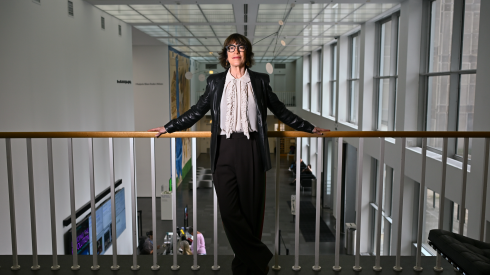
Grynsztejn, 64, announced earlier this year that she will step down at the end of 2026, right before the MCA marks its 60th anniversary next year. In 1967, the museum was founded in a small building at 237 E. Ontario. Two years later, it became the first structure to be wrapped by Christo and Jean-Claude, who became known for their controversial large-scale environmental projects like partitioning a mountain valley near Rifle, Colo., with a 1,250-foot-wide orange curtain.
The MCA began collecting art in 1974 – its first acquisition was a piece by famed pop artist Marisol Escobar – and moved in 1996 into its present location, a five-story building in Streeterville designed by Berlin architect Josef Paul Kleihues.
Grynsztejn said she decided this year was the right moment for her to move on to the next chapter in her professional life in which she wants to find new ways to support artists outside the confines of a museum.

She was born in Lima, Peru, and grew up in Caracas, Venezuela. She got her start as an associate curator at the Museum of Contemporary Art, San Diego, in 1986, and after two other positions, became senior curator of painting and sculpture at the San Francisco Museum of Modern Art in 2000.
She got to know Chicago in the early 1990s, when she served as associate curator of 20th century painting and sculpture at the Art Institute of Chicago, organizing such shows as “Affinities: Chuck Close and Tom Friedman” (1996) and “About Place: Recent Art of the Americas” (1995).
James Rondeau, now president and director of the Art Institute, succeeded her in 1998, and he praised her short stay in what he called an “underdog job” because contemporary art held little sway there at the time. He complimented “About Place” and noted that she was the first person to bring a work by now-celebrated Chicago artist Kerry James Marshall into that museum’s collection.
He called Grynsztejn a “brilliant curator,” and he believes she has led the MCA with what he called “curatorial-centered values,” including diligently supporting artists.
She has continued what she calls the museum’s longtime practice of seeking out new artistic talents and being the first museum to showcase them. She began the Ascendant Art Series, which gives on-the-rise artists their first survey show and scholarly publication, as well as the Chicago Works Series, small shows that target local rising talents.
In some cases, the MCA has seen a “boomerang effect,” with some of these up-and-comers, such as Johnson or Gary Simmons, returning years later as established artists for more substantial showcases. Lorna Simpson, whose work deals with race and identity, had her major one-person museum exhibition at the MCA in 1992 and later became the first artist to serve on its board.
“This is proof-positive that we are an artist-centered museum. Artists trust us,” Grynsztejn said.
But the director’s tenure has not been without its challenges. In 2021, as cultural institutions grappled with the COVID-19 pandemic and its impact on audiences, a group of artists withdrew their work from an exhibition titled “The Long Dream” to protest the layoffs of more than 40 workers a few months earlier.
In June of that year, a group of visitor-services and other employees formed a group called MCAccountable, to lobby the museum for change, including greater transparency around work pay and benefits.
“Artists demanded, along with staff and community, that the museum not only be excellent in its exhibitions and programs but it also be excellent in its operations, that it be as ethical on the inside as the messages it was putting on the walls.” Grynsztejn said, “And that came down to paying people well.”
The director called the COVID-19 shutdown and labor unrest the most difficult moments of her career. “The circumstances brought me to my knees,” she said. At the same time, she called herself “grateful” for what she learned from the “productive demands” of artists and staff.
In 2023, she said, the MCA undertook a compensation analysis to make sure that its wages and salaries for every employee met or exceeded Chicago job-market norms. And a year later, the museum voluntarily recognized the MCA Workers United, which represents more than 70 workers at the institution.
In March, the union reached a four-year agreement with the museum that raises wages by 12% across the board, with a 3% increase retroactive to July 1, 2025. “As director, Madeleine Grynsztejn respected the right of employees to form a union, voluntarily recognizing MCA Workers United/AFSCME, and we were able to reach agreement on a fair first contract,” Anders Lindall, a spokesman for AFSCME Council 31, said in an e-mailed statement.
The art of balancing museum budgets
One thing Grynsztejn can take credit for is helping the MCA find more steady financial footing. The years post-COVID-19 brought budget deficits ($6.7 million in fiscal year 2022-23 and $2.3 million in fiscal year 2023-24, according to its most recent annual reports) and, like many cultural institutions, mounting expenses.
But the institution has weathered tough economics, reporting a $200,000 surplus in fiscal year 2024-25. “We are financially viable here,” Grynsztejn said, “but that is not to say that we haven’t been challenged as every other institution has been since COVID to make sure to balance revenue with expenses.”
It helps that the museum’s endowment has grown from $55.7 million when the director first arrived to $157.2 million as of Aug. 31, according to figures provided by the director. The 2025 annual report shows that investment earnings from that endowment provided 21% of the museum’s revenue in fiscal year 2024-25.
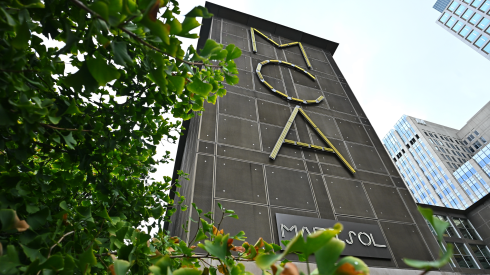
In all, Grynsztejn takes credit for raising more than $300 million in donations during her tenure, including an $82 million campaign in advance of the MCA’s 50th anniversary in 2017 that included $16 million for an interior facelift meant to make the museum more welcoming. The project converted 12,000 square feet into Marisol, a James Beard-recognized restaurant, education wing and public gathering space known as the Commons.
Among the most visible aspects of what any art museum does are its exhibitions, and Grynstztejn has overseen a mix of blockbusters as well as less-flashy, probing shows like the Doris Salcedo retrospective in 2015 – the Colombian artist’s first such in-depth survey anywhere.
“I think Madeleine will be remembered for a program that tries to balance real intellectual concerns with a sense of pop,” Beckwith said. “Madeleine was not someone who was afraid of a little bit of spectacle.”
The Salcedo show offered a cross-section of her haunting sculptures and installations that recall and mourn the thousands of lives lost to contemporary political violence in her native Colombia and around the world.
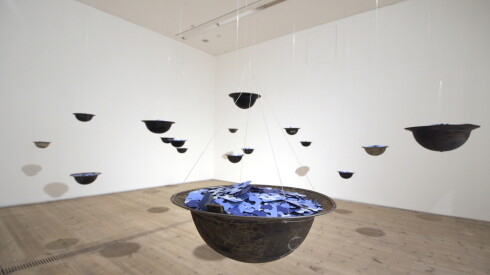
Grynsztejn has booked some blockbusters in her tenure, including Yoko Ono’s recent solo exhibition.
Yoko Ono, Helmets (Pieces of Sky), 2001. Installation view, Yoko Ono: Between the Sky and My Head, Baltic Centre for Contemporary Art, Gateshead, UK, 2008. © Yoko Ono. Photo © Baltic Centre for Contemporary Art.
The blockbusters have included a 2017 show devoted to Japanese pop artist Takashi Murakami that set a museum attendance record with nearly 206,000 visitors, and a much-praised Marshall retrospective that traveled to New York and Los Angeles. Others focused on such splashy figures as Virgil Abloh, David Bowie, Nick Cave and, most recently, Yoko Ono — creative forces who blur art with music, fashion and design.
“It was an exciting era,” said Chicago artist Cheryl Pope, who worked for nine years in the museum’s education department. “She [Grynsztejn] really saw a broader vision of what art can be and how art can impact both an individual and a community.”
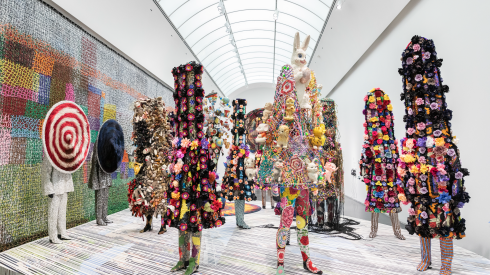
More behind the scenes have been Grynsztejn’s efforts to build the MCA’s collection, which grew from 1,300 to 3,800 objects during her tenure. One of the biggest additions came in 2022, when the D. Daskalopoulos Collection (created by Greek entrepreneur Dimitris Daskalopoulos, one of two international members of the MCA Board of Trustees) made a joint donation of more than 100 artworks, most from the 1990s and early 2000s, to the MCA and Guggenheim, Under the innovative agreement, the two institutions both own the works, which are primarily stored in Chicago, and take turns showing them.
Through it all, there has been a constant emphasis on diversity, not only in the museum’s offerings but also its staff. Beckwith pointed to curatorial fellows and such international curators under Grynstztejn as Omar Kholeif and José Esparza Chong Cuy who brought a “world view” to the MCA.
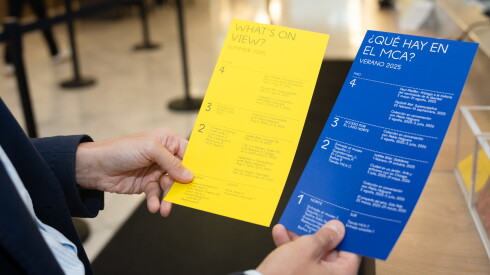
In 2022, the museum announced a $1 million grant from the Mellon Foundation to develop a Latinx and Caribbean art initiative focused on the exhibitions and acquisitions of work from those regions and help fund its transition to a completely bilingual Spanish/English museum.
This bilingual approach is “smart business,” said the director, who speaks Spanish and French, because nearly 30% of Chicago’s population is Latino. Since the change to bilingual signage and labels, attendance at the museum’s monthly free family days has doubled, with much of the increase coming from Spanish-speaking visitors.
What’s next at the MCA
Who will succeed Grynsztejn is the subject of current chatter, with the word around the Chicago art scene that Beckwith could be it. The museum has said nothing about who will fill the soon-to-vacant position. Beckwith will only say she is “busy for quite some time,” an apparent reference to her serving as the artistic director of Documenta 16, an international art fair set to take place in Germany June 12-Sept. 19, 2027.
“I don’t remember Chicago being so gossipy,” Beckwith said with a laugh when asked if she is in the running for the position.
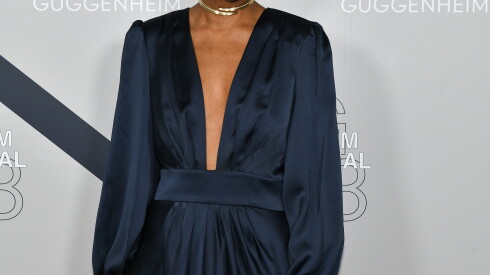
Who will succeed Grynsztejn is the subject of current chatter, with the word around the Chicago art scene that Beckwith could be it. “I don’t remember Chicago being so gossipy,” Beckwith said with a laugh when asked if she is in the running for the position. Here, she attends the 2023 Guggenheim International Gala.
Craig Barritt/Getty Images for Guggenheim Museum
There are plenty of notions of what the new director should be like. Beckwith called for someone with the same “dynamic spirit” as Grynsztejn. Rondeau would like a continuation of the artist-centered values described earlier. Cave, who joined the board in 2025 as artist trustee, hopes to see someone with “fire” and who is fearless and is focused on the future.
“It’s a tough museum,” Pope said. “It’s not big. It’s not small. I think it’s going to take someone who is able to see both the small picture and the big picture. It’s a place that is on the big map in the art world, and it wants to stay relevant there and, at the same time, it wants to stay relevant to a very specific Chicago community.”
As she looks forward, Grynsztejn believes the MCA and her successor must embrace and respond to the next generation of artists, philanthropists and audience members and their evolving needs and wants.
“We need bold leadership on all fronts,” she said. “The greatest challenges to museums are the greatest challenges to society at large. Museums build citizenship muscles. We need to build citizenship muscle as a society. Museums are places where all are welcome. We need all to be welcome as a society and be less divisive. So we’re the antidote to the challenges.”