Recently, my life has been full of firsts. I bought and furnished my first house. I got engaged for the first (and hopefully last) time. And I’ve acquired my first robot—a Mammotion Luba 3, a Roomba for yard care. That last development might seem out of place, but it’s been of some real consequence, and I say that with all sincerity.
At least in my area, most people—including myself prior to the Luba 3’s arrival—have never seen a robotic lawn mower. And their reactions say a lot. My typically stoic best friend, who collects every tool and appliance he can possibly justify with even the most niche need, became excited upon hearing the news: “You got a robot mower?” When I mentioned its arrival at a family dinner, my dad insisted on coming over immediately afterward to witness a demo. My next-door neighbor, a middle-aged woman who takes great pride in the chemical-free cultivation of her lawn and enviable landscaping, said that it looked “pretty cool.”
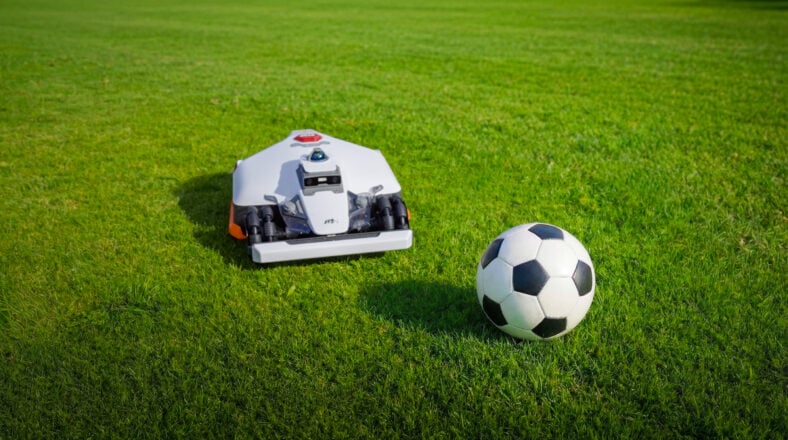
Even my fiancée, who has managed to avoid ever mowing a single square foot of grass, gazed out of the window with great curiosity as the Luba 3 chugged along on a nighttime run. Granted, she really was uncomfortably concerned about what appeared to be a single LED light levitating across our lawn at 10 p.m. on a Tuesday, until I explained it’s just the Luba 3 doing its job in the dark.
This speaks to one of the Luba 3’s strongest selling points. Unlike previous Luba models, this latest evolution can mow at any hour thanks to the inclusion of Light Detection and Ranging, known more commonly as LiDAR—the same sensing technology used in automobiles’ driver-assistance and self-driving systems. On the Luba 3, LiDAR constructs a 3D map of its surroundings via data collected from a laser apparatus housed in a dome atop the mower’s body, which fires 200,000 beams per second and then measures the time it takes for each to bounce back. Because the Luba 3 is effectively generating its own “light”—the laser beams—it can see in ambient darkness.
The addition of LiDAR for the Luba 3 makes it what Mammotion calls the “world’s first Tri-Fusion” robotic mower. As implied, the Luba 3’s autonomy-enabling vision system is comprised of two other technologies. RTK (Real-Time Kinematic) GPS delivers centimeter-level location accuracy by combining standard satellite signals with reference maps. Mammotion products get RTK-enabled iNavi support for the duration of their lifecycles—all that’s needed is a connection to your home’s WiFi. Additionally, all but the base Luba 3 come with a physical RTK Station that picks up satellite locations and feeds them to the Luba 3 via radio transmissions—no WiFi or cell phone service needed.
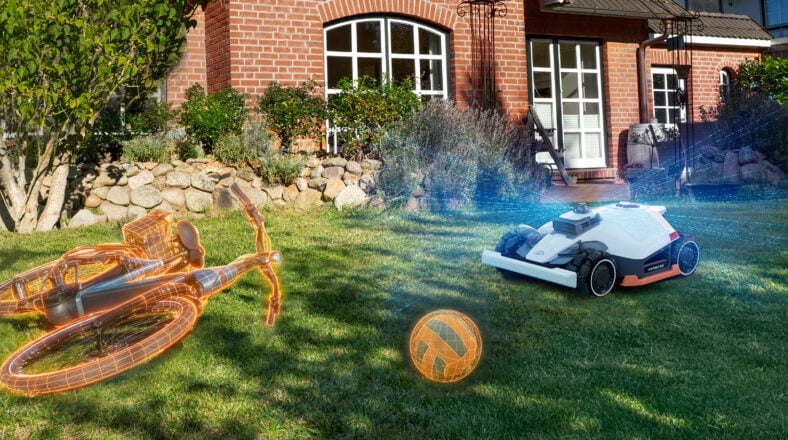
The Luba 3’s all-seeing trio is completed by AI vision suite, featuring two cameras and a chip that allows processors to perform 10 trillion operations per second (up from 5 trillion per second in previous Luba models). This is how the device identifies obstructions—like tree branches, soccer balls, or even critters—and analyzes color, texture, and surface patterns to distinguish grass from pavement or flower beds.
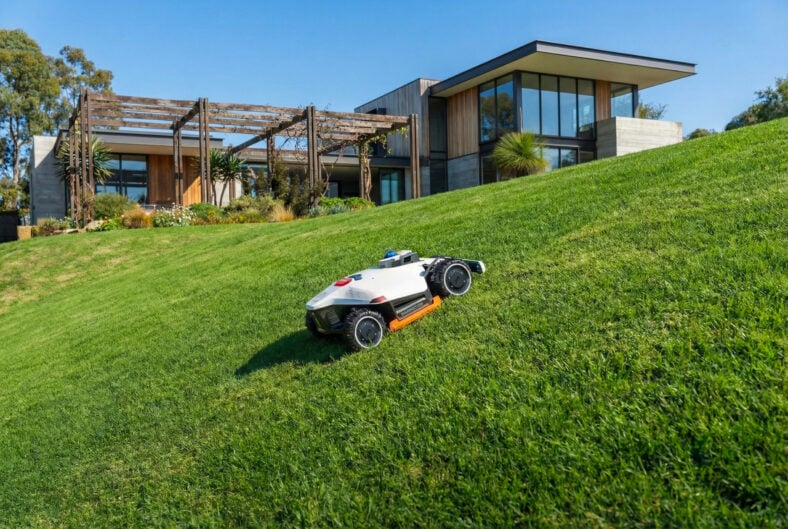
LiDAR provides a 3D map of its environment RTK mapping tells the Luba 3 where it is, and AI vision tells the Luba 3 what it’s looking at. That leaves one piece of the autonomous grass-cutting puzzle: movement. Mammotion says that its four independently driven electric motors and adaptive suspension give the Luba 3 the ability to drive up slopes of up to 38.5 degrees and over curbs, roots, and other thresholds. Perhaps because the sheer amount of time I’ve spent pushing a mower across lawns ranging from immaculately leveled and cared for to steeply graded and bump-riddled—the latter being descriptive of my own yard—I was skeptical of the Luba 3’s ability to do a serviceable job, if not one comparable to my own. Especially after I unboxed it.
My very first impression was its small size. The Luba 3 has a cutting width of 15.7 inches, which is considerably smaller than the 21-inch deck of my Yardmax. Its wheels are also about half the size of typical push mower wheels. It looked less like a lawnmower and more like a kind, composite-shrouded sibling of the freaky, Boston Dynamics inspired Metalhead robo-dog from Black Mirror. The components were equally mystifying: there were bumpers to attach, a chip to insert, several wires, a docking station, and a weird, lantern-like pole (the RTK station).
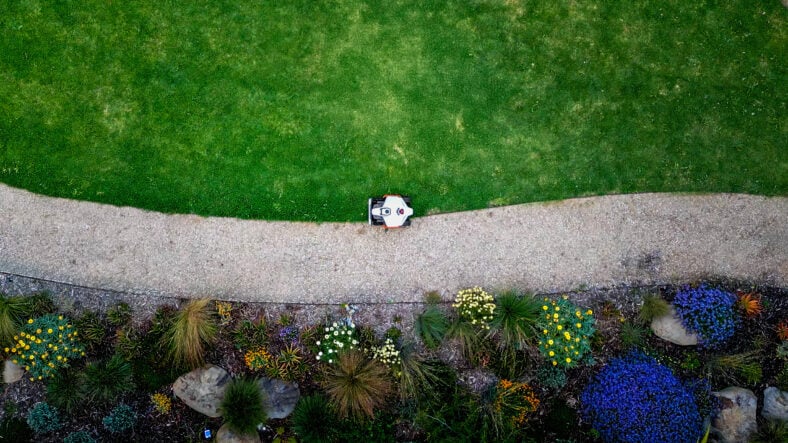
Despite my initial confusion, it was simpler to assemble than an IKEA coffee table, and it paired to my phone through the Mammotion app like a set of Bluetooth headphones. The most intimidating part of setup was mapping the perimeter of my lawn, which the Luba 3 can do on its own if the area is clearly defined and features plenty of open space. Embarrassingly, much of my lawn perimeter is currently brimming with unwanted (but soon-to-be eradicated) vegetation that muddles boundaries, so I decided to manually map. With all the accuracy of a drunk Call of Duty player, I guided the Luba 3 using a pair of onscreen thumbsticks—one for forward and reverse, the other for turning, which it does on a dime like a tank thanks to independent four-wheel drive. When I got off-track, reversing erased the erroneous boundary, and the many collisions with fence posts and flower beds didn’t seem damage or faze the Luba 3.
At the end of the mapping session, I’d guided the Luba 3 around the edges of sidewalks, streets (I live at an intersection), fencelines, and my driveway. Each area was connected a “channel”—a modifiable path a user maps to the Luba 3 to traverse. One particular perimeter made me nervous: a curb that naturally sloped toward the street. While mapping this edge, I had to keep lifting the Luba 3 away from the steepest part of the slope so that it wouldn’t slip into the road. Given my trouble guiding it, I seriously doubted that it would be able to navigate this section on its own, so I assumed I would have to use the area editor, which also allows users to identify restricted areas and modify any channel.
It was finally time for the Luba 3’s acid test, one made extra acidic by a slightly absurd grass height that, pitted against my moderately powerful Yardmax, would typically require me to walk slowly. I watched as it exited its dock and spun around in place to capture a 360-degree view of the first area. It moved to the perimeter first in accordance with the setting recommended for first-time mows, but then it appeared to move somewhat randomly. I left it alone, and when I checked back in, it had perfectly cut narrow stripes into the first area. The lawn’s slightly overgrown state was apparently no match for its Adaptive Cutting feature—which uses AI to automatically make adjustments based on grass density—or the cutting apparatus: two discs, each fitted with 6 double-sided razor blades that are spun at up to 3,000 RPM by a pair of 165-watt motors. It continued to the aforementioned problem area that sloped toward the street. Gulp. I looked on as the Luba 3 navigate the boundary cautiously but without issue.
This Luba 3 variant has a 12Ah battery that can run for up to 175 minutes under ideal conditions with the most efficient settings. My mapped lawn area measures 6,835 square feet, and the app estimated that my area would take about 190 minutes, so I knew it wouldn’t finish in one go. When it hit 15 percent, it automatically found its way back to the station, recharged to a suitable battery level, and headed back out to finish the job, all without any input from me. As my neighbor so succinctly said, “pretty cool.”
I initiated its next mow a few nights later—a perfectly reasonable decision, given that it emits under 70 decibels of sound, so anyone farther than five feet from it can’t hear a thing. Aside from geekily checking in via a camera that gives you a first-person view of the device, I didn’t think about it. I went to bed and woke up to a cleanly mowed lawn, with the Luba 3 charging on its dock.
There are several other features that will take time to dial-in: mower speed, blade speed, cutting height (between 2.2 and 3.9 inches), mowing pattern (stripe or grid), and obstacle detection sensitivity—it will even mow shapes or words into your lawn.
But the amount of time I’ll spend making these tweaks in the Mammotion app over the course of its life is already dwarfed by the 15 hours (6 mows that would take me 1.5 hours each) the Luba 3 has already saved me over four weeks of ownership. Over years, it would save me cumulative days that I’ll get to spend with my fiancée, my friends, and my future family. That’s of some real consequence.
Mammotion Luba 3 AWD Series
| Spec | LUBA 3 AWD 1500 | LUBA 3 AWD 3000 (Tested) | LUBA 3 AWD 5000 | LUBA 3 AWD 10000 (To Be Launched) |
|---|---|---|---|---|
| Lawn Coverage | 0.37 acres (16,146 sq ft) | 0.75 acres (32,292 sq ft) | 1.25 acres (53,820 sq ft) | 2.5 acres (107,639 sq ft) |
| Positioning | 360° LiDAR + Dual-Camera AI Vision | Tri-Fusion (360° LiDAR + NetRTK + Dual-Camera AI Vision) | Tri-Fusion (360° LiDAR + NetRTK + Dual-Camera AI Vision) | Tri-Fusion (360° LiDAR + NetRTK + Dual-Camera AI Vision) |
| Cutting Motor | 88W | 165W | 165W | — |
| Battery | 9.4Ah | 12Ah | 15Ah | — |
| Mowing Time per Charge | 135 min | 175 min | 215 min | — |
| Mowing Efficiency | 4,306 sq.ft/h; 6,997 sq.ft per charge | 5,382 sq.ft/h; 15,069 sq.ft per charge | 5,382 sq.ft/h; 18,299 sq.ft per charge | To be revealed |