A team of Chicago developers unveiled Thursday a $10 billion, 100-acre development plan for the former Michael Reese Hospital site — both as a Hail Mary to keep the Bears in Chicago and to hit a city-imposed deadline to submit updated plans.
The Bears previously dismissed the Michael Reese site, saying it was too narrow and posed safety concerns because the stadium would have to be built over an active rail line.
But with Capri Investment Group founder Quintin Primo joining GRIT Chicago, the group of developers and investors led by Farpoint Development that purchased the Michael Reese site, the partners have nearly doubled the size of the proposed Bronzeville Lakefront development.
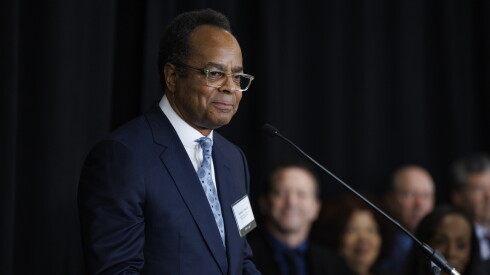
Quintin E. Primo III, founder and executive chairman of Capri Investment Group, speaks during a press conference at Olivet Baptist Church. He unveiled a new Bronzeville Lakefront development plan that would transform the former Michael Reese Hospital site into a sports, entertainment and cultural district anchored by a potential Bears stadium.
Anthony Vazquez/Sun-Times
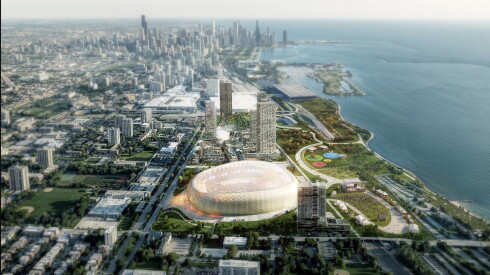
They shared grand plans to redevelop a large portion of the South Side into a sports, entertainment and cultural district that would, of course, be anchored by a domed stadium at the widest portion of the trapezoid-shaped site.
To further lure the Bears, Capri and its investment partners said they were willing to purchase the team’s Arlington Heights property. It’s “the key impediment to the team staying Downtown and fairly considering Bronzeville,” Primo said.
“There should be absolutely no reasons why the Bears and the NFL should not seriously consider Bronzeville Lakefront as the best site for their new home,” he said during a Thursday press conference.
When asked if the updated plans were shared with the Bears, McLaurin Development Partners founder and CEO Zeb McLaurin said the team will leave “no stone unturned” when it comes to communicating the benefits of the site.
A Bears spokesperson declined to comment.
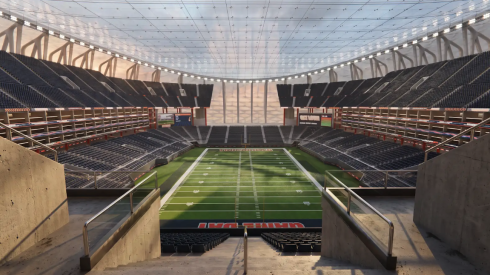
Renderings by Chicago-based design firm Studio Inference show a glassy 75,000-seat stadium that would host the Bears in addition to other sporting events and concerts. High-rise and mid-rise buildings surround the stadium, along with a sprawling public park, event stage and youth sports complex, among other features.
“It is our belief that a modern, competitive dome stadium such as the one we are proposing will outperform suburban locations such as Arlington Heights or Northwest Indiana,” Primo said. “This is just plain common sense, in our opinion, as these remote locations are not at the heart of the most important economic driver of the entire Midwest.”
In addition to the 48.6-acre Michael Reese site, the project would include the nearby five-building apartment complex Prairie Shores, along King Drive between 26th and 31st streets. The property is owned by Golub & Co., who initially purchased it with Farpoint for an estimated $180 million in 2019.
Golub didn’t respond to a request for comment.
Plans call for demolishing up to 1,000 units at Prairie Shores during Phase 1 and building about 1,500 apartments. The developers said they would build 1.5 replacement apartments for every existing unit that’s demolished.
Fourth Ward Ald. Lamont Robinson represents the South Side ward that includes the Michael Reese site, once purchased by the city for an Olympic Village that was never built after the 2016 Summer Games were awarded to Rio de Janeiro.
“I want to be very clear that before you can remove, tear down Prairie Shores, you have to put the units up first. You need to have 1,000 units up before you can take one unit down or have one family displaced,” Robinson told the Chicago Sun-Times. “You have to have someone that is stewarding this. And the commitment is, before you can bring any housing down, you have to have the new property up. That is a commitment that this developer has made.”
The developers are also proposing a community benefits agreement that would give “priority treatment for affected households to reside in new housing within the district or nearby, rent protections for five years, additional assistance for longer-term residents and oversight by a resident committee and independent monitor.”

In total, more than 5,000 homes are expected to be built on-site and in nearby locations, including affordable, senior and student housing. The plan cited Lake Meadows as a potential housing site as well as “early discussions” with Illinois Tech to build on-campus housing.
It also proposed air rights over the McCormick Place Marshaling Yard to the east and expanding McCormick Place’s convention and meeting spaces by 300,000 square feet.
The Metropolitan Pier and Exposition Authority, which owns McCormick Place, said it supports efforts to boost Chicago’s economy.
“However, the Authority must follow its governing mission as well as adhere to its legislatively mandated procurement procedures. The proposed Bronzeville project may offer interesting opportunities for Chicago, but it is in its early stages. MPEA looks forward to learning more about the plans and discussing it with our clients and community stakeholders. At this time, the Authority has not made any commitments related to the project,” an MPEA spokesperson said in a statement.
What sets the development apart from others attempting to woo the Bears, the developers said, is that the new stadium will be joined by hotels, recreational facilities and housing that would bring an economic boon to Bronzeville.
The developers estimate housing, hotels, retail and commercial uses could generate about $135 million in annual tax revenue. They also project about $14 billion in regional economic activity during its development, with about 60,000 construction-related jobs.
Second chance
If the Michael Reese stadium plan has a familiar ring to it, it should.
In March 2025, developers of the former hospital site went public with a dazzling Hail Mary plan to build a $3.2 billion Bronzeville stadium and an adjacent mixed-use development — with a great lawn extending over Du Sable Lake Shore Drive all the way to Lake Michigan.
Scott Goodman, principal of Farpoint Development, acknowledged then that he had not met with the Bears, nor had he finalized the financing for the dome or the $600 million in state money needed just to ready the site for development.
The previous stadium construction cost, estimated at $3.2 billion, was the same amount the Bears assumed in 2024 when team president Kevin Warren stood with Mayor Brandon Johnson to unveil their preferred lakefront stadium proposal on the Museum Campus — a plan that got stuck in the mud in Springfield and could face legal challenges due to the city’s lakefront protection ordinance.
Robinson acknowledged the Bears long ago dismissed the Michael Reese site. But he’s all for the idea of including it in the salad bar of Chicago stadium sites for the Bears to consider, along with the site they already own in Arlington Heights.
“As the alderman of the 4th Ward, I have to develop this site. I cannot leave this site dormant for another 20 years,” Robinson said. “We need more housing, and we need to put this back on the rolls for taxes. The city needs resources and we need housing. As the Bears have stated, they are still looking at sites, and why would we not put everything on the table and have the Bears look at it?”
If the Bears refuse to take a second look, Robinson said the plan will serve to showcase the “beautiful site on the lakefront” to other interested parties.
“There’s a lot of talk about other stadiums shifting. We’d be open to having those conversations,” Robinson said, acknowledging the White Sox and the Stars as possibilities.
Without an anchor like a stadium, Robinson said the Michael Reese development could remain bogged down with another city deadline looming. GRIT has until Dec. 14 to submit an updated infrastructure plan for the site as part of the Bronzeville Lakefront redevelopment process. The development team said it’s preparing a new infrastructure plan to submit to the city and the proposal will continue to be refined with stakeholders, including the Bears.
“That’s why this plan is out. So many folks can look at it and decide if they’re interested in the site,” Robinson said. “We can’t just do nothing. We have to put plans out there … We gotta develop it. We’ve got to get this thing moving.”
Bronzeville Lakefront would be a massive public-private undertaking and comes days before lawmakers in Springfield consider financing tools that could sweeten the deal for the Bears to stay in Illinois, making it the perfect time to announce the new plans, McLaurin said.
State Sen. Willie Preston recalled walking his grandmother to the train, where she’d put in her train token to go to work at Michael Reese Hospital, before urging public officials during Thursday’s news conference to act in favor of the Bronzeville site.
“What you all have created and provided, this development team, is a token to get on the train,” Preston said. “So I’m asking Mayor Brandon Johnson, my good friend Gov. JB Pritzker, the McCaskey family: Take this token and get on the train to economic development … [and] economic prosperity for the South Side of Chicago.”
Capri and GRIT’s plan envisions a publicly owned stadium similar to Allegiant Stadium, home of the Raiders. Allegiant is owned by the Las Vegas Stadium Authority and was partially taxpayer-funded through a hotel room tax.
The developers said the Bears could help foot the bill through the sale of stadium naming rights and personal seat licenses, NFL financing programs and refinancing and issuing Illinois Sports Facilities Authority bonds. It would also count on a mix of municipal, state and federal dollars, as well as tax increment financing, sales tax-backed bonds and transportation funding.
The development team also said it recently signed a memorandum of understanding with “a major capital provider.”
“We have had some very good conversations with capital partners, global organizations, who understand the virtue of how important sports and sports economic development is,” McLaurin said. “We’ve educated them all about the aspects, of the uniqueness of the Bronzeville community, our connectivity, which has been well discussed here today. Our timeline is today.”
Contributing: Patrick Finley