The long-vacant and decaying City Methodist Church — at one time the largest Methodist church in the Midwest — is slated for demolition, more than 50 years after it closed.
The wrecking ball comes after a number of unsuccessful attempts to save the historic church in Gary, Indiana.
In 2018, city officials worked with Chicago-based architecture firm Bailey Edward on a redevelopment plan for the site, which spurred the idea for an open-air ruins that made use of the church’s structure.
Gary and the University of Notre Dame’s Housing and Community Regeneration Initiative then came up with a vision in 2025 to use the church’s bell tower for a proposed City Renaissance Park — part of a larger strategic plan to revive Downtown Gary. In January, the city’s redevelopment commission approved spending $112,500 to work with Bailey Edward on a plan for stabilizing the bell tower and cathedral so it could be incorporated into the new park.
But because a funding partner was never found for the $4.2 million stabilization effort Gary leaders decided to demolish the property, according to Steve Segura, chief communications officer for the city of Gary.
The Northwest Indiana Regional Development Authority solicited bids for the church’s demolition earlier this year. During its monthly board of directors meeting on Wednesday, the agency awarded the contract to Homrich Wrecking, who estimated demolition costs at $5.3 million.
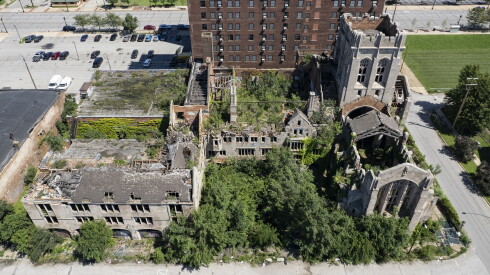
Demolition will begin after the contract is finalized, according to David Wellman, Northwest Indiana Regional Development Authority’s communications director.
Segura said the church had been deemed unsafe and unrecoverable so Gary Mayor Eddie Melton needed to address the safety concerns after a funding partner was never found. The church, 577 Washington St., is located near the 21st Century Academy charter school and Genesis Towers, which opened as Hotel Gary in 1926 and converted into senior housing in the 70s.
“Ensuring the safety and well-being of our students and some of the community’s most vulnerable residents in the immediate vicinity had to become the City’s foremost responsibility,” Segura said in a statement.
Steel roots
Immigrants and migrants came to Gary in the 1900s, as the city boomed with steel mills.
As the population swelled, Rev. William G. Seaman founded the church in 1926, according to the Indiana Historical Bureau. U.S. Steel helped fund the church’s construction with $350,000, equivalent to about $6 million in 2026.
The church was open everyday and was a central meeting place in Gary. It included a gym, theater, music studio, cafeteria and commercial space. The congregation was segregated, though it offered programs to Black residents and immigrants.
When the city saw an influx of Black residents and immigrants in the 1950s, some City Methodist leaders tried to integrate the church. But its white congregation largely opposed the move, according to the bureau. And by the 1960s — when Gary’s white residents fled to the suburbs — the church’s population started to shrink. Efforts to build relationships with the community came too late.
“City Church leaders considered merging with a local Black church, but when community interviews revealed that minority groups did not trust the church, leaders decided to close in 1975,” according to the bureau.
Lauren Pacheco, artist and board member of Landmark Illinois, said the church has been “taken by the elements” over the years, but the building is still striking with its intricate limestone work and terra cotta detailing.
“It’s hard not to look at the building and get sort of drawn into a story of what history might have been like, or what life would have been like walking the halls in that building,” Pacheco said. “The Gothic Revival architecture and the sheer scale of it reflected what enormous confidence and ambition the city of Gary [had] at that moment. In that moment, it wasn’t just a sanctuary. It really became and functioned as a broader community and civic institution.”
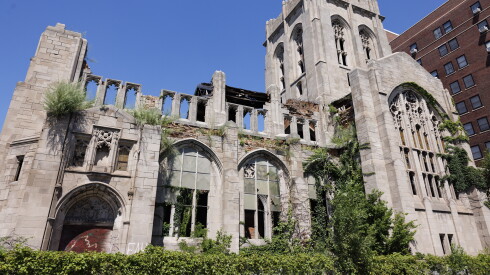
She said the church’s demolition should be treated as a “significant moment” to think about Gary’s future.
It’s not the only property slated for demolition. The Genesis Convention Center, which played host to Whitney Houston and Prince, will be torn down and the site redeveloped. This follows the demolition of other historic properties like the Gary Water Tower and Gary Memorial Auditorium in 2020.
Pacheco, who has lived in Gary for nine years, hopes city officials consider saving materials from City Methodist for a sculpture or similar display. The site could become a spot for open-air painting or photography, she said, since previous plans to create a ruins garden were dropped.
The city didn’t respond when asked if it was — or plans to be — in conversation with local groups about the future of the site.
Pacheco said it’s not always possible for every historical site to be saved. And in a city like Gary that has seen decades of economic decline, she argues it’s important to not become a museum of the past. If the City Methodist site becomes an
other hub for civic and community engagement, it could help contribute to Gary’s progress.
“It could be a lovely way to engage residents to create a new sort of civic space — something that the City Methodist was celebrated for, “ Pacheco said. “This site, although taking a different shape, could mean something really special.”