Seeing an August Wilson play on a small stage is always a unique experience. But the intimacy of City Lit Theatre, located on the second floor of an Edgewater church, makes the intensity of gritty drama “King Hedley II” feel especially immersive.
This production is directed by Manny Buckley, a City Lit artistic associate who recently mounted Wilson’s “Seven Guitars,” a play that includes some of the same characters and storylines as “King Hedley II.” (Buckley’s production won the 2024 Non-Equity Jeff Award for best production). This play transports the audience to a Reagan-era Pittsburgh and, in it, an underserved neighborhood enduring the harsh effects of trickle-down economics.
It’s 1985 in Pittsburgh’s Hill District, and King Hedley (James Lewis) has recently been released from prison for killing the man who left a grotesquely visible scar across his face. King is trying to build a new life. When the audience meets him, he’s bent over a patch of dirt planting seeds — a running parallel in the show will be the new life the ex-con attempts to cultivate in that dirt.
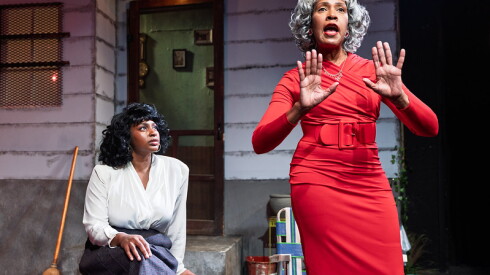
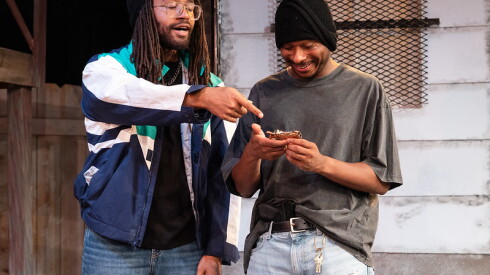
King lives with his mother, Ruby (Andrea Conway-Diaz), a former singer who didn’t raise him and instead left him in the care of a friend. His wife, Tanya (Isis Elizabeth), is pregnant. Along with his friend Mister (Ernest Henton), King sells stolen refrigerators in hopes of one day opening his own video store business.
James Lewis delivers a masterclass in his embodiment of King. Perhaps the proximity of the audience to the stage in this production is a factor, but from my seat I could feel his rage. King is ambitious. Through all the adversity he’s faced, both self-imposed and some inherited, he still has a strong sense of self.
Blood-for-blood is a recurring phrase in the play and vengeance is prevalent, but underneath the visceral nature of violence and revenge, King has dignity — he commands respect. He’s willing to die for it.
As King, Lewis moves from ambition to desperation seamlessly. He ping-pongs from moments of begging Tanya not to have an abortion —- literally pleading for life — to moments where he demands death. It’s a tough role to play, and Lewis nails it.
This play builds on characters and stories from past Wilson plays, including “Seven Guitars” and “Gem of the Ocean.” But in true Wilson fashion, the production stands alone. You don’t need the past context to understand what happens here.
Outside of the connections to his own work, it’s also hard to miss the ways Black playwrights influence each other. Lorraine Hansberry’s classic play “A Raisin in the Sun,” presents Walter Lee Younger, who wants to achieve financial security in the 50s by opening a liquor store. In Dominique Morrisseau’s “Detroit 67,” recently staged on the South Side, Lank, who along with his sister inherits a home from their parents, sees the path to Black freedom through business ownership, and wants to open a bar in the 1960s. Here, in the 1980s, King wants to build a future that hinges on opening a video store.
The barriers to King achieving his ultimate dream are the elements that make this play so powerful. He never goes to a bank for a business loan — that’s so farfetched it isn’t considered. He attempts to hustle way to freedom, but he’s hindered by years of generational trauma, systemic oppression and an underserved neighborhood plagued by aimless youth committing crimes, like robbing the community’s elders.
Passed-down trauma is inescapable here. Watching the show, it’s clear where fate is taking King, yet he fights like hell to control his own destiny. But when Ruby’s former lover Elmore (Jelani Julyus) returns, he unearths a secret that explodes into gunfire.
All of this action unfolds on a cozy set designed by Jeremiah Barr. Wilson is so deft with language that this three-hour production, all happening behind Ruby’s house, never feels stale. Even though characters never leave the backyard, lighting designer Mike McShane transports the audience into a surreal world during monologues with his clever use of tones and textures that drive home the emotion of actors.
This play has always reminded me of the Tupac poem “The Rose that Grew from Concrete.” In that poem, a beautiful flower grows, against all odds, in an unlikely place. Here, we see King, hands in the dirt trying to cultivate life that will beat all odds.
At one point, Elmore steps on King’s budding plant, sending him into a fury. That’s an excellent use of foreshadowing, and encapsulates the play. Sometimes, our fates are sealed long before we are born.